Lo! We have heard of the glory of the kings of the people of the Spear-Danes in days of yore – how those princes did valorous deeds!
Beowulf
The first real playtest of any iteration of The Death of Arthur was1 a separate campaign centered not in Arthurian myth, but the Old Norse sagas.
After a long period of not hosting any games, and just tinkering on custom systems by myself, I included two narrowly scoped trial-runs of the then unnamed and unfinished system (among other unrelated games) in a pitch to a new group that wanted to form.
When it was picked, I had my work cut out for me isolating out a minimum viable product for the first session, simplifying the sheets into something approachable for an introductory game, and otherwise polishing things.
This meant I dropped some things I realized weren’t necessary or might be easier to test in a simpler form, along with some things that I still liked but couldn’t justify in this smaller campaign. The Arthurian character sheet and treasure/estate sheet got merged into a single character sheet for instance. So any learnings have to consider what it meant for A Wind Age and what that means for the slightly different goals of The Death of Arthur.
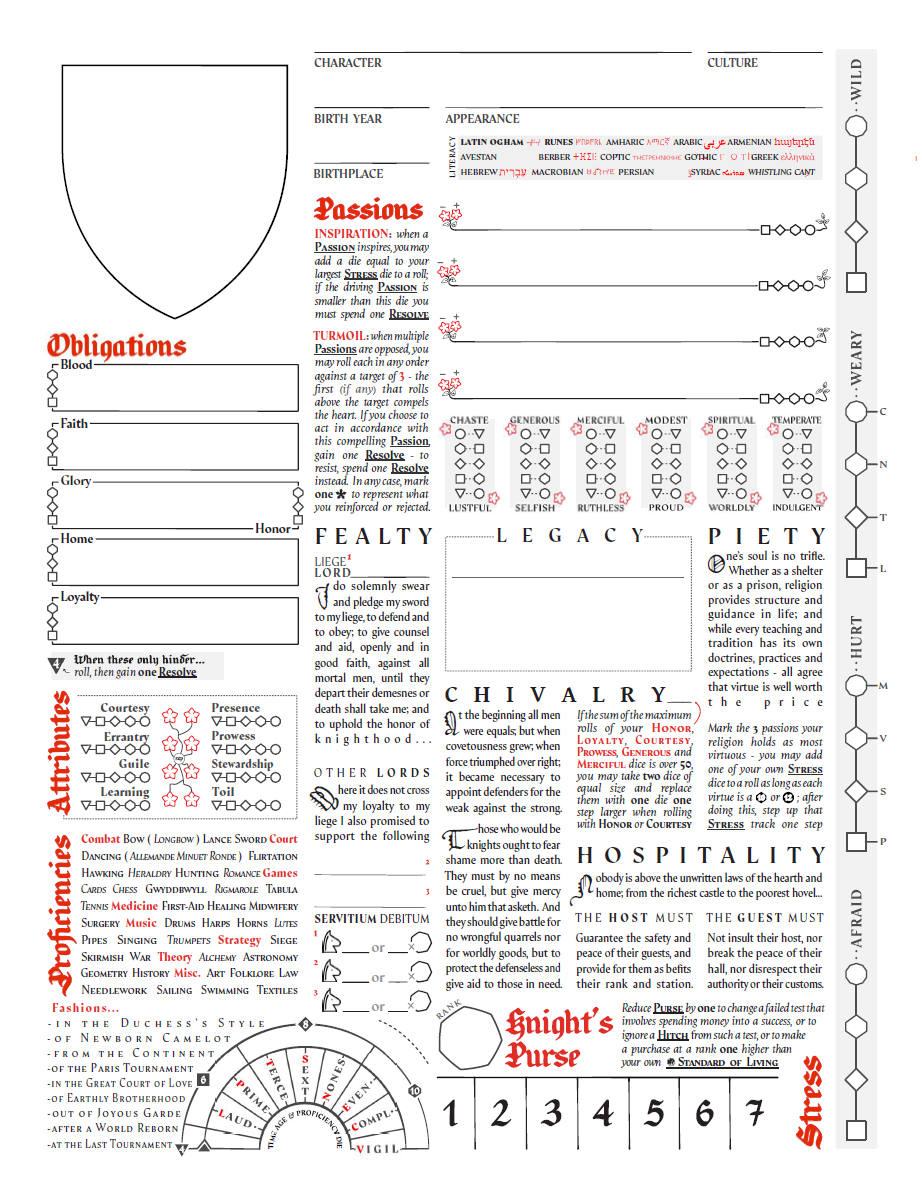
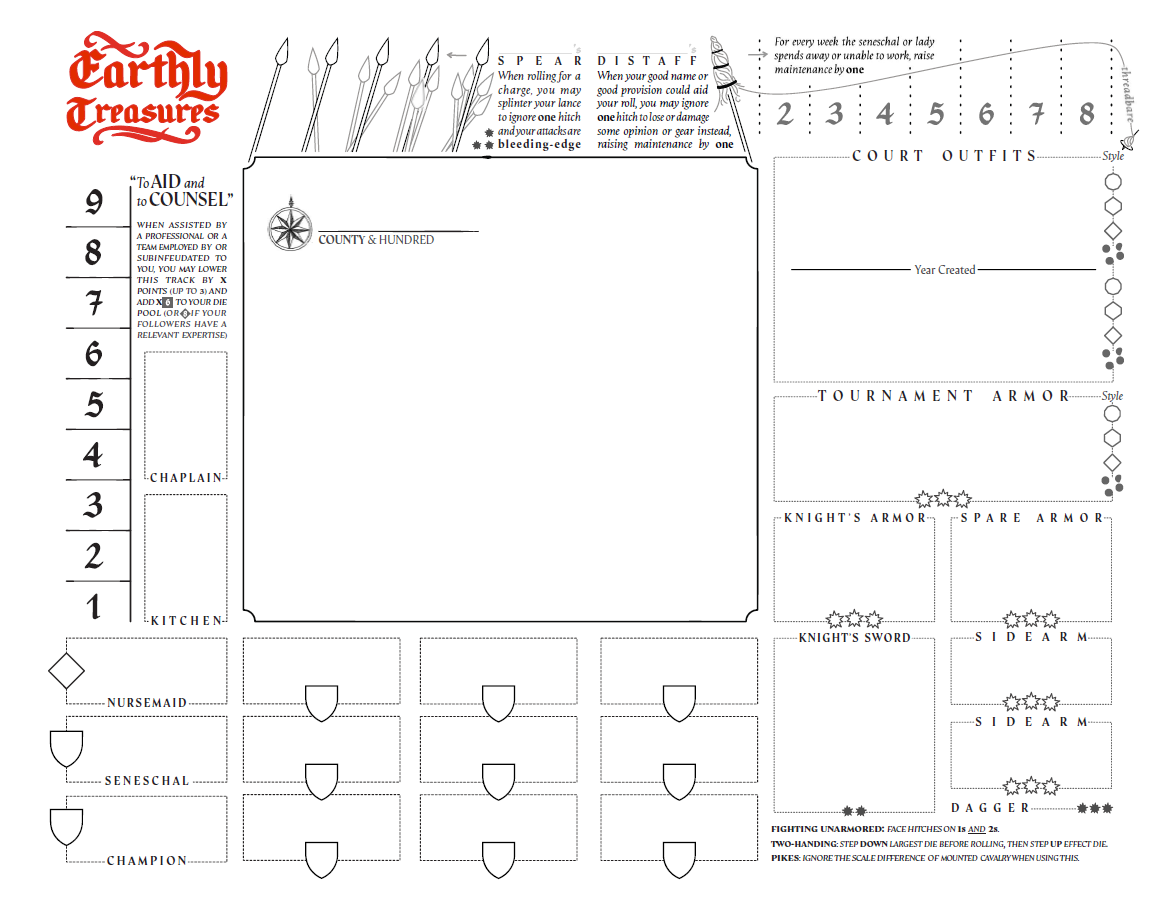
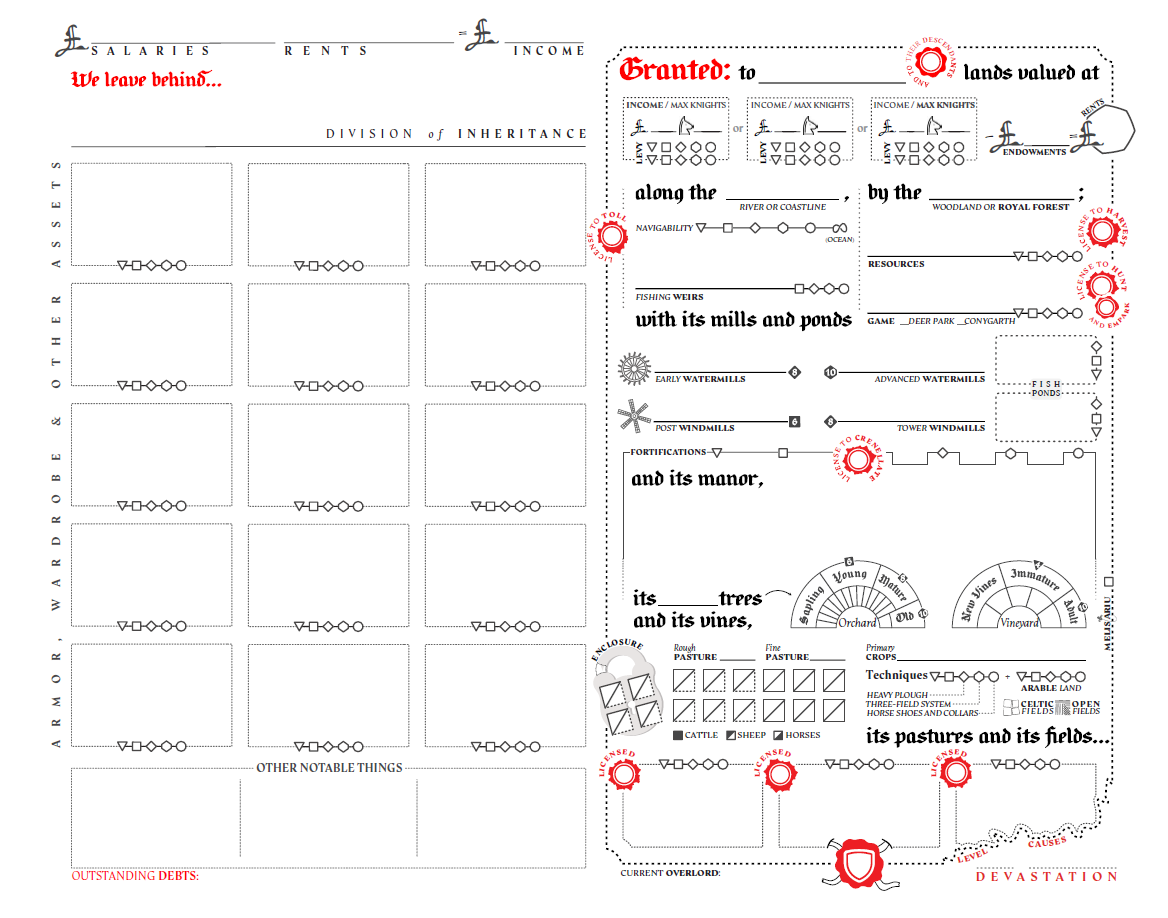
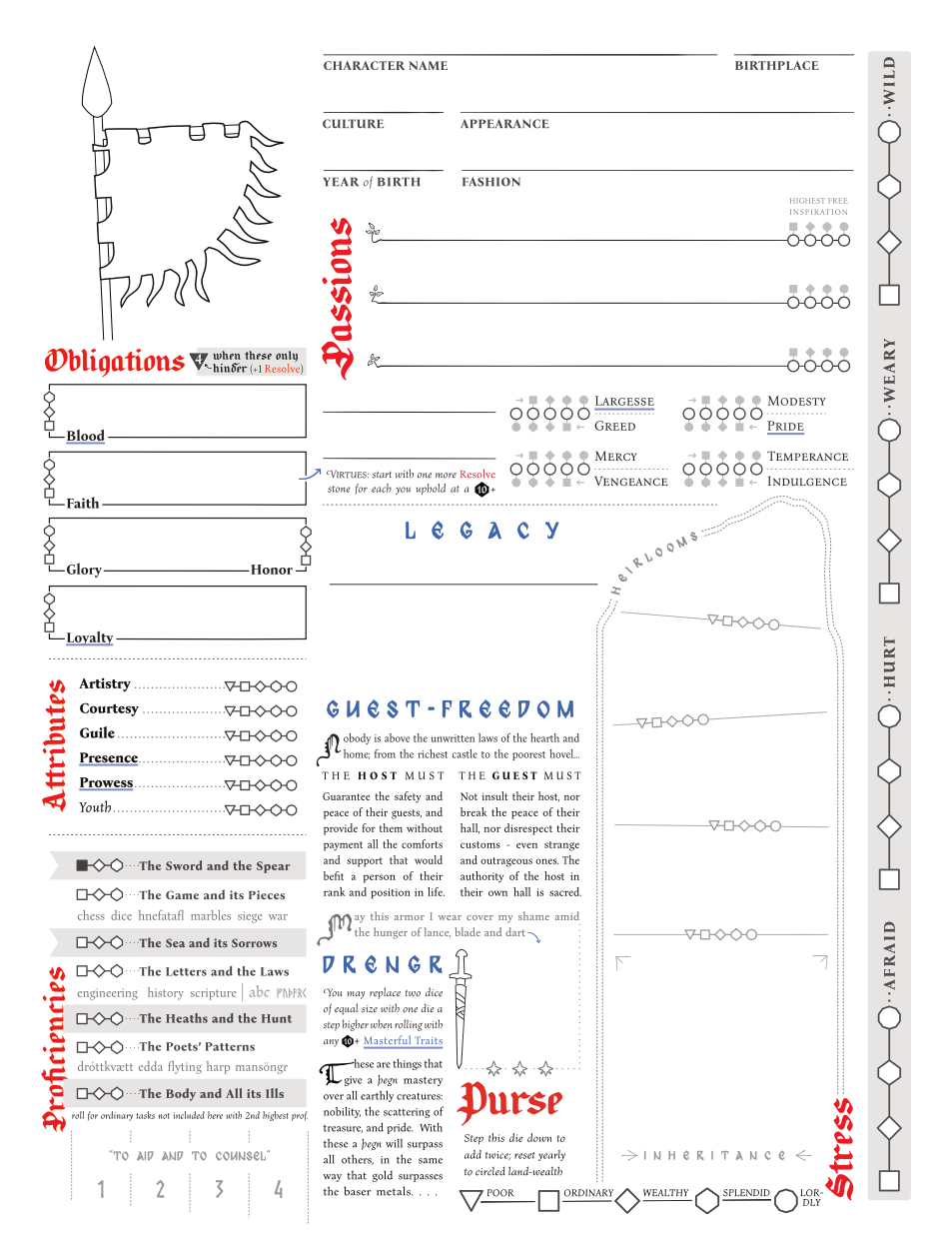
The Characters
I mapped the knight-lady-clergy divide pretty 1-1 with þegn/kvinna/papar2. But… I hadn’t really devised what to do with the latter two classes yet3.
I put a simplified form of the armor rules for þegn’s4, a soothsaying mechanic for kvinna, and a book-copying mechanic for the papar.
Both players chose to play female characters - one kvinna, one papar - so immediately I got to test out what adventures look like without a knight, while armor went out the window5 as part of the playtest.
- Accumulating books is interesting, but not something that can be kept up consistently session to session. I do think there’s a fun aspect in collection here, and I like the book drawing I used, but I don’t think it can anchor a character’s gameplay loop.
- Soothsaying is even less consistent. Oops.
- But it’s fun and entirely playable to have characters who don’t have the traditional rpg “be in charge and kick open doors” societal role, or much of an ability to fight - even when dealing with the very martially inclined sagas.
The Family
The family is the “real character”6 of a Pendragon game, but one that I had rather sparse mechanics for.
They had a sheet in the system before I started working on the simpler A Wind Age, but for the most part it just had two points:
- A collection of Legacies (a consolidated place for Cortex’ various SFX - or if you’re used to D&D, something like Feats - the place where you have a standalone rule that changes things). The idea was that individual characters would each get a legacy, but could pick from an expanding group you were crafting/collecting for your family.
- For A Wind Age, I figured this could be tracked outside of a separate page for convenience. There wouldn’t be as much time passing to build a huge set of legacies, and I didn’t want to introduce so much complexity anyway.
- A variety of Connections which were just a special trait set for doing relational things with unfamiliar groups of people.
- I cut this entirely; without as focused an area (and so well defined one), I didn’t have a clear replacement.
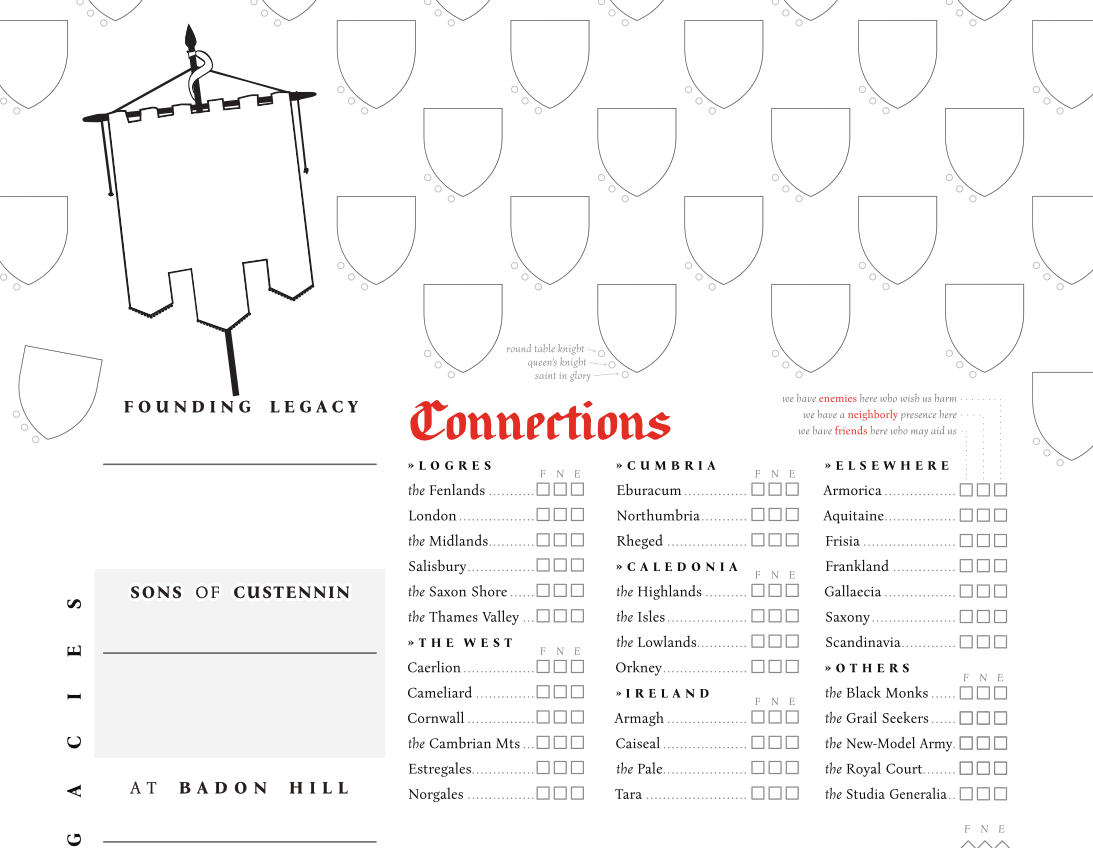
The other aspect of a family is its history, though. Pendragon is famous for the rich family backstory it generates - which it largely does by random tables: for each year, roll and see what happens. This is also how families continue to evolve each year - a very simulation-focused style.
This was still largely where I meant to take family history in my game. I’d tie in Cortex mechanics like traits, but keep the same structure. I had run one before, with an expanded Book of Sires and custom event table - and it was fun.
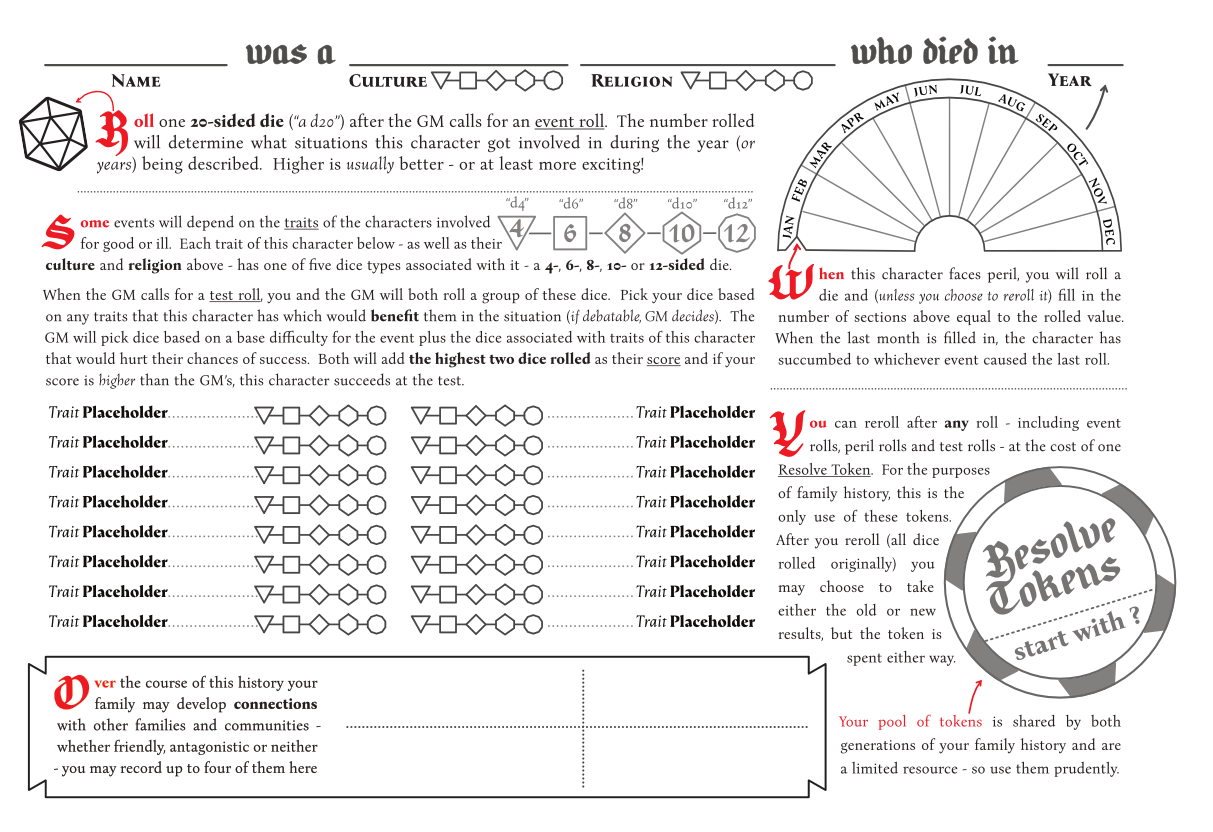
Cortex Prime has a different kind of life-path system for creating characters, though. “Pathways” relies a lot more on player decisions and invention, and I had started to toy with what that would look like.
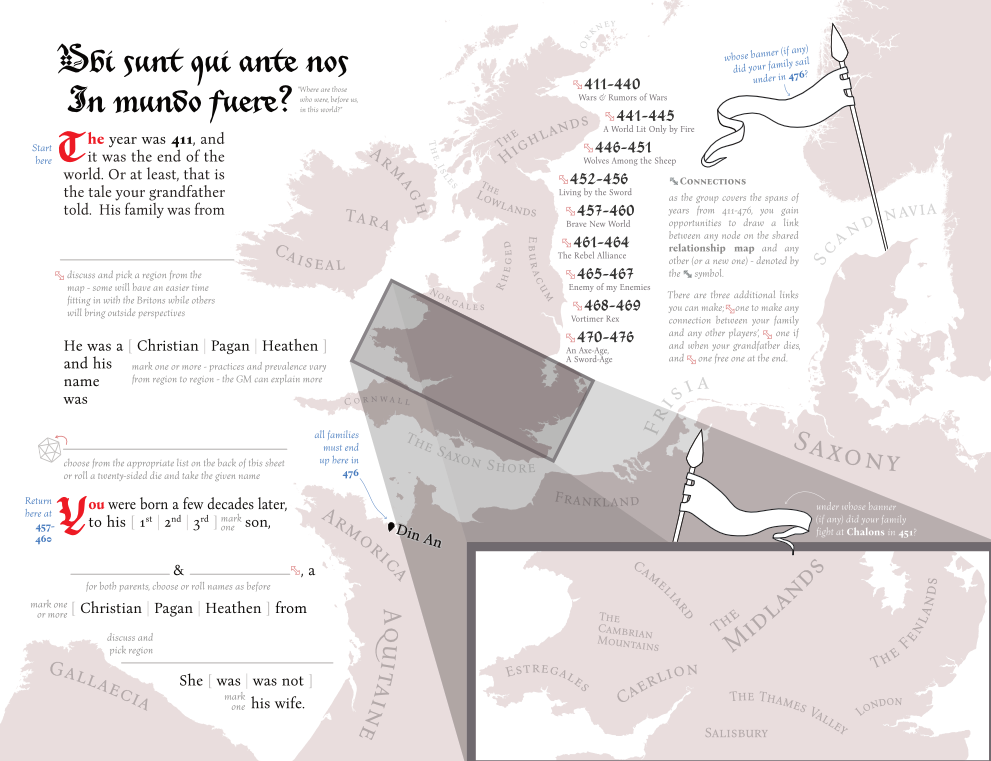
(this map is actually from midway through playing A Wind Age - at the time it would have looked more like this)
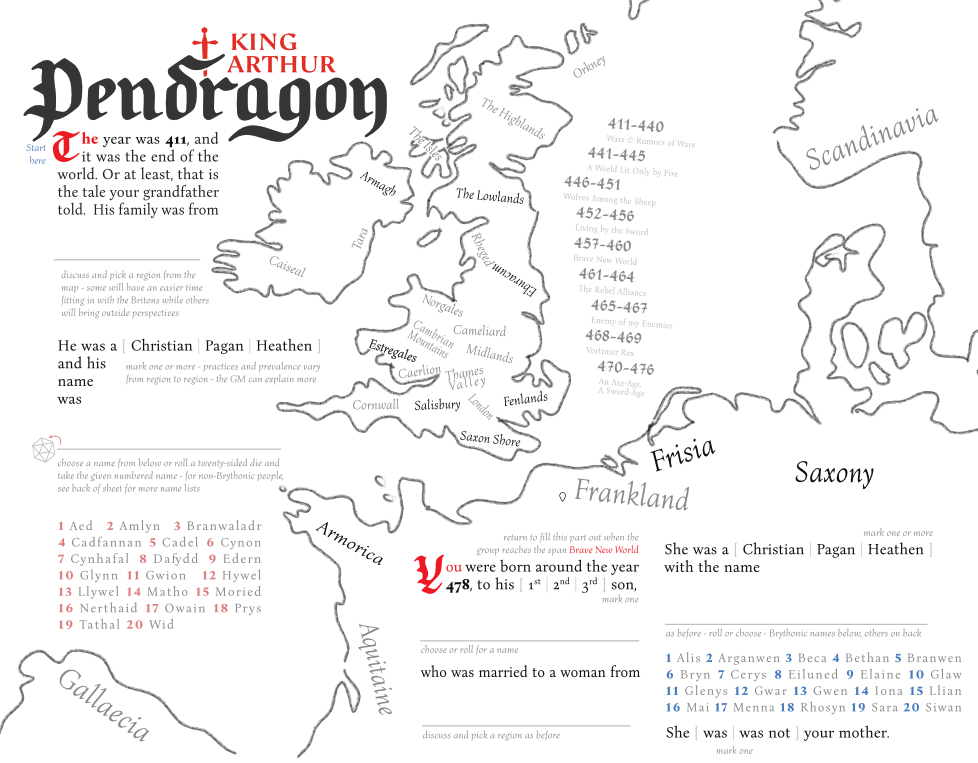
I decided to try this out as a simpler start, and even to simplify that out. I already knew the players were going to go with a single shared family7, and not anything too far-flung, so I could scope a very specific story.
I threw together a simple three-piece sheet8 and winged most of the results.
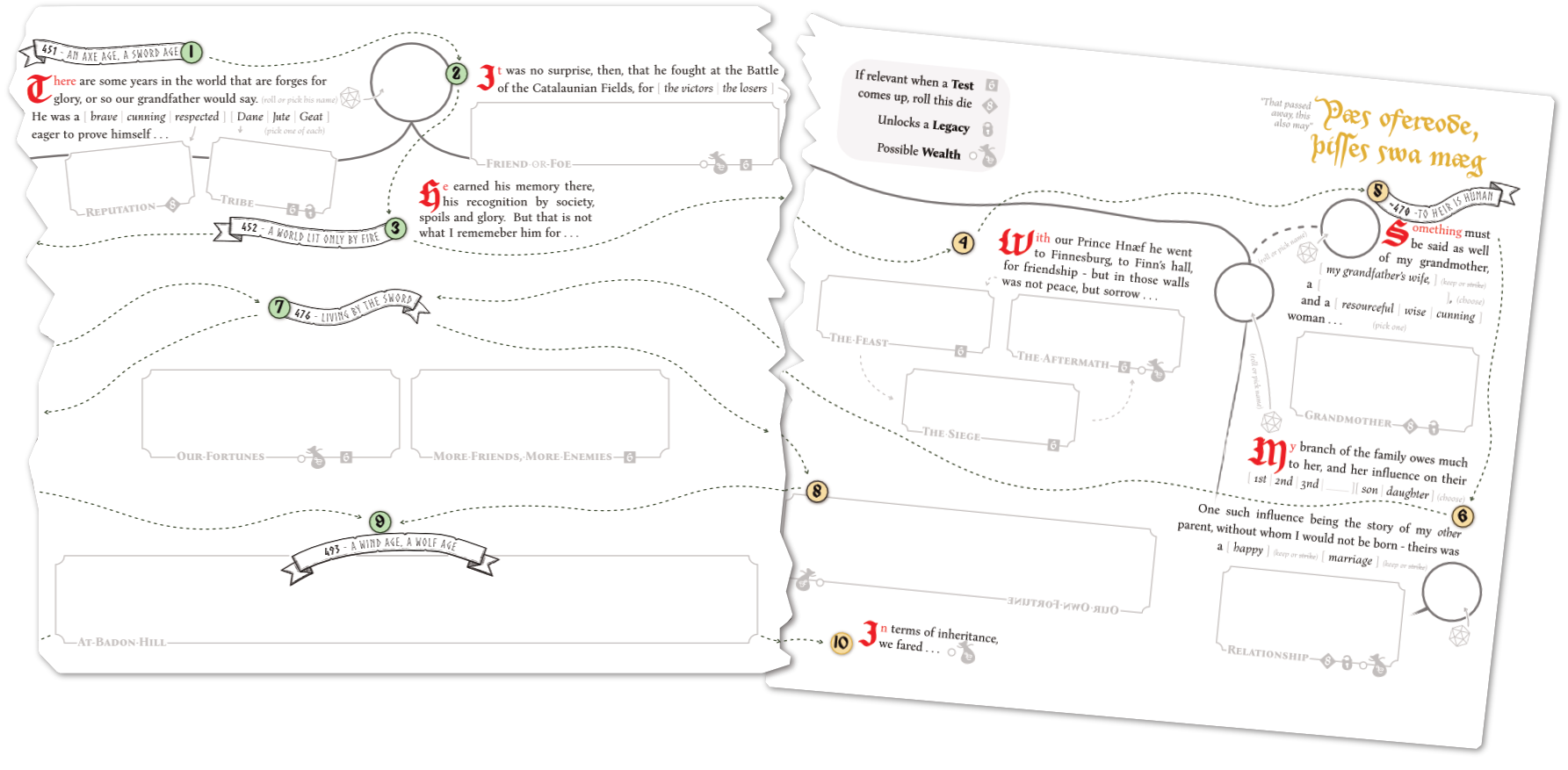
- I think the family history landed well, and gave a lot of depth to the local history while still encouraging engagement in the wider history.
- I meant to have the system also slowly introduce mechanics - to be a soft tutorial… that didn’t happen that much, though maybe because the core Cortex system is not that easy to tutorialize9.
- The family itself also immediately caught player interest, and local history was engaging.
- It was somewhat tricky with the big family - it’s a bit OP.
I also realized I never set up a plan for how courtship would work as I moved away from the roll-on-all-the-tables Pendragon systems10 - which led to this hasty gimmick.
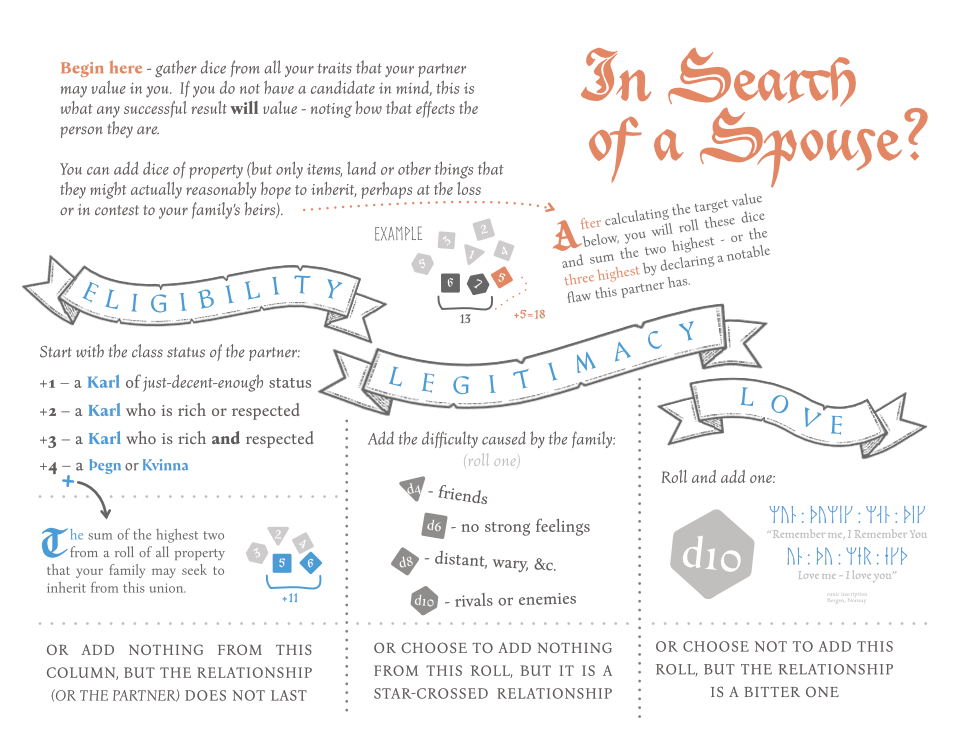
This worked well enough, I think some of the tradeoff points are fun and led to an interesting path the one time it got used. I still have no idea of the balance.
Time & Aging
One of the biggest constraints for A Wind Age compared to a Pendragon campaign was that we weren’t going to meet all that often. Having a session a year wasn’t going to work.
Instead, I played this very loose - so there wasn’t any specific threshold or normal amount of time between sessions, and things like aging advanced when it felt right11. There were a lot of misses in this, I think.
- Running one year per session was very hard. I don’t know if it’s fully impossible (with a fast system and a shorter rhythm - and also suggesting a longer normal session duration), but at the very least I think expecting 2 sessions per year to be commonplace has to be baked in. That may mean even a year-to-year format actually skips years now and then.
- Similarly, running the stuff between years took a long time - though partially because I hadn’t baked that system into something easy to run. It definitely makes the pacing harder to keep to a regular length - so… I have some ideas there.
- Aging was interesting - and specifically noted as exciting for the players - but I don’t feel the main lever I had been using worked. I had always relied - from much earlier in the design - that aging would “tighten up the stress valve” - giving you less and less room to navigate.
- This valve… had almost no effect. So that requires some searching for what makes a character really feel old.
- Afraid/Wild stresses in particular didn’t get heavily used.
- I’ve not yet got the opportunity to see generational switches (and might complicate it when it does happen by testing newer variants of the system).
The Map
I had always had a vague idea to have a regional map for The Death of Arthur, printed in large format - but mostly as an informational prop. The map would be only there to be read, and just as a map.
I also planned a larger map of Britain and nearby Europe - again, informational only.
I had to find a new region to stick A Wind Age to - eventually settling on the small island of Hlesey to give my players a pretty central place no matter which direction of the setting interested them the most. This is smaller than an area like Salisbury, but a similar localized scale.
I had also had information in the family/estate sheets that I hadn’t fit into A Wind Age’s main character sheet, so I decided I could put that into the map itself - it would be easier, knowing exactly the group I was baking the map for12.
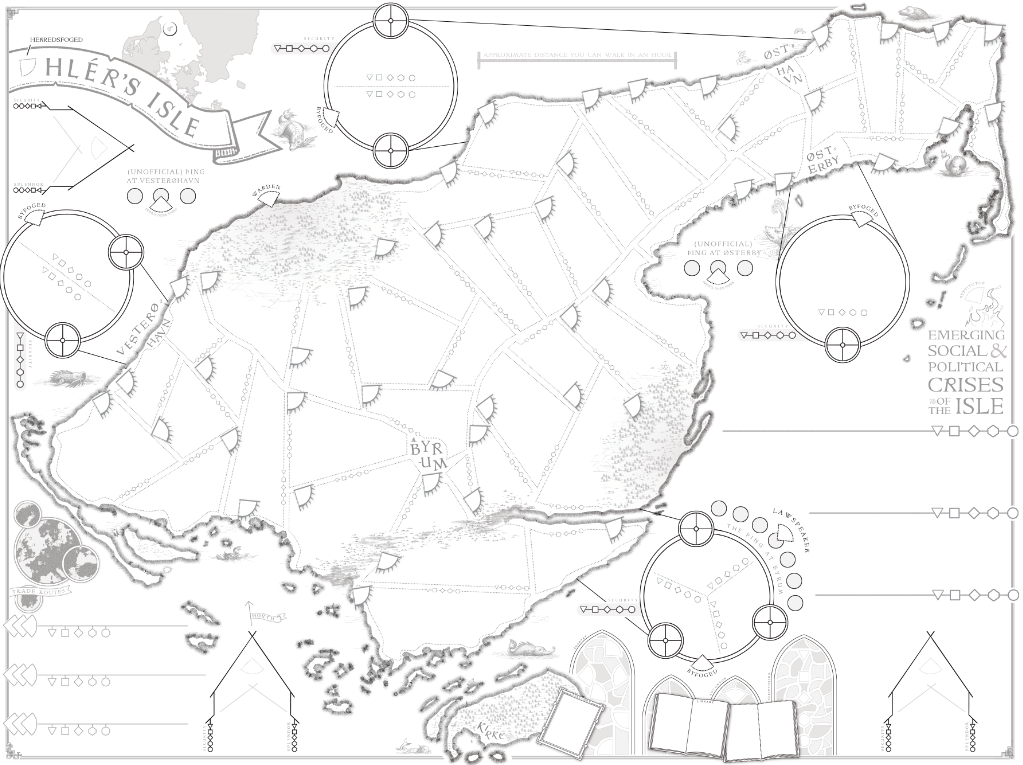
The map was a big hit, but:
- Only the local map. The regional map saw a lot less use and switching the map is hard.
- Hlesey was far too small an area - family history quickly made it reasonable to give the players a large chunk of power on the island, and players tend to only gain more power. Even when the party starts to deal with bigger fish, the bounds of the island map make it hard to represent the bigger picture, so the real gameable area remains a small pond.
- Writing on a map is hard, but small colorful labels are very effective - working somewhat like a legacy boardgame at least aesthetically.
- While I set up that colorful system for convenience, “painting” the map also turned out to be really evocative - it satisfied the “characters should feel an urge that only land will fill” feeling that I had tried to bake into other systems.
- The granularity of development I had originally envisaged wasn’t particularly interesting. It did make the initial setup interesting, but left limited decision making past that point. The big factor was how many colorful dots did you have.
- The map was quite effective for tying player decisions to local political forces, reminding them of characters, etc. - it made the micro-history angle work. Maybe one of the biggest takeaways of the playtest was to center the map in design (and to make it paintable).
Other Prop Gimmicks
I had a lot of fun with tokens, using small amber stones for Resolve (Plot Points).
I had less fun with trying to make my own self-standing (standee-style) sheets with cardstock. I used them for ships, which I thought would be a fun way to show them standing around at different points on a map (you can see one side below - note the Paperclip Track on the side for veterancy)
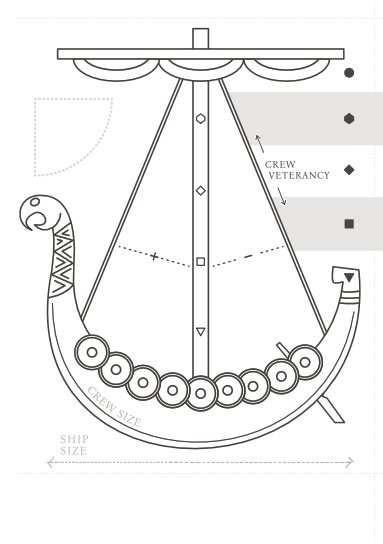
These quickly crowd a map, blow around easily, don’t stand up well, are hard to write on, and are tricky to store. The idea was neat, I don’t fully regret the little boats, and maybe some gripes could be handled by a better design or a more purposeful sheet… but I think the appeal of these outstrips their usefulness.
Using index cards for Assets with freeform text seemed perfectly practicable, and easier for a lot of things I would have tried making bespoke gimmicks for before trying it.
The Economy
The very last system I baked in - after play had already begun - was “what does power on the map actually do?” - how you were meant to feel about playing the bigger economic game. In an extreme example of building the sheet first I put all the details in before I figured out what I was planning to do with them. Players would have lots and those would have dice and… something.
None of this was set up in my previous designs, which had assumed estates were generic aspects and each would be kind of like a character with their own sets of traits. In Pendragon, after all, you can end up getting estates anywhere, and each estate would be built up differently.
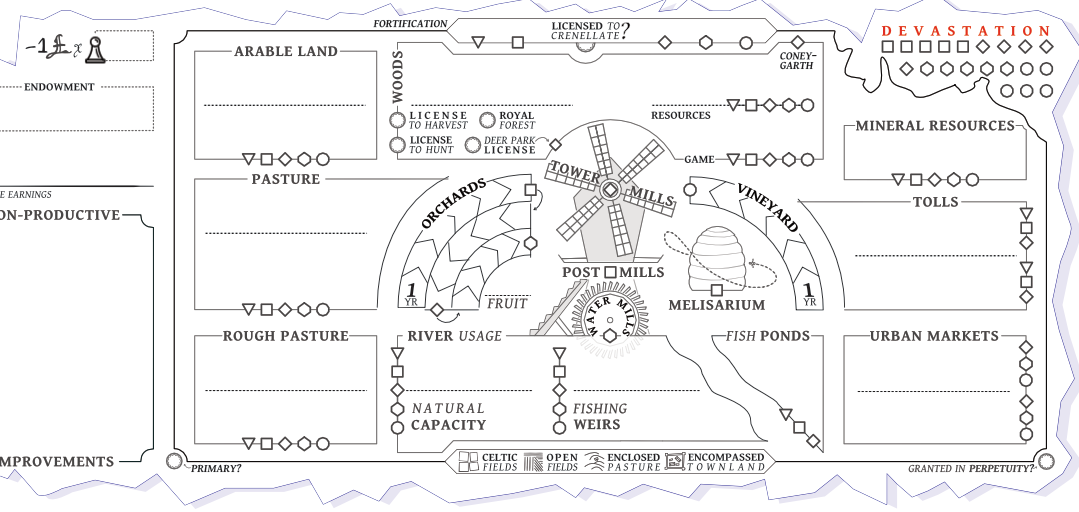
So this was very half-baked, and had a bunch of weird extra calculations and “divide the number of dice by X” hacks to make it fit back into something vaguely Cortex shaped - boiling down to “collect a big pile of dice”.
- This… largely worked.
- I don’t think it should be as complicated/hacky, but having wealth be a whole bunch of dice you apportion to tasks is good enough. Players liked to push around power and making decisions.
- The player-facing aspects - Purse, Aid and Poverty - on the other hand kind of disappeared from play. Back to the design board for those.
The System
Some of the other things I noticed.
First, on the meta-economy - the economy of plot points (or Resolve as I framed it) was anemic. I maybe just didn’t make things difficult enough?
Legacies - the “lets make a custom dice trick” SFX part of Cortex fell pretty flat. I found them really hard to make, even harder to push that onto players in any reasonable way - and the legacies characters did have didn’t see a lot of use. Without being so integral to play as, say, D&D feats (or probably how they fit in other versions of Cortex), it was always too specific to pay attention to.
Passions did kind of work, but didn’t come up that often and so always had to check the rules. Turmoil (the most Pendragon aspect left of the system) didn’t come up a lot, probably because of the plot point economy being weak.
Also, I shortened the list of traits - including cutting Chaste vs. Lustful near the last moment - and… didn’t really miss them.
The multi-column aspect of Cortex rolls went over well - players could understand having multiple aspects to define what they were doing, but a couple particular pain points existed:
- Instead of Cortex’s default Distinctions I had a concept of Obligations, which… were hard to explain on every single roll. Having the “why” of why an action was taken be highlighted felt good in design, but it ended up being really one-note. Either obligations had to be defined very specifically, and led to a lot of time figuring out which one made sense - or they had to be defined very broadly and lost any meaning.
- Hinder also wasn’t really used - perhaps because it seemed complex, or maybe again because the Resolve economy wasn’t really firing the way it should have.
- Custom passions let players set flags for things that interested them, but it wasn’t really well guided to make ones that got incorporated a lot.
- I had pivoted to highly poetic skill names - instead of Combat you’d get The Sword and the Spear, etc. - and these often caused confusion and delay.
- But… I also found I was delighted by these regardless. I think this is actually a bad pattern and one that I should move to a simpler naming scheme, but it’s one that I like regardless.
Footnotes
-
And is - the group doesn’t meet that often, but it’s still ongoing as of writing this post. ↩
-
A historical indulgence for expanded character possibilities. Christian missionary work in Scandinavia wasn’t heavy until after this period - but we can excuse an island-specific oddity. ↩
-
And the most developed points were either very specific to a more western clerical context, or the rather strong points of having marriage be a field only on the lady’s sheet (something which still is on the current designs - this still has a point, it’s just a bit intense). ↩
-
Simplified because the campaign wouldn’t have the same passage of time to care about highlighting changing technology. ↩
-
Probably for the best. ↩
-
But… the scare quotes are important to avoid overstatement. ↩
-
As in, their grandfather would be the same - and they’d be two branches of the same family tree. ↩
-
To highlight where some of the decisions would be made for the family as a whole, and some for each of them individually. ↩
-
The very central core is - but you have to abstractly understand that recognize it in actual play later on. ↩
-
Not that I need to fully abandon that strategy - but I certainly hadn’t picked which versions of those tables to use and how the parts that tied into other table-rolling would tie into other subsystems instead. ↩
-
Which is hard to run, and I didn’t keep a great hand on that rudder. ↩
-
Down to only needing to put labels facing one direction. One complication in previous map drafts was how I should orient text if I abstractly considered the group to be sitting around a table on both sides of the map. For A Wind Age and the specific case, my specific furniture at the time, etc. - I knew it only needed to be readable on one side. ↩
