Fate, and the dooming gods, are deaf to tears.
The Aeneid
How do characters get hurt? How do they die? How do they recover1?
In the last post (this is part of three - the final post is here) - part of this three-part series - I already hinted about one aspect of this - Doubt - but didn’t go deep into the details. I barely mentioned Doom at all.
In short, I have a desire for two kinds of consequences that come out from rolling the dice - the more ephemeral Doubt and the perilous and inexorable Doom.
Both should account for some degree of non-combat, non-injury “harm”, and Doom in particular is going to have to also change as characters age - because that should feel like fragility.
Hit Points & Their Alternatives
I’m not a huge fan of traditional hit points - where there’s some pool of points to whittle down to 0, at which point the character dies2. It’s tricky to balance the damage when there’s a lot of different kinds of situations a character can be in3, leading to endless incredulous edge cases.
The granular nature of attrition - especially in large pools of hit points - also forces you to roll for granular events, with the attendant math and erasing.
So what are the alternatives? Lets look at some of our inspirations:
- Pendragon is firmly a hit point system4, so it’s of no help to us here.
- Alien also has hit points as Health, but also has Stress which is an interesting model: as you push your luck, you get more bad dice, and it’s a ticking time bomb before those dice roll the bad numbers. Very interesting, but probably not easy to tune to our situations5.
- Blades in the Dark has a different kind of Stress6. This is a small pool of points, with the twist that players have the option to spend them to avoid what would happen otherwise, and also to be greedy and spend them on other actions.
- Cortex Prime has several ways to manage health, including creating Stress (yet again, same name but different meaning) or Complications that penalize later rolls - or filling up the Doom Pool of dice that a GM can spend on other effects.
- The Wildsea breaks up the health pool into individual Aspects which can each be impaired and lost separately.
- Slugblaster has Taking Slams that are short lived but build up to Disaster (and may have situational effects, but no major penalties otherwise), and “Noping” those slams and taking Trouble. The more Trouble you build up, the worse it will be when disaster strikes, and the more you will be spending in downtime trying to get rid of it (but that’s also made to be interesting in its own right).
- Trophy Dark has Ruin - a small pool of points - and Dark Dice. With a similar push-your-luck mechanism to Alien, you can usually get more dark dice in your die pool to give you a better shot… and more risk. If the dark die is the highest die and higher than your current Ruin7, you must raise Ruin - meaning you tend to gain damage on higher rolls, especially for the final steps that drive your character to total ruin.
Some Initial Sketches
My first sketch of Doubt was actually as a kind of tarnished reward. If you succeeded you would get Fame, but if you struggled you’d get Doubt instead8 - which would be more fickle.
Specifically, if you used Fame to get advantage, you’d lose it only on a failure. If you used Doubt, you’d lose it only on a success - making it strangely better when you were going through a rough spot of constantly losing, but worse when you succeeded.
The problem was that - especially when I tried to somehow make it consistent with Disaster as well - you ended up just getting more and more resources over time, with finicky rules to drain them. In particular, Doubt was only lost on successes… where you’d immediately be getting something to replace them, so it hardly would feel like a loss.
Realizing I also hadn’t gotten a satisfactory replacement for The Wildsea’s attrition of Aspects, my next idea cleaved closer to that. You’d gain Doubt that would basically “lock down” equivalent tokens of Fame, eventually strangling out use of each famed motif you had9 until your character sheet itself started taking on Doubt.
I also considered if Doubt would maybe be better as a group resource - something that would go into a pool (similar to Cortex’s Doom Pool) that would build up for the GM to spend on… something. Something that would make you want to keep that pool in check.10
With all of these designs I also didn’t want it to just be “build up Doubt until you die”, but the alternative was just another hit point scale on the side.
Doubt
My current design11 is that Doubt is a token—a metacurrency—that is given when you hit trouble in rolls, while Fame is a token given when you succeed. You can get both at the same time in a Struggle as described in the last post.
Doubt12 applies to specific Motifs, your equipment, companions (including animals), relationships, reputations, etc.—rather than applying to you generally. A rough horse race through the dark might end up putting Doubt on your horse; as it is worn out, injured, or proves less certain than you had believed before—or it may put Doubt on your “The one knight who’s willing to face the enemy” reputation you gained from previous adventures—or it may add a new Motif to add Doubt to like “tore a muscle” or “caught a cold” or “Sir-too-slow” if those fit the consequences closer than your existing motifs13.
As you build up Doubt—especially as it drowns out the Fame—it becomes more dangerous to invoke Motifs. The wear and tear eventually breaks down into…
Peril
Doubt is ephemeral and intangible. It represents the kinds of tension that builds in a scene but doesn’t necessarily resolve to anything meaningful. Doubt is potentially hazardous, but it can also be perfectly safe to have any amount of it, if that tension never resolves.
When a roll might resolve that tension14, it is Perilous and at the same time you learn about how challenging it is and what the rewards and consequences might be, so you will learn about how perilous it is.
This is marked by a number of Perilous Dice, which “replace” some (or in terrible situations, all) of the dice you would be normally rolling (for the sake of clarity, these non-Perilous dice are Heroic Dice). These should be visually distinct sets of dice15.
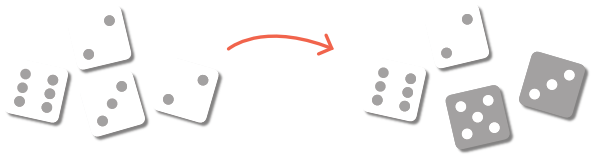
Say you had a dice pool of 4, but the roll had a Peril of 2. Two of the Heroic Dice you would have rolled get replaced with Perilous ones instead.16
Peril is a separate axes of concern to the challenge and Cut of the roll. Some actions are challenging, but not exactly mortally dangerous. For instance, climbing a short but very steep wall is likely really hard and you likely won’t succeed, but the damage for failing is probably just a bit of regret and minor injuries (which are covered in Doubt). Other actions can be very perilous but easy; many combats may be this to an experienced knight—a cakewalk, but never completely safe.
Doom
On each character sheet is a Paperclip Track representing the current state of a character’s Doom. The higher you are on the track, the closer you are to that final doomsday.
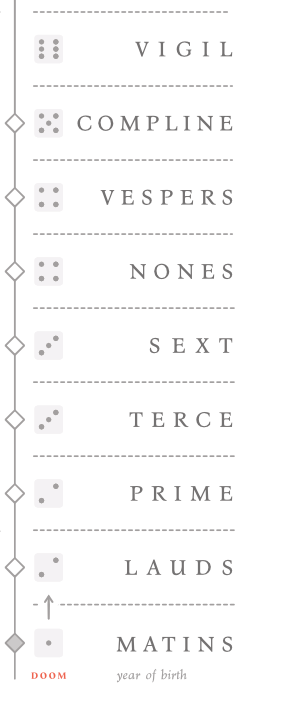 The labels for each level are the Canonical Hours, as a metaphor for how “close to midnight” things are.
If you roll a dice pool with Heroic and Perilous dice and (A) one of the highest dice rolled17 is Perilous18 and (B) is higher than your current Doom track, you trigger Doom.
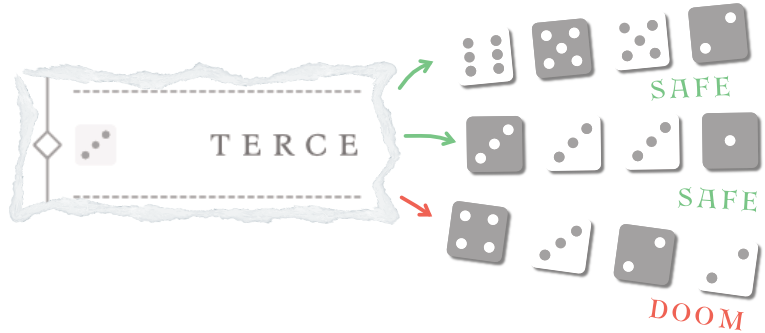
Say your Doom Track was at Terce, or a 3. Rolling a 6 and 5 from your Heroic Dice and a 5 and 2 from your Perilous dice is safe, because the highest die is Heroic. Similarly, rolling two Heroic 3’s and a Perilous 3 + Perilous 1 is safe, because while the Perilous die highest, it’s not higher than your current level19. The final hypothetical roll with the highest die being a Perilous 4 does trigger Doom.
When you trigger Doom, you push up the track a number of steps determined by:
- How many perilous dice were rolled > the track?20
- How much Doubt was invoked (i.e. on invoked Motifs)?21
I think this should be multiplicative22, but I’m not solid on the math for this yet2324.
When the Doom Track hits Vigil, the character dies25.
Age
The reason why the Doom Track (as shown above) has year of birth tacked on the bottom is that this track is also tracking a character’s age, as that sets the starting/minimum level the track can be at.
Because the higher die value means Doom is less likely to trigger, this is not quite the same as saying they have that many fewer steps before death. An old character can face a lot of Peril, but once it resolves against them, they have no youthful luck and vigor to keep going. Youth may get kicked on their butts more often, and the dice can really turn against them26, but they have an ability to take the punishment and keep going.
In Summary
To carry on the example from the last post, you’re riding to warn your friends of an ambush - four Heroic Dice, two Cut for all the reasons in the last post.
But now you’re riding through that enemy territory, and they understandably want to kill you to stop the message. You have an injury that’s a Motif with 2 Doubt on it, and your horse is weary with a single token of Doubt too (you needed to invoke it anyway, for the Advantage, but that might be pushing your luck one step too far).
You’re young, in your Prime quite literally - so your Doom Track is at a 2.
Here’s some randomly rolled results and their interpretations:
| H | H | P | P | Highest Die before Cut | Highest Die after Cut | Final Doom |
|---|---|---|---|---|---|---|
| 3 | 1 | 1 | 4 | 4, Perilous | 1 → Disaster | Nones (+3) |
| 2 | 2 | 4 | 6 | 6, Perilous | 2 → Disaster | Vespers (+4) |
| 2 | 4 | 4 | 6 | 6, Perilous | 4 → Struggle | Vespers (+4) |
| 6 | 2 | 4 | 4 | 6, Heroic | 4 → Struggle | Prime (unscathed) |
| 6 | 1 | 1 | 2 | 6, Heroic | 1 → Disaster | Prime (unscathed) |
| 5 | 4 | 5 | 2 | 5, Perilous | 4 → Struggle | Nones (+3) |
But roll for yourself27 and see how you fare.
Footnotes
-
Recover from being hurt, I mean. Usually you don’t recover from being dead, though stranger things have happened. ↩
-
There’s plenty of variants to this, and pretty much all damage systems have to look somewhat like this (if you don’t fully commit to some kind of roll-to-not-die, you’ll want to track how close you’ve gotten to death), so my generalities here won’t look like any one example. ↩
-
And this usually gets into weird territories when there’s also a lot of different types of situations - all of which should be dangerous but in different ways. It can feel silly balancing the heartache of getting rejected socially with a bullet. ↩
-
There’s a little nuance in the way wounds work, which is interesting but not something I’ve found a place for in this model. ↩
-
Alien has to advise to not roll the dice often because Stress is dangerous and always-on. Even for its action-horror genre setting, the failure of Stress is Panic, which is dangerous but not immediate death. It could easily seem punishing and arbitrary to have a break immediately throw the character away. ↩
-
And some other systems that tie into it that I won’t fully cover here. ↩
-
Conveniently a 6 point scale. ↩
-
Actually I called it Doom at the time - but I don’t want to confuse you since I took that name for a totally different concept. ↩
-
Again, we’ll get to Motifs in later posts - but for now think of these as the equivalent of Aspects. ↩
-
Having individualized rewards in Fame and collectivized penalties in Doubt is still an interesting idea. ↩
-
And I should emphasize - the reason these posts took so long to write is that it is current as of me writing this - and specifically this part of it. ↩
-
And Fame, but we’re not covering that here. ↩
-
Some of these may be turned later. An injury might become a cool scar if you can give it Fame, and a reputation might warp over time to “I wasn’t slow when it mattered” or so on. All Motifs are mutable. ↩
-
Most obviously this is when a roll is dangerous in an immediate physical sense (like someone swinging a sword at you), but not necessarily. Disease, fatigue of old age, etc. can kill - as well as being put into deadly situations (e.g. if you’re in the middle of the ocean with no hope of rescue, the doom doesn’t come when you drown, it comes when you fall overboard) ↩
-
I’m representing them generically as light and dark colored dice, as that’s usually the obvious split people will have, but any two sets that can be distinguished and which everyone knows which is which will do. Different players could have different color themes of Heroic vs. Perilous dice, maybe themed after their characters. ↩
-
You might ask, what if the Peril is higher than the number of dice in my pool? Good catch! You roll the higher number, but add additional Cut to make up the difference. For example, if you only had 2 Heroic Dice from your skills, etc. and were engaging in a very Perilous activity of 4 Perilous Dice and it had a Cut of 1 from its normal challenge, you would roll 4 dice, but treat it as a Cut of 3. ↩
-
To be clear, before Cut. So you can suffer from this and still fail. ↩
-
“One of” means this triggers even if a Heroic and Perilous die tie. ↩
-
This makes it harder to trigger Doom the closer you get to death, and you have to have rolled a higher roll in total, thus trying to make sure the rolls that are the highest tension have high stakes on both sides, and often you can go down in a blaze of glory (though… Cut can cut into that). ↩
-
Allowing more Perilous rolls to not just make it more likely to trigger, but also capable of higher volatility. Peril 2 is both more likely to trigger Doom, but also more capable of hurting you when it happens than Peril 1. ↩
-
Here’s where Doubt comes into play: making the damage from Doom hit a lot harder. ↩
-
Specifically, you always go up 1 point regardless of Doubt, but then for every Motif that’s invoked with Doubt on it the GM removes one token of Doubt for every die > the threshold. So if you rolled a single die over the threshold and had two Motifs, one with 1 Doubt, one with 2 Doubt, you’d go up 3 steps (one by default + 1 for each Motif). If you rolled three dice over the threshold, you’d go up 4 steps (one by default + 1 + 2 from the Motifs, only adding the extra dice while there was remaining Doubt on the Motifs). This would also clear the Doubt from the Motifs for later rolls. ↩
-
It could also be strictly multiplicative as (Motifs with Doubt + 1)(dice over Doom); in the previous example that would be 3 steps and 7 steps, respectively, or additive (3 steps and 5 steps, respectively, though the edge cases can be very different). In previous designs I also considered tracking what counted as “dice over the threshold” dynamically as the doom track rose (i.e. for each die, resolve how many steps it rises, then check if the next lower die still is above the threshold) - so more extreme swings would be less likely. That has a lot of benefits in avoiding making some rolls riskier because you were healthier to begin with… but I worry it’s a really finicky procedure to follow. ↩
-
And I might do the math later and tweak a lot of the pieces in this and the next post… but I can’t keep redoing that over and over and not actually writing these up, so for now lets just assume it looks good. ↩
-
Some caveats, but that’s for later posts. ↩
-
i.e. youth may feel invulnerable, but when a really dangerous situation goes bad, it can take that all away in an instant in a way that’s much rarer after the “young and dumb” years. ↩
-
For this, if you don’t have two sets of dice you can just roll 2 dice, then roll another 2 dice - with something like this generator. ↩