“But the five knights you toppled weren’t in love!”
“Weren’t in love?” said Troylus, angry now. “How can you possibly know?”
“Don’t get annoyed - you should be grateful for the advice. I tell you, no knight like you who’s not in love could have brought down five knights as good as these if they were!”
“I think you and other lovers,” said the irritated Troylus, “trust too much in love.”Perceforest
In the first two posts in this series, we’ve explored the basic dice mechanic of The Death of Arthur - how to assemble a dice pool and measure challenge, then how to measure peril and the danger of doubt and doom.
It’s already an intricate set of mechanics1 but there’s still a few tricks to explore - and the biggest of these are Passions.
This is a game about the heart and I want to capture the feeling of Pendragon’s Inspiration mechanic - where a knight’s passions and instincts could call upon them to try to seize success against the odds.
I also have a block on the character sheet called Passions with the intent of having these invocations of inspiration.
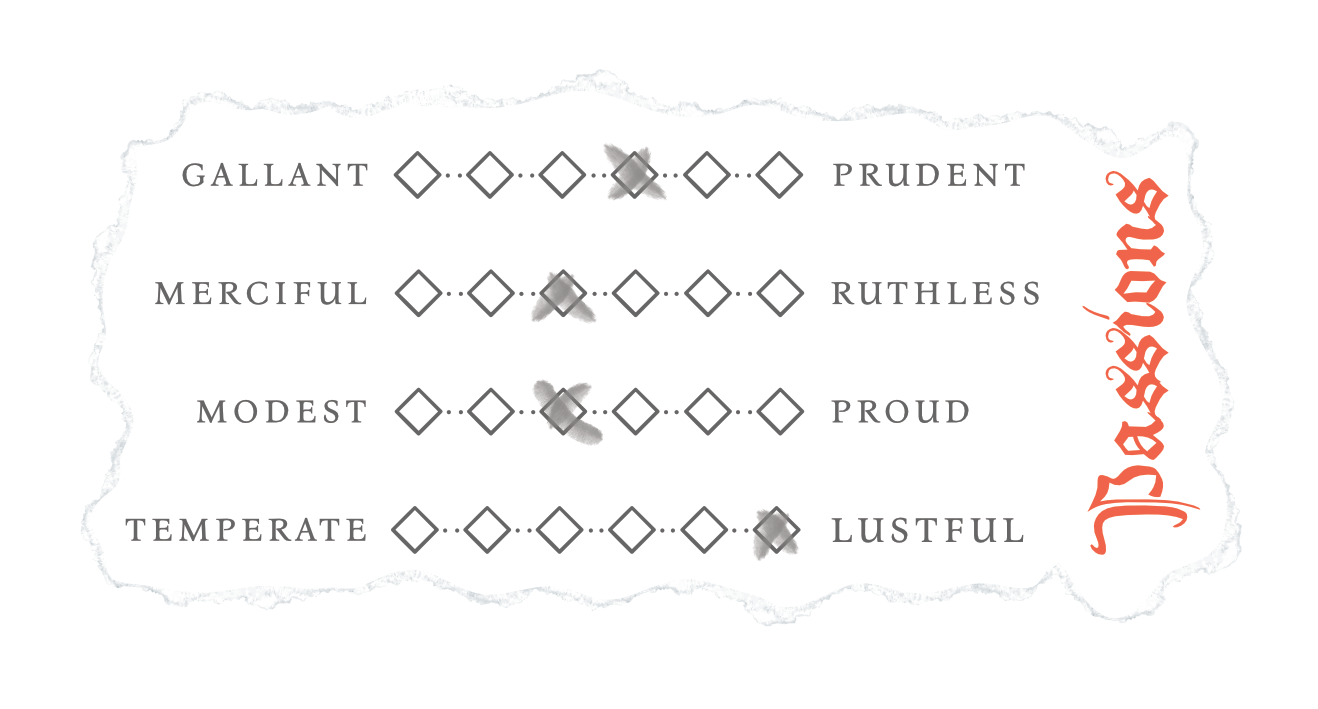
But what should invoking them do? Pendragon gives a flat bonus to a roll - useful in a d20 dice system, not meaningful in a dice pool.
Shame2
Lets first talk about something we didn’t talk about in the last post; how do you recover from Doubt? If it only builds and builds on your Motifs, you’re just a ticking time bomb before Doom explodes.
For that we have another section of the Character Sheet we haven’t addressed yet: Obligations.
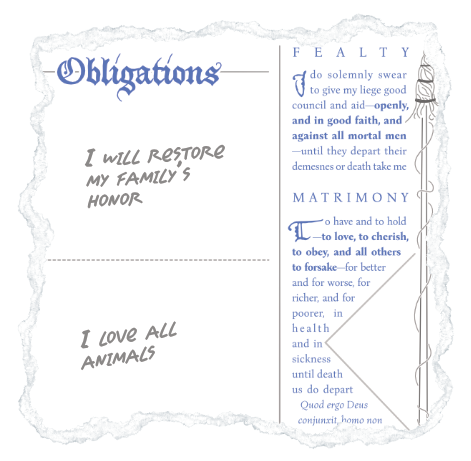
Obligations consist of fixed societal expectations3 and freeform declarations of things that matter to a character: oaths they’ve sworn, core parts of their ideals and behavior, and anything else that compels and obligates them4.
When you act in accordance to an Obligation5 you can move a Doubt on a Motif into a Shame that you put on your Obligations instead6. Once you have one Shame per Obligation, any additional Shame you add7 can eventually be cleared from the sheet entirely8, so the goal is to keep internalizing and swallowing these doubts so you can get rid of them inside your rigid shell of Obligations9.
Shame will, appropriately, provide both the power and the risk of Inspiration. But what does that do?
Trust in the Heart of the Cards… er, Dice
There’s a dice technique that comes up a lot with dice pool games, even if not in any of the ones we’ve been pulling these mechanics from: Exploding Dice - if you roll a 6, you can get another die to add to the pool, possibly pushing you beyond the possibilities of your original pool10.
This is what we’ll pull in for Inspiration. As long as you have Shame and a Passion that you can invoke, Inspiration means your dice can explode.
There’s immediately some points to clarify:
- Can the dice you get from the initial explosion also explode, potentially forever? For our cases, no - it’s just one-and-done11.
- How do they interact with Doom? I don’t think at all - these are neither perilous nor heroic dice.
- How do they interact with Cut? They apply before Cut12 but will mean you have more dice after cutting.
This last point notably opens up some13 of the previously locked out parts of our Cut vs. Pool size chart - here again showing the probability of any type of success14 first:15
| 1d6 | 2d6 | 3d6 | 4d6 | 5d6 | 6d6 | |
|---|---|---|---|---|---|---|
| Cut 1 | 8% | 33% | 56% | 73% | 84% | 91% |
| Cut 2 | — | 8% | 24% | 43% | 60% | 73% |
| Cut 3 | — | 1% | 6% | 18% | 33% | 48% |
| Cut 4 | — | — | 1% | 5% | 14% | 26% |
The most obvious addition are those Hail Mary plays - you can risk something that’s a little challenging even with a single die, and as long as you have two dice you technically have a shot at basically any reasonable challenge level. But lets look more closely at how much Passions raised your chances.
| 1d6 | 2d6 | 3d6 | 4d6 | 5d6 | 6d6 | |
|---|---|---|---|---|---|---|
| Cut 1 | +8 | +8 | +6 | +4 | +3 | +1 |
| Cut 2 | — | +8 | +11 | +12 | +10 | +7 |
| Cut 3 | — | +1 | +6 | +12 | +12 | +14 |
| Cut 4 | — | — | +1 | +5 | +11 | +15 |
It’s a wild set of numbers16 - but the general trend is: passions matter more when the task is difficult and it was beyond your skill.
Which, as well as the evocative feel of those additional dice rolling in to save the day - is exactly what I want the mechanic to feel like.
While we’re at it, lets look at probability of trouble, modified by passion:
| 1d6 | 2d6 | 3d6 | 4d6 | 5d6 | 6d6 | |
|---|---|---|---|---|---|---|
| Cut 1 | 97% | 93% | 87% | 80% | 74% | 67% |
| Cut 2 | — | 99% | 98% | 95% | 91% | 88% |
| Cut 3 | — | 100% | 100% | 99% | 98% | 96% |
| Cut 4 | — | — | 100% | 100% | 100% | 99% |
We can again look at this as the change to our chance of suffering:
| 1d6 | 2d6 | 3d6 | 4d6 | 5d6 | 6d6 | |
|---|---|---|---|---|---|---|
| Cut 1 | -3 | -4 | -6 | -7 | -6 | -7 |
| Cut 2 | — | -1 | -4 | -3 | -6 | -6 |
| Cut 3 | — | -0 | -0 | -1 | -2 | -3 |
| Cut 4 | — | — | -0 | -0 | -0 | -1 |
This is less dramatic than success rates - you’re still going to feel pain, though maybe less so if you’re passionate and really good17.
What’s the Catch?
In terms of balance, we’ve just seen the probability shift isn’t extreme18. Thematically, passions should be a little dangerous - they’re outbursts of the heart, after all - but I don’t want to overcorrect. It’s a genre convention that knights hurl themselves into danger, so it shouldn’t be so punishing it’s a last resort19.
But we can introduce a couple of small thematic catches - one small but more common risk, and one bigger but pretty rare risk.
Turmoil
There’s a little track of 6 slots between each pair of Passions. If we count these as 1,2,3,4,5,6 towards the passion on the right, 6,5,4,3,2,1 to the other, we get two scores that are inverses to each other.
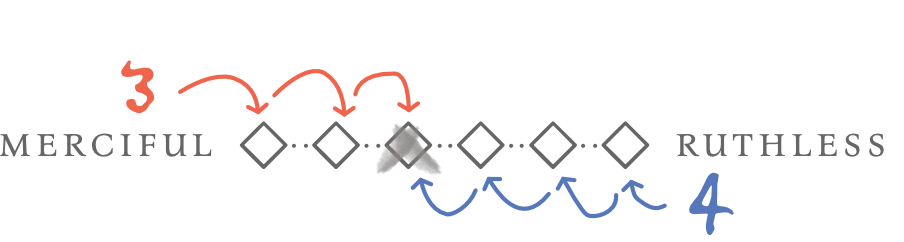
When you’re invoking inspiration, you’re calling on a specific Passion. If your extra dice roll above this score, you push that score in that direction as the character builds the habit20 - and weakens the hold of the opposed habit.
And you have to move one Shame back onto a Motif as Doubt.
You race through the night21 and this time we’re looking inside - you have a Prudent 5, Gallant 2. You’ve spent your years taking all the safe options, maybe feeling like a coward each time.
But with your four dice you roll 1, 1, 4, 6. There’s 2 dice cut, so that 6 won’t cut it. But another die could push that 4 into play22 - you’d just have to do something daring for once, that side of you that’s rarely seen but is still there despite it all. You need to be Gallant.
Pushing this hard against your habits is almost certainly23 going to give Turmoil, but you’d get Doubt from failure anyway - why not risk it for the chance that it’s worth it?
Madness
Alas, said Sir Launcelot; and therewith he took such an heartly sorrow at her words that he fell down to the floor in a swoon. And therewithal Queen Guenever departed. And when Sir Launcelot awoke of his swoon, he leapt out at a bay window into a garden, and there with thorns he was all to-scratched in his visage and his body; and so he ran forth he wist not whither, and was wild wood as ever was man; and so he ran two year, and never man might have grace to know him.
Sir Thomas Malory, Le Morte D’Arthur
Well, there might be another risk to talk about. What if you still fail? You roll the die… and get a 3. If you had rolled a 1-2, you would have gotten the same result, but at least you could blame your nature - your overwhelming Prudence strangling out the seeds of valor before they could take root. But at a 3, your Gallantry really made an effort, you really changed… and you still failed.
What’s the likelihood that you face this point? Well, it will depend on the Cut, the number of dice you have, and how high your initial Passion was - if you have to declare Inspiration before rolling anything24, here are the probabilities[^39] for invoking a passion scored 1-525:
For Passion 126
| 1d6 | 2d6 | 3d6 | 4d6 | 5d6 | 6d6 | |
|---|---|---|---|---|---|---|
| Cut 1 | 5% | 6% | 4% | 3% | 2% | 1% |
| Cut 2 | — | 18% | 17% | 13% | 10% | 7% |
| Cut 3 | — | 25% | 30% | 30% | 25% | 20% |
| Cut 4 | — | — | 35% | 40% | 40% | 36% |
For Passion 2
| 1d6 | 2d6 | 3d6 | 4d6 | 5d6 | 6d6 | |
|---|---|---|---|---|---|---|
| Cut 1 | 3% | 3% | 2% | 1% | 1% | 1% |
| Cut 2 | — | 13% | 12% | 9% | 6% | 4% |
| Cut 3 | — | 20% | 23% | 22% | 18% | 14% |
| Cut 4 | — | — | 29% | 32% | 31% | 28% |
For Passion 3
| 1d6 | 2d6 | 3d6 | 4d6 | 5d6 | 6d6 | |
|---|---|---|---|---|---|---|
| Cut 1 | 0% | 0% | 0% | 0% | 0% | 0% |
| Cut 2 | — | 8% | 6% | 4% | 3% | 2% |
| Cut 3 | — | 15% | 17% | 15% | 11% | 8% |
| Cut 4 | — | — | 23% | 25% | 23% | 20% |
For Passion 4
| 1d6 | 2d6 | 3d6 | 4d6 | 5d6 | 6d6 | |
|---|---|---|---|---|---|---|
| Cut 1 | 0% | 0% | 0% | 0% | 0% | 0% |
| Cut 2 | — | 6% | 4% | 3% | 2% | 1% |
| Cut 3 | — | 10% | 11% | 10% | 7% | 5% |
| Cut 4 | — | — | 15% | 17% | 15% | 13% |
For Passion 5
| 1d6 | 2d6 | 3d6 | 4d6 | 5d6 | 6d6 | |
|---|---|---|---|---|---|---|
| Cut 1 | 0% | 0% | 0% | 0% | 0% | 0% |
| Cut 2 | — | 3% | 2% | 1% | 1% | 1% |
| Cut 3 | — | 5% | 6% | 5% | 4% | 3% |
| Cut 4 | — | — | 8% | 8% | 8% | 7% |
So there’s not a really big chance at any point27, but unsurprisingly you’re more likely to face this kind of extreme turmoil when you’re acting against your normal behaviors or in desperate situations28.
And I think it’s probably going to feel better to give the player the option to invoke Inspiration after the initial roll anyway, so you’re not taking these shots in the dark29 - and to make the penalty steeper.
You move all the Shame you had corralled onto your Obligations back onto Motifs3031.
Summing It All Up
Sequentially, we can see the roll as these steps.
- Determine if you should roll, and what you’re rolling for.
- Figure out what you’re rolling with. Skills, Reputations, Advantage, Peril, Cut…
- Assemble your Dice Pool.
- Roll.
- Do you need (and are willing to risk) Inspiration?
- Check the highest die for Doom, and if relevant (you called on Inspiration) for Turmoil.
- Cut dice.
- Check the final highest die. Victory, Struggle or Disaster?
Or diagrammatically we can think of it as as a flow of dice, doubt, fame, shame and doom like this:
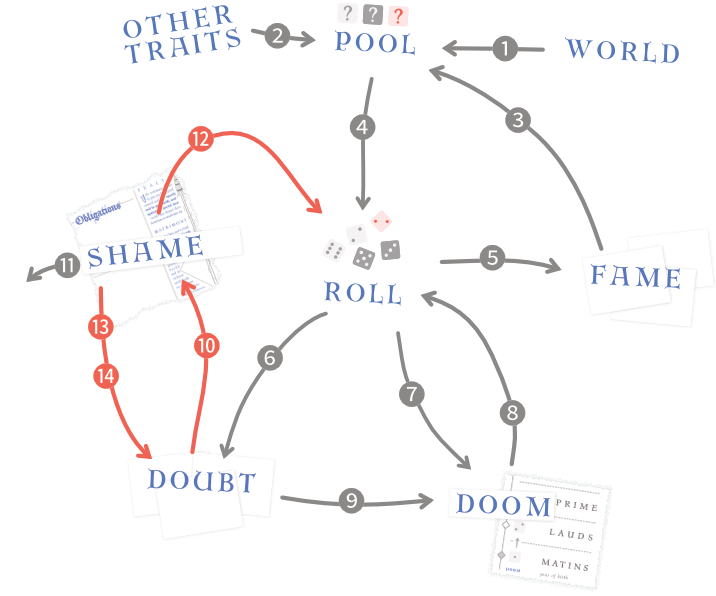
Your Dice Pool is influenced by the situation you’re in ① and various character traits ② including Advantage which can partially come from Fame ③ all together determines the Heroic and Perilous Dice in your dice pool and its Cut.
This is rolled ④ and the results can on successes create ⑤ Fame and on failures create ⑥ Doubt (and can create both), and can raise your Doom ⑦ dependent on its current state ⑧ and invoked Doubt ⑨.
Following your Obligations can ⑩ convert Doubt to Shame, which can be cleared ⑪, and which can power Inspiration ⑫ which can effectively add more dice to your roll, but can risk Turmoil ⑬ and Madness ⑭ releasing Shame back into Doubt.
Miscellaneous Other Thoughts
There’s some tricks and options I didn’t end up going with, or going with yet.
- Can the GM invoke certain Passions, even when it might not be beneficial for the player? This is somewhat how Pendragon traits work; strong traits or strong effects32.
- What if we changed the size of a die? i.e. if something let you change a d6 into a d8, you’d have more chances to get a good roll (if we presume 6+ all count as Victories)33
- Can anything go over 6 dice?
- Trophy’s main loop with “dark dice” is to allow you to reroll freely, but at the cost of adding more of these dice - making it a question of how much you’re willing to push into danger to get a success. I don’t think it’s a great fit here, but it has interesting dynamics.
- Other reroll mechanics (on failure, dynamically, as a limited resource) are common ways to make something useful (and potentially dangerous)
- Trophy also has an interesting take on helping and “weak points” for threats that play into Ruin/Doom.
- The Wildsea’s Storm & Root introduces mechanics where the dice that get Cut can be used against you34
Footnotes
-
And I mean that with a bit of foreboding. I’m a little wary of how complex this might be. ↩
-
I’ve also considered the term “Guilt” for a similar implication. I think “Shame” is a slightly better term, but definitely not settled on that yet. ↩
-
Based on social class. ↩
-
Loves, hates, fears are all good places to start. ↩
-
I believe whether or not you succeed, though that could be a lever for making it easier or harder to trigger. I think it fits that trying is what matters. ↩
-
I think including if this was the action made when you first gained the Doubt. If you were acting to pursue an Obligation it may be immediately become a Shame instead. The point is that not all actions need to be done based on Obligations, but the characters should feel a pressure to keep behaving “the right way” by society and their own internal compass. ↩
-
This makes Obligations a two-edged sword. Having more Obligations lets you pull more Doubts away from your Motifs where they’re dangerous, because it’s more likely an action will match at least one of them. However, it means you’re stuck with more Shame that won’t go away fully. ↩
-
Aside from when a Doubt triggers higher Doom - but that kind of removal from the board is what you don’t want to happen, because you don’t want Doom. That’s just compensation for suffering the Doom penalty. ↩
-
If you’re saying “this seems a pretty questionable message about how to deal with failure”, just stick with me for the rest of this post. ↩
-
Exact definitions may vary game to game because there’s slightly different rules. ↩
-
I don’t think it changes the probabilities that much - exploding dice drop off fast. It’s simpler to just have it be a single extra roll, though - and certainly easier for me to calculate the probabilities. ↩
-
So they don’t just bypass the rule (again my primary reason for this choice is because it’s simpler). ↩
-
If we allow explosions to be unbounded, it technically opens up all. You could just keep rolling 6’s from a single original die and get as many dice as you needed. But it’s vanishingly unlikely. ↩
-
On a computational note, I’ve switched at this point from exact probabilities (counting every single permutation of up to 6 dice) to Monte Carlo simulations because of how quickly the calculations rise up. I’ve already been loosely rounding things, but this introduces a bit of randomness to the calculated percentages. ↩
-
Note that we’ve cut off Cut 0 because if you have no dice to cut, rolling a 6 will already have guaranteed your result. Passions are only useful when there’s a challenge. ↩
-
Partially because of that randomness (and it’s fully possible I wrote down some fields wrong too), but exploding dice also just have some unexpected probabilities. ↩
-
a.k.a. the namesake of my Naked Lancelot Test. This man keeps getting away with it because he’s both an extremely good knight, and an extremely crazy one. ↩
-
And it’s strongest in rolls the player might otherwise not risk. Encouraging the player to both think about the character’s heart and take daring choices is already enough value. ↩
-
And as a reminder of another design concern: we want it to be simple to remember in play. ↩
-
Note this means you’re generally pushing this when inspiration helps you - because it’s giving you a high die. And you have diminishing returns as you grow in a passion - it’s harder to roll higher than the score as it goes up, and easier and easier to fall to its opposite. ↩
-
Remember the extended horseriding metaphor in the previous posts? We’re back on that again. ↩
-
Or if there’s recursive explosions, you might even be able to squeeze a full Victory out of this. ↩
-
And in this case, if you don’t run into Turmoil, you’re going to fail. But when you’re inspired by a stronger Passion you might just have a shot of getting low enough to not trigger turmoil while still getting something you want. ↩
-
Otherwise you have more control over the outcome - so you get situations like the one above where there was a 50% chance of Madness even for Passion 2, dice 4, Cut 2 (9% when you consider plenty or rolls won’t have the opportunity to be passionate, or won’t have the possibility to fail). ↩
-
If the Passion is at a 6, you can’t ever go higher. You’re so zealous it doesn’t matter if you fail. In exchange, if you need to invoke the opposite passion, it’s the riskiest (though, not by so much - so one thing this system might be encouraging is pushing for really high passions). ↩
-
1 before the change, so getting bumped up to a 2 by this dramatic event. Effectively leaning on something antithetical to you and for which you’re pretty good at suppressing. ↩
-
i.e. even if your Passion is weak, you can still risk it. ↩
-
And the amount of Cut seems to matter more than your level of skill. ↩
-
But in the same vein, when it is risky, you’re gambling with the knowledge that it matters. ↩
-
Should there be a prescribed way to do it? ↩
-
As well as the obvious downsides: riskier to do anything Perilous, more likely the GM will start pulling Motifs against you (and the other even more obvious downside: as part of this, you failed - in fact, you’ve gotten another Doubt from the Disaster in most cases), there’s a subtle one too. Because you now have no Shame bottled up, you can’t be inspired until you’ve gotten a bit of control of the Doubt again. ↩
-
Magically compelled mind effects, or rare marvels like the beauty of a once-in-a-lifetime-stunning knight or lady forcing a reaction. ↩
-
Though it’s still vulnerable to Cut. ↩
-
And so the difference between cutting 2 die from 6,6,2 and 6,2,2 might be different (it makes it so the lower the cut dice are - i.e. the worse the roll was - the harsher the effect is). ↩