In faith, lady, I’ll get mended, I’ll recover – but my shield wouldn’t have got over that blow!
First Continuation of Perceval
Reference sheets in rpgs tend to get pretty messy. Writing a lot of text, often in small boxes, in a bit of a rush, sometimes with the description being dictated to you in real time… it’s not surprising sheets can end up being pretty illegible. Then if you start erasing and rewriting on them and soon you have to replace your reference sheets for no other reason than that they no longer are easy to reference.
Start By Not Writing
Do you need long sections of text that you copy from a book onto your page? In Pathfinder and D&D the big offenders here are feats and spells, which can have several lines of special conditional logic that you need to check each time you’re using it.
All that writing also takes time and requires more time to keep rereading, especially if you need to realize you made a mistake. It often means starting up a new sheet often has a lot to fill in (tough if characters are going to die), and definitely means that transferring from one sheet to another requires a lot of copying.
But for a focused game, you might be able to print some of those lines on the page. Maybe have the player mark a box next to a piece of text when they get the effect, or to pick which option they’ve chosen when there’s a small enough set you can put them all in view1. Maybe separate sheets different characters need. Maybe you have systems with fewer edge cases and special rules. Maybe you put a Paperclip Track instead of marking the page directly.
Then: Don’t Erase
Some stuff has to be written in. Characters have names for instance, and I’m not going to print separate sheets for every possible knight’s name, or leave a “select one” set of pre-chosen names2.
We don’t want to be too dogmatic about having nothing to write - because it weakens our options to let players deepen and distinguish their character - but it’s better when these written sections are only written, never to be erased. A name rarely changes, for example.
Erase Big/Simple
But… even then some things will need to be erased. Even trying to remove all oft-erased sections is probably too hard to do. There’s a lot of benefits in games for tracks that go up and down, and characters that change in ways that can be seen and felt on the page.
But we can still try to mitigate how hard it is to erase and rewrite these areas.
For some important context that probably should have gone earlier in this article, this is the Pathfinder 1st edition character sheet like I used when I started in the hobby:
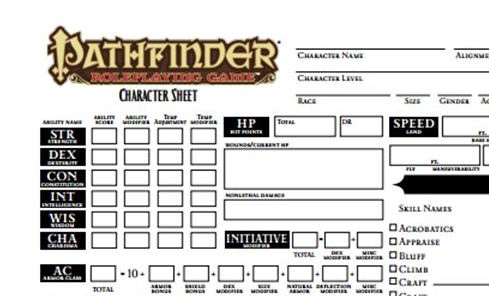
See the “Wounds/Current HP” section? That’s a section that changes multiple times in a combat - usually while doing a significant amount of mental arithmetic - where you need to be able to read the exact multi-digit number. Sometimes you even need to keep a couple numbers up there (temporary hitpoints and special spell effects - that are also all ephemeral).
Also, I tend to have overly dull pencils and weak erasers.
But the point is, that little box was the weak link of many sheets I saw. While it is, to its credit, bigger than the slower-changing attribute score or AC or total hp scores3, it wasn’t enough for me. I’d like erased text to either be:
- In open areas with a lot of room to write large enough to be legible even with erasing.
- Simple shapes - underlines, bubbles-to-fill-in4, places to put a tick mark. Things that can be visible even if they’re drawn lightly, or which can be read even with low contrast between the erased and real marks.
What About the Colors?
In another pillar I want to encourage people to use colored pencils on large areas of a page, which can also become out of date.
These are even less erasable than writing pencils and will mean replacing the sheets entirely when they expire.
…I don’t have a good solution for this. At this point, the two pillars are in conflict and we have to balance both interests.
Footnotes
-
This is what a lot of rpgs with “playbooks” seem to do. ↩
-
This works in games that are more focused than this one, or which have fewer characters and lean more into trope conventions. There’s certainly design space for a similar Arthurian game with a name selector. There’s also design space for one with a name selector where every name is Uwaine, and that would be funny. ↩
-
Though even these often can change every level up (and sometimes other times), which can be too much for a long campaign. ↩
-
Sometimes these can be a bit worse than alternatives because they encourage - maybe ingrained because of standardized testing from elementary school - a deeper filling-in. ↩