Armor is heavy, yet it is a proud burden, and a man standeth straight in it.
Mark Twain, A Connecticut Yankee in King Arthur’s Court
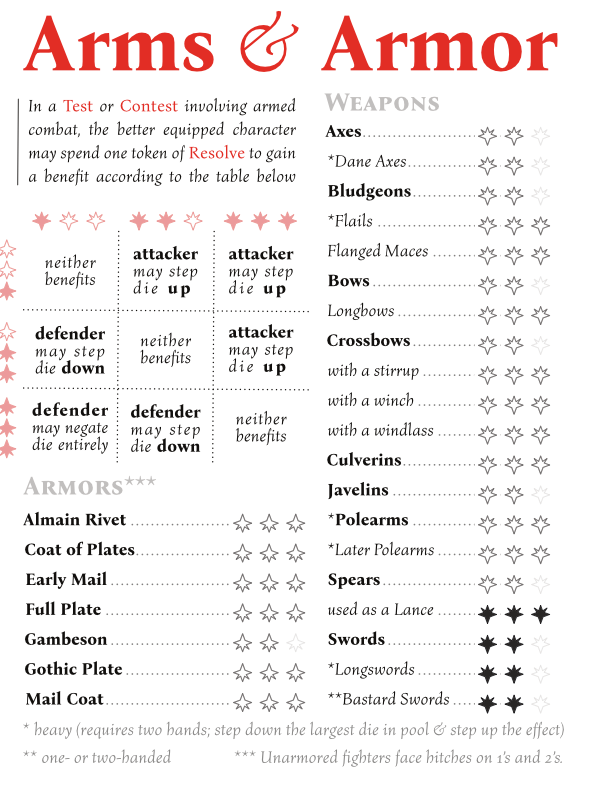
Armor is the special rule for knights—that iron skin that covers their shame from the hunger of the lance, blade and dart. Armor is a tool for battle; there may be some uses for it outside1 but its primary use is to prevent harm and allow you to attack more aggressively when in combat.
Armor on the Knight’s Sheet
All armor has the following:
- Tier - Broadly a measurement of the armor design’s quality and obsolescence2, summed up in a letter score3. This determines starting and max Quality.
- Quality - The current state of the armor. As a certain Tier of armor grows less and less cutting-edge, the max Quality it can have declines, representing newer weapons and techniques catching up, no matter how well it is maintained. But if you bang up the suit enough, it’ll drop below this maximum as well.
- Age - Largely for the same reason Attire has it. People can tell if your armor is old. Even the same design might betray its age compared to a newer suit because of stylistic bits or cosmetic wear and tear.
- Description - Armor is the face you present the world. What does it look like?
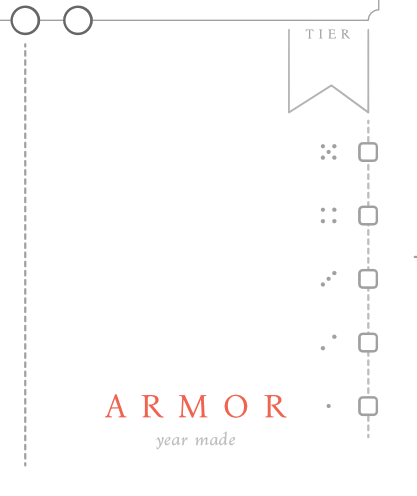
You will see each point of Quality has the face of a die next to it. This can replace the Doom Track die value when you face Doom4 caused by the kinds of things armor protects against5.
Damaging and Repairing Armor
Is something that should happen, rules WIP.
- I think degrading Armor can at least be a penalty roughly on the same par as picking up Doubt, but that would need to be used in moderation (I don’t want the GM to just be starting out each session trying to break everyone’s armor as a kind of extra bar of health).
- Repairing costs Riches/Fame and time, and can’t go over the max from the tier + current year.
Tiers
From older (and more fiddly) rules where I had split this out before, I think the rough tier list would be:
| Tier | Armors |
|---|---|
| S | ”Gothic” Plate of the last years of the campaign. |
| A | Full Plate Armor |
| B | Coat of Plates and other transitional forms as we reach the middle “knights in shining armor” era of the campaign |
| C | More advanced Mail Coats circa Arthur’s rise |
| D | Early Mail - the “premium” armor at the start of the campaign |
| F | Gambeson |
Plus or minus some later cheaper variations, like Almain Rivet.
Footnotes
-
And not just for style, which it can be useful for as well. There’s a reason it’s put next to Attire. But by other uses, I mean that a helmet does serve a bit for a hard hat even in non-combat scenarios, a coat of chainmail might help against some bites and claws (though you’re not especially trained to use it that way), etc. ↩
-
Because these are two separate axes. There are armors that were top of the line… when your father bought them - and there are armors that are brand new but aren’t the top models. ↩
-
I think this will be useful to differentiate it from so many other scores and levels here that are obviously numerical. Also, either way, I think it’s good if it counts down. We know all the tiers we want, so for player anticipation we can start at F tier armor and slowly build, so when the top grades appear they know the end is near. ↩
-
Thus making it less likely Doom triggers. In fact, with good armor you might feel pretty safe from harm. ↩
-
i.e. it won’t protect you from sadness, or disease, or the like. But if you’re in Peril because someone is swinging a big sword at you, Armor is your friend. ↩