For truly as thou sayest, a Fairy King
And Fairy Queens have built the city, son;
They came from out a sacred mountain-cleft
Toward the sunrise, each with harp in hand,
And built it to the music of their harps.
And, as thou sayest, it is enchanted, son,
For there is nothing in it as it seems
Saving the King; though some there be that hold
The King a shadow, and the city real:Alfred, Lord Tennyson, Gareth & Lynette
What is a knight without a castle—and all its other trappings; the fields of grain, the laboring peasants, the flocks of sheep or cattle, the mill, the little village church, the blacksmith, etc.?
Part of giving the players gentry characters is giving them a character fantasy of having all that property and influence mean something, especially something that can change to shape the character and especially to grow. And this is also a game focused on the progression of time, which promises that decisions about such things will matter.
So this a game that needs a way of handling Downtime. And… I don’t know exactly what that looks like.
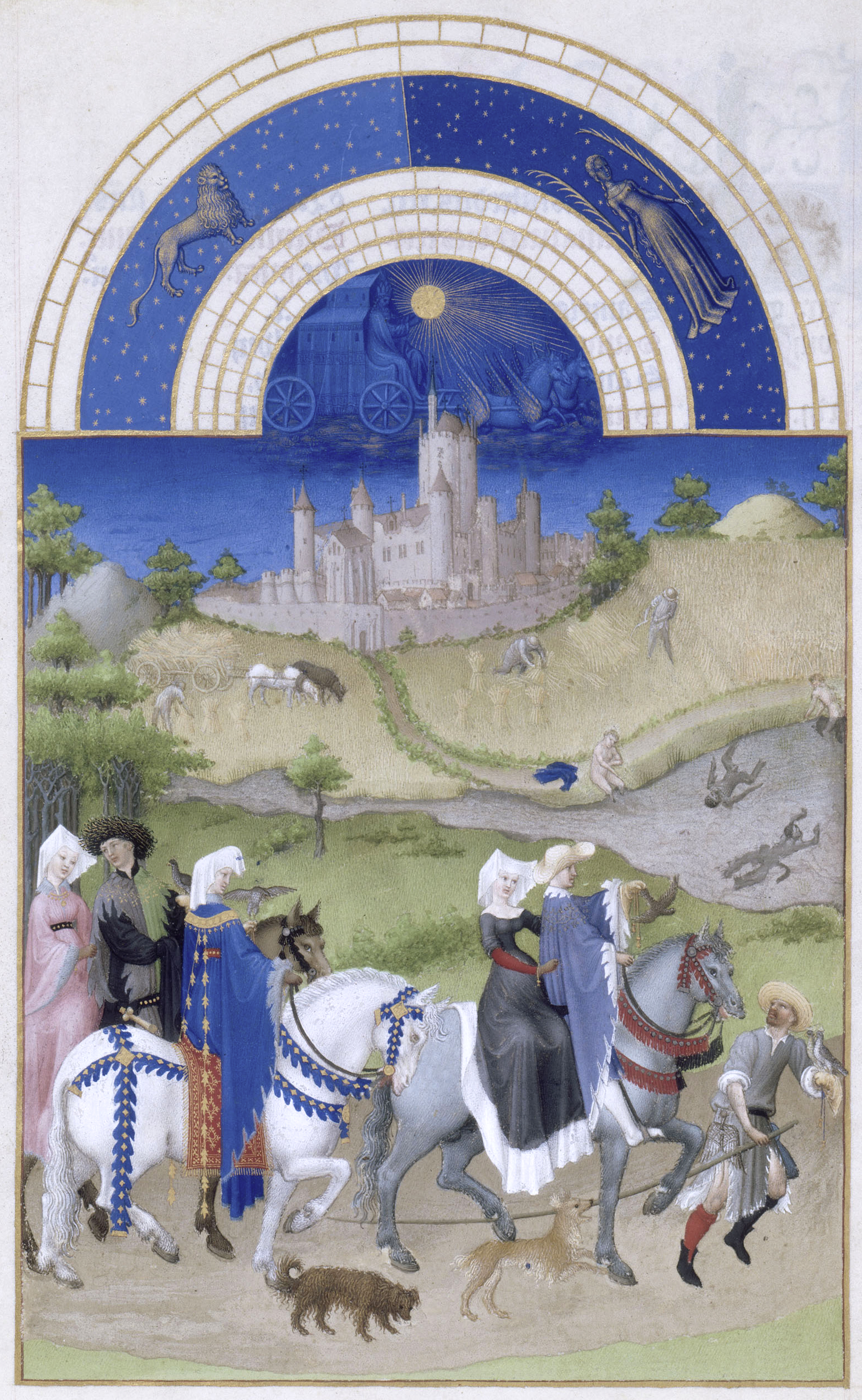
The Winter of Our Discontent
Winter is the time for rest, recuperation, and character growth. During this time, knights engage in training, amorous pursuits, and gossip. In game terms, the players perform character updating.
The Great Pendragon Campaign]
Pendragon’s 6th edition Nobles Handbook is probably going to release soon1 and bring with it this edition’s consolidation2 and guidance for downtime; especially the kind of downtime that’s often categorized as “domain play” or “realm management”3, and which a lot of players gravitating to Pendragon are interested in.
And while I’m excited to see what it has to say about downtime, it’s probably not going to resolve what downtime should look like for The Death of Arthur. Most of 6th edition is a refinement of the previous editions of Pendragon; downtime might be a place it will innovate more4, but it’s still probably going to be the same general shape.
In Pendragon, the primary downtime of the game happens during “Winter” each year5, generally between each adventure.
This is when you:
- Roll for Solo Scenarios6.
- Adjust Character Traits (Passions) and other traits for Experience gained over the year - i.e. advancing and changing the character based on events in the adventure which were heretofore marked but hadn’t made an effect.
- Check for Aging effects.
- Check Economic Circumstances for the weather and prosperity of your lands
- Roll for your Stable as companion animals might be dying of old age, etc.
- Roll for your Family to simulate an extended family - getting events for births, marriages, deaths, etc. constantly mutating a large family and the roster of other characters you might bring into play
- Training and the like to pursue some specific character upgrades
- Compute Glory and add Glory Bonuses to your character for the upcoming year
The supplements and extra rules for manors, estates, etc. typically just extend that Economic Circumstances step with an additional series of rolls and purchasing decisions - making it more granular or abstract depending on which supplement you’re using.
It is a very simulation-focused system, optionally tied into some micromanaging of budget sheets7. That can work, if the simulation is good; but making a simulation good is a hard process and I don’t have the decades of iteration Pendragon has had8.
So what are the other ideas to steal?
This Thing All Things Devours
…some DMs prefer a campaign with pauses built into it—times when adventurers do things other than go on adventures.
Dungeons and Dragons 5e, Unearthed Arcana: Downtime
Downtime is the space between adventures, where your PCs take a step back before the next chapter starts. In downtime, you can sum up the important events of a whole day with just one roll.
Pathfinder 2e: GM Core
Heroes are not always busy navigating deep caverns, fighting back the Shadow, or fleeing from dangers beyond their ability to face. Even the most eager of adventurers needs some time to rest, to gather their wits, and allow time for their hurts to mend. Whether the Player-heroes spend it in pursuit of a personal goal, or simply resting comfortably to recover their energies before setting out on the road once again, the time between adventures is called the Fellowship Phase.
The One Ring (2e)
During downtime, you take turns spending trouble and style points on beats. Beats are events and moments that fuel the story, prompt freeform roleplaying scenes, grow your characters, earn you doom and legacy and get your crew closer to its ultimate goal—becoming legendary slugblasters!
Slugblaster
As the seasons pass, both your characters and your Clan will grow and change. You can make long-term plans into motion and watch as they come to pass. You will spy on other Clans, build castles, hire vassals to protect your Daimyo, mine metals for weapons, grow crops and prepare exquisite items of fine art.
Blood and Honor
A domain can be a source of friends, faithful companions, and political entanglements, but such things cannot be allowed to smother the fun of players who desire more direct adventures. Let affairs in the domain provide reasons for adventures, so that all players may get something for their time.
Wolves of God
Downtime fulfills two purposes in the game:
- First, it’s a break for the players. During the action of the score, the PCs are always under threat, charging from obstacle to obstacle in a high-energy sequence. Downtime gives them a reprieve so they can catch their breath and relax a bit—focus on lower-energy, quieter elements of the game, as well as explore personal aspects of their characters.
- Second, the shift into a new phase of the game signals a shift in which mechanics are needed. There are special rules that are only used during the downtime phase, so they’re kept “out of the way” during the other parts of play. When we shift into downtime, we take out a different toolbox and resolve downtime on its own terms, then shift back into the more action-focused phases of the game afterwards.
Blades in the Dark SRD
My first introduction to Downtime was in the first campaign I ever played, Kingmaker, using rules meant for that Pathfinder (1e) adventure path, slowly augmented with Ultimate Campaign9 and other releases.
A lot of so called “zero-to-hero” games (which Pathfinder, and D&D in general, fall into) can struggle with pacing10. This happens even when they have theoretical “downtime” systems meant to prevent that, making it hard to get into the character fantasy of mattering to a community and being its movers and shakers or its lifelong protectors and fighter of systematic problems11.
The solution that a kitchen-sink system like Kingmaker’s Ultimate Campaign brings for this problem is to try to encourage the players to get downtime like a reward. Winning a fight with a Big Bad Evil Guy will net you 500 gold and 21 days - here’s a menu of things you can buy with that gold or with those days12.
The other trick is to keep the two systems separate, so it doesn’t matter how much adventuring you’ve done in between checking in on your investments, or how many years roll by running through the big picture before your character lands back into some new adventure1314.
The Death of Arthur’s seasonal cycle15 leans more closely to games with a strong procedural order of things, like Blades in the Dark or Slugblaster, where the downtime is part of the resolution of the adventure16.
But still - what would you do there? A broad survey of some different systems I know about.
- Many systems have the basic loop be “get some kind of resource over time and/or in adventures, spend it on special upgrades17 that you can then call upon in non-downtime play18.
- Even non-tabletop games like Crusader Kings or Mount and Blade can be seen with similar systems. Get a currency in adventure or by accumulating it from currency-accumulating improvements, and spend it on upgrades.
- Some particularly interesting sources for “what might you want to buy?” that I have sitting around and don’t otherwise get a shoutout would be Blood and Honor19, and Vaesen.
- Wolves of God, set in a similar early Medieval setting, leans into the gift-giving economy by making the focus of lordship giving gifts to maintain your followers (and maybe gain some) without running out.
- Blades in the Dark has a whole host of currencies: Heat, Reputation, Coin, etc. that different actions spend or gain from the last adventure - allowing each heist to have a nuanced result: maybe you got a lot of goods, but now need to manage a lot of new heat, and that introduces new problems. It focuses the downtime arc on resource management - and where that has gaps, new adventures arise20.
- I also don’t have Blades in the Dark: Deep Cuts, which I understand to have some innovations and optional rules there, or A|State (2nd ed).
- Trophy in its Trophy Gold mode21 has the Hearthfire options, which are a simpler but similar system. You’re typically spending gold from the last venture and extending your burden (making a bigger need for results from future ventures, which also counterweights snowballing). Some options have limited slots and many involve some cross-cutting narrative decisions (narrating some detail of it, or giving that narration to another character - fun stuff). There’s also an interesting aspect of giving a funeral[^25] in order to gain the dead character’s stuff.
- In a similar point (to the funeral), The One Ring22 lets you recount stories and write songs; things with mechanical benefits, but which also force a tie-in with the themes and especially with the history of the group.
- Slugblaster has a simple system where you can acquire negative and positive currencies from each run (not that different from Fame vs. Shame, so there may be some compatibility to consider) which are then spent on story Beats. These fill up some currencies or shift balances to the final resolution23, or can have effect on the character going into the next run or to the run itself (making it harder, more lucrative). A big piece of this system is how the Beats play into specific story arcs2425.
- Good Society is perhaps the most complex procedure, with a series of “phases” of play, none of which draw quite as hard a line between “adventure” time and “downtime”, but include evaluating reputation after scenes, playing “society as a whole” making rumors26, writing letters27, weather interludes, household gossip, etc.
- I’ve also heard some things about Stonetop - another game I don’t have - and its focus on a singular village and its evolving community that could be interesting28
The earlier semi-The Death of Arthur playtest A Wind Age, A Wolf Age also had a winter downtime mechanic29, which seemed to be enjoyable to the players. It was very tied to the dice mechanics of that iteration of the game, though, and not balanced or streamlined at all. In particular, spending an entire session each downtime period is a hard sell for players30. I’ve learned a lot from it, but I think it’s a dead end, design-wise.
In the Dead of Winter
Al that gren me graveth grene; (all the grain men bury green/unripe)
Nou hit faleweth al bydene. (now it falls early)
Jesu, help that hit be sene, (Jesus, help that this be understood)
Ant shild us from helle, (and shield us from Hell)
For Y not whider Y shal, (for we know not where life will take us)
Ne hou longe her duelle. (nor how long we will here dwell)Anonymous, Wynter wakeneth al my care (Winter wakens all my care/sorrow), 14th century
As I said at the start of this post, I don’t actually know what I want as the system for Downtime - but I have some ideas of what I want the system to do:
- It is a yearly rhythm: one adventure, then one downtime. Maybe you could skip a few years here and there, and some sessions won’t cover an entire adventure + downtime, but it’s meant to not go from adventure to adventure.
- It is probably bifurcated into a Winter and Spring phase31 - one to resolve the last adventure, and one to begin the next32 (possibly three phases in reality).
- It could use Fame and Shame from the last year as part of its process33.
- I’m interesting in having a large component which has no rolling and no collaboration required… so it can be done between sessions34.
- I want it change between eras35.
- It probably involves creating Improvements and other Estate changes, seeing Companions and other characters die unexpectedly36, and doing things that adjust house relationships. having large amounts of clearing and healing Doubt and even some degree of Doom…
- I’d like clear ways the NPC houses can feel like they’re acting and reacting without acting like every one of them is a player37.
- As for the players, I’d expect them to be fairly independent of each other, compared to some systems where the downtime is focused on shared team things38 - but at the same time expect they’d often be able to coordinate together and fairly cooperative. We’re looking for a system where they can make “plays” and compete for resources against each other39 in a fun way, but it’s also balanced if they all gang up on the NPCs.
A vague idea I drew up some prototype40 half-sheets for was vaguely that:
- For all the Fame and Doubt characters had, they’d draw cards at the end of the session.
- They’d then be able to use these to “purchase” (kind of like Slugblasters or Hearthfire) good or bad story beats. You’d need to expend the bad cards (with different options of what that meant for you) and you could use the good cards to finish up improvements or get various era-specific boons.
- There’d be a series of eras that would overlap and/or have some generic options you could always pick, which would change the “menu” of what you could spend things on, as a way of making the game change over time. Good eras might have really cheap wins and ways to burn a lot of bad cards for relatively safe failures. Bad eras would have really tempting options to burn cards for harsher drawbacks, or rewards that had more downsides, etc.
- Players would make the decisions and be able to make most of their adjustments (what skill did they want to boost, who’s the new family member, etc.) that didn’t need a lot of collaboration between sessions.
- When they came back, there’d be some resolution of points where some more randomization or opposed rolls were needed, some kind of rumor phase like Good Society’s to develop the rumors of the year (each player might bring some from what they did - to loop the rest of the party in to what their choices were, but also just things they’re interested about in the world around them - the GM brings plot foreshadowing and a soft “steer which adventures you want to pick”), and players and the GM pick the characters to play in the upcoming year.
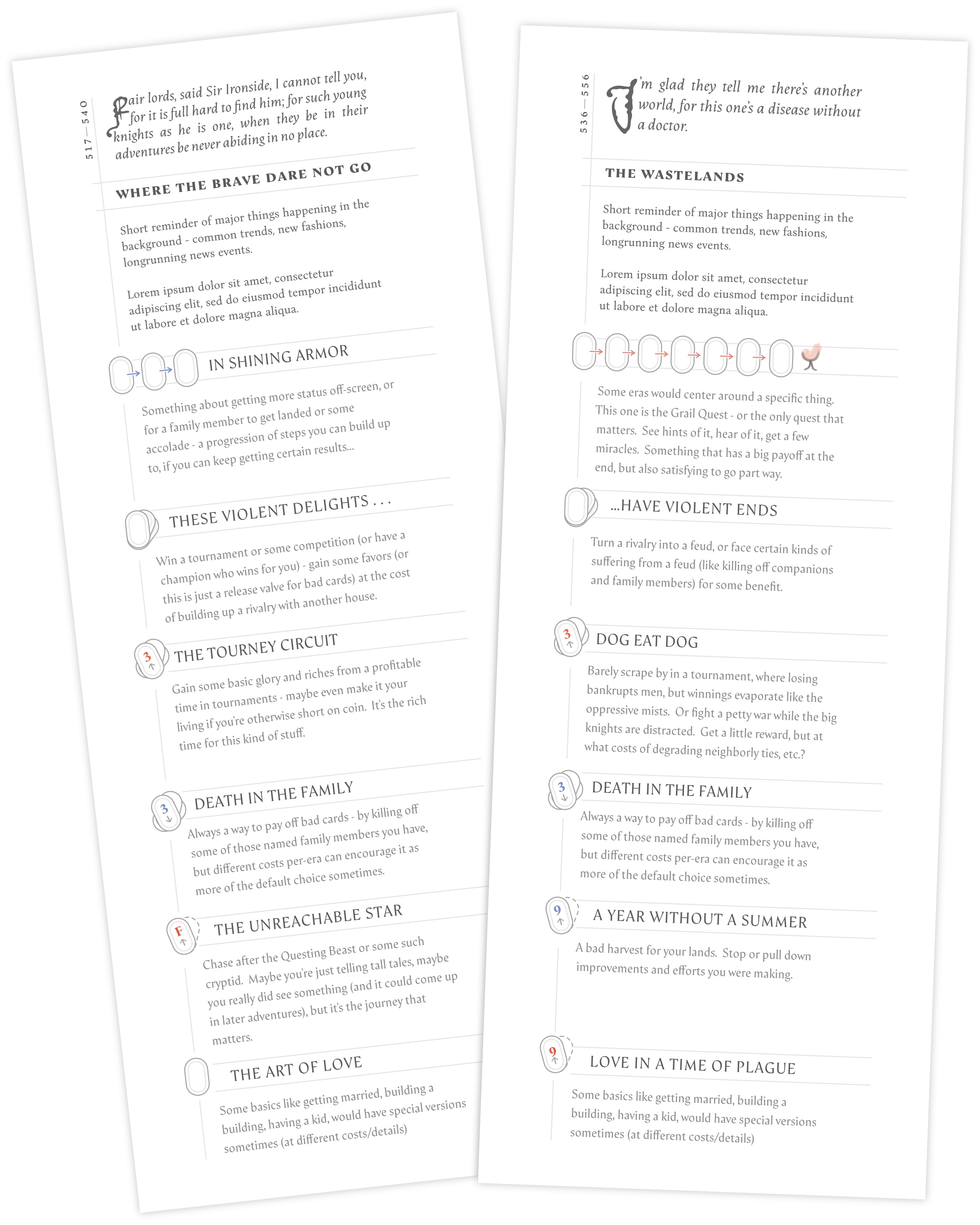
That is also a very hard to balance and create system - so it’s probably not the final goal (though I do like the menu design41), but maybe some pieces of it could last. Or maybe there’s something else out there that will inspire me.
Footnotes
-
In fact, I was slow enough writing this post that a release date was announced - it’s June 24th (this is also later than I had expected when I first wrote that line, because they, also, have been delayed). ↩
-
5th edition had Book of the Manor, Book of the Estate and Book of the Warlord in its somewhat… choppy (or at least, not very centralized and consistent) release cycle. Each took a different view of what the downtime operations of handling your land might look like; both because they were designed for different scales and because they had very different philosophies. ↩
-
The line between this kind of downtime - where characters are influencing the big picture, usually by acting as officials, kings, or other Great Men - and other kinds is… fuzzy. Many more generic rpg downtime systems (like D&D or Pathfinder, which are trying to cover a broad set of archetypes - sometimes even in the same game) have some amount of realm-building as an optional part of downtime - but that’s definitely quite different from games or campaigns that are expected to focus in on it. ↩
-
Just because there’s been a lot of different scattered ideas about this previously. ↩
-
There might be other times of rest during the campaign season of the summer, but these are not considered long enough to have the same kind of meaningful changes and developments as happens in “Winter”. It’s at least not the realm-management kind of downtime I’m mostly focused on here. ↩
-
Not that important to this topic, but something we’ll have to consider. These are short adventures meant to be resolved with a decision and roll, to build continuity of “what was that character doing?” for characters who weren’t there because the player wasn’t, or was playing a different character, etc. ↩
-
The Book of the Estate improved on The Book of the Manor on this point, and I expect 6th edition’s Noble’s Handbook to further improve on this - but… man, it’s a lot of budget management and optimization in a way that can feel like calculating your taxes. Some of that is very reasonable texture (if it can be made engaging as well), but I fear it can drag in a lot of modern associations to a player, diminishing their focus on the way it matters to the characters. Optimizing profits can end up covering over all the other concerns of a character (the classic D&D problem of adventurers wanting to camp outside the inn to save money) which I found Pendragon to awkwardly have to solve by adding even more subsystems and rules and guidelines to “block” the wrong kind of optimization. ↩
-
But can’t just steal the same simulation tables because it flows into different traits and systems in The Death of Arthur. There’s inspiration to be grabbed, but if I wanted to make tables that would just magically simulate an engaging, playable experience at all points, it would be a huge amount of work. ↩
-
Which for the most part was “lets codify the Kingmaker rules for generic use” though it also had some extensions/innovations. ↩
-
One day you’re nobodies, and the next week you’ve probably saved the world. It’s fun and exciting, but certain common plot points, even simple ones like “the enemy has time to hear rumors about you” start to fall apart when you only really came into the area a few hours ago. Gathering armies, traveling long distances, falling in love with an NPC - plots can end up feeling rushed or nonsensical if you accidentally pick ones which need time to develop and don’t just choose as a group to give it the time. ↩
-
Even if the systemic problem somehow always turns out to be something like “these merchants are charging me too much money” ↩
-
And sometimes the days can often buy you more gold. If this scales fast enough, it can enforce the character fantasy of being a shrewd businessman whose acumen matters to your goals… and make it a nightmare to balance how much gold and time you’re giving players. ↩
-
A Wind Age, A Wolf Age did this, as did “East Asian Kingmaker”. Both had involved separate systems for the passing of years and individual adventure moments, but no specific process for switching between the two. At their best this gives almost the same flexibility as just “spend downtime for downtime actions”, but at their worst it can end up feeling like you’re interrupting the cool stuff you wanted to do just to let time pass (or let characters actually act, if the cool stuff was the time-passing mode). ↩
-
Ultimate Campaign has a foot on this side of the fence too, but the days-for-gold sources of certain levels of downtime can really mess with the “it doesn’t matter” when equipment purchasing is also so integral to Pathfinder’s level balance (and when your party is using any part of the book they’re interested in, instead of just pulling in certain subsystems - we also had that problem). ↩
-
Directly from Pendragon. ↩
-
i.e. while the adventure could have multiple twists and plot points, and doesn’t have to be resolved in a single session (though it’s often easier to design for this convenient scope in these games), you can’t just go from adventure to adventure forever without having downtime. The next adventure comes because of the downtime, and the unresolved aspects of the adventure aren’t fully complete until you go into the longer time view. ↩
-
Cities in a kingdom, buildings in a city, rooms in a building, specialists in a crew, etc. - the mechanics are often very similar regardless of what the scale of the game is focused on. ↩
-
Or that help you get more upgrades later - the classic balance of buying things for current power or building an economy that will get you more resources later. ↩
-
And World of Dew as well, though it’s again a bit more urban focused. ↩
-
I don’t so much need what many games pull out of downtime: a new adventure hook (because the nature of Arthur’s Britain or feudal responsibilities can force that anyway - I don’t feel a need to make feudal responsibility a resource to manage, for instance, because I think that’s part of the buy-in characters are invested in in choosing the game). It’s a cool trick, and having resources force some new trouble or puzzle is always good… just not the way it’s oft presented. ↩
-
Which is built towards longer-term play. ↩
-
Which otherwise has some notable Pendragon inspiration in its “Fellowship Phase” downtime and its somewhat generationally focused playstyle. ↩
-
Because Slugblasters is built on a definite end of campaign. The Death of Arthur technically is as well, but it’s so far away in many cases that it’s hard to pull off a similar focus, I think. ↩
-
Including arcs that might start mixing good and bad effects (but also spending good and bad currencies). ↩
-
This is a different kind of hard-to-make for The Death of Arthur (I still am aiming for more flexibility of the house’s character over time than a single archetype easily fits, so some of the benefits of games that have very clear character directions, that can then build distinct character arcs, are difficult to handle) ↩
-
Playing as society gives players a really fun way to describe rumors and scandals against their character (or to encourage sharing points their character or family might not naturally let loose). The cycle of creating rumors (where you can make new rumors or reinforce existing ones - unreinforced rumors fade out as merely interesting thoughts, reinforced ones might be real scandals that build the next adventure) is very captivating as well. ↩
-
Good Society has a lot of systems for getting inner monologues out of other characters, including this epistolary phase. Writing letters isn’t exactly the staple for the medieval era (not that people didn’t - it’s just such a huge part of regency romance, and rarely comes up in courtly romances), but it’s a fun step and a fun kind of step: backing into a different way of looking at the characters, however that might come up in this genre. ↩
-
And overall has a lot of guidance, as I understand, in grounding characters in the town. It’s an iron-age town (earlier even than the starting point of Pendragon’s timeline, and focused on the village community instead of the gentry community of the county), but trying to derive similar lessons for our contexts may be useful. ↩
-
But only partially meant as a trial run for what The Death of Arthur’s playstyle might look like. ↩
-
It works a bit better when downtime happens “when you feel like it”, but again - The Death of Arthur as a longer campaign I think would benefit from having a more regular pacing of time where players can understand the normal rhythm and plan for the future. ↩
-
Pendragon’s Winter is in some ways already doing this, just without making it explicit. ↩
-
Ideally done at the end and beginning of sessions, respectively. Splitting out Spring lets us focus on any points that matter for the characters involved in that adventure even if those are different from the ones last year.. ↩
-
The total ones gained/lost, stored after using them on The Family Sheet, if needed (this avoids what can happen with systems that use a metacurrency as both a way to get temporary bonuses and an experience-point system, which forces players to an optimal pattern of always hoarding a certain amount and avoiding doing the cool things with them) ↩
-
i.e. it’s deterministic spending of options. This isn’t very common, and splitting off the points where these story choices get shared, riffed on, etc… without causing them to go back into loops of new decision making… is going to be tricky. There are systems that do something similar in roleplaying games, though: point buy character building, levelling up, etc. in many games does allow for this isolated decision making process. ↩
-
i.e. some things become more likely, or cheaper, or less likely/more expensive, at certain times. Times of peace push for stories of peace, maybe sometimes decadence, and romantic adventures like tournaments. Times of war bring more raiding, economic uncertainties, etc. In particular, the Grail Wastelands should be able to be felt economically. ↩
-
But without needing to track every minor character and familiy member. ↩
-
But not, as I did in A Wind Age, A Wolf Age, just eyeballing their responses every time. ↩
-
Though the overall county is a shared space for all their antics. ↩
-
A Wind Age, A Wolf Age’s downtime had the awkward feature that each player was making decisions on spending their pool of dice on different goals (as many as they’d like, if they were willing to spread the dice thin enough for it), so theoretically a player could just wait the other one to lose all their good dice and then do a hostile action. I had a loose rule of “if you’re going to fight, you have to mention that early enough they can plan for it”, but I didn’t have to use it because my party was good to each other (and usually also very cooperative). I’d like to not have to have that kind of rule, though. ↩
-
Don’t take any of the exact wording or icons as a sense of something I had pinned down - I was just riffing on vague ideas. ↩
-
But also it’s not going to be easy to list every single possibility. There’s a lot of arcs to switch between - perhaps more than Slugblaster had in its design - and trying to make it also feel different between eras puts a pretty high burden on having a wider variety than fits on half a page. ↩