Whither shall I go from thy Spirit? or whither shall I flee from thy presence?
If I ascend into heaven, thou art there: if I lie down in hell, thou art there.
Let me take the wings of the morning, and dwell in the uttermost parts of the sea:
Yet thither shall thine hand lead me, and thy right hand hold me.Psalm 139:7-10
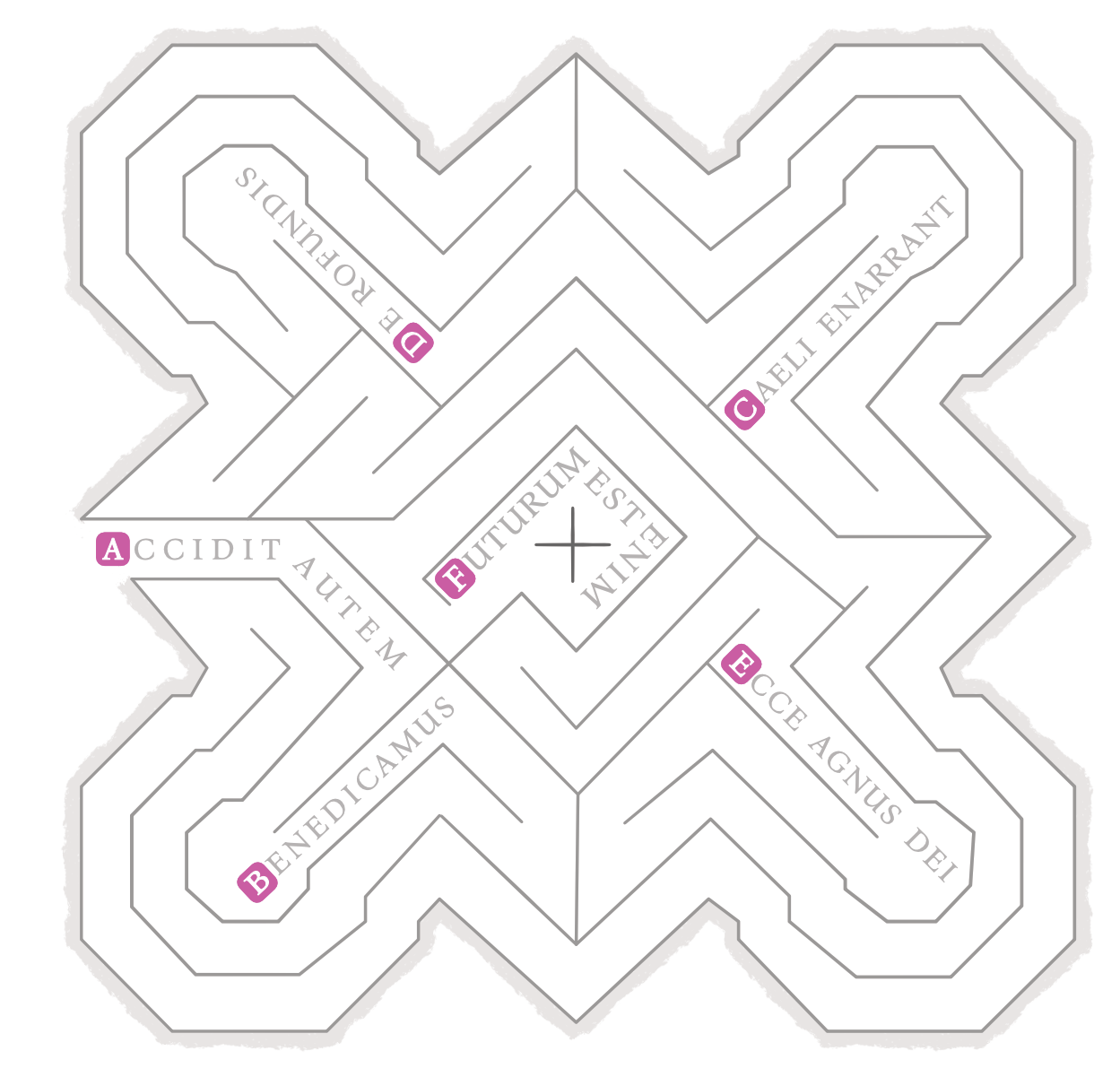
The special mechanic of the clergy is this representation of a Cathedral labyrinth1. Labyrinths are commonly thought to have been some kind of meditative practice2 where the twists and turns (but no dead ends) represent the certainty and uncertainty of life, and the center of the Labyrinth is usually some representation of God.
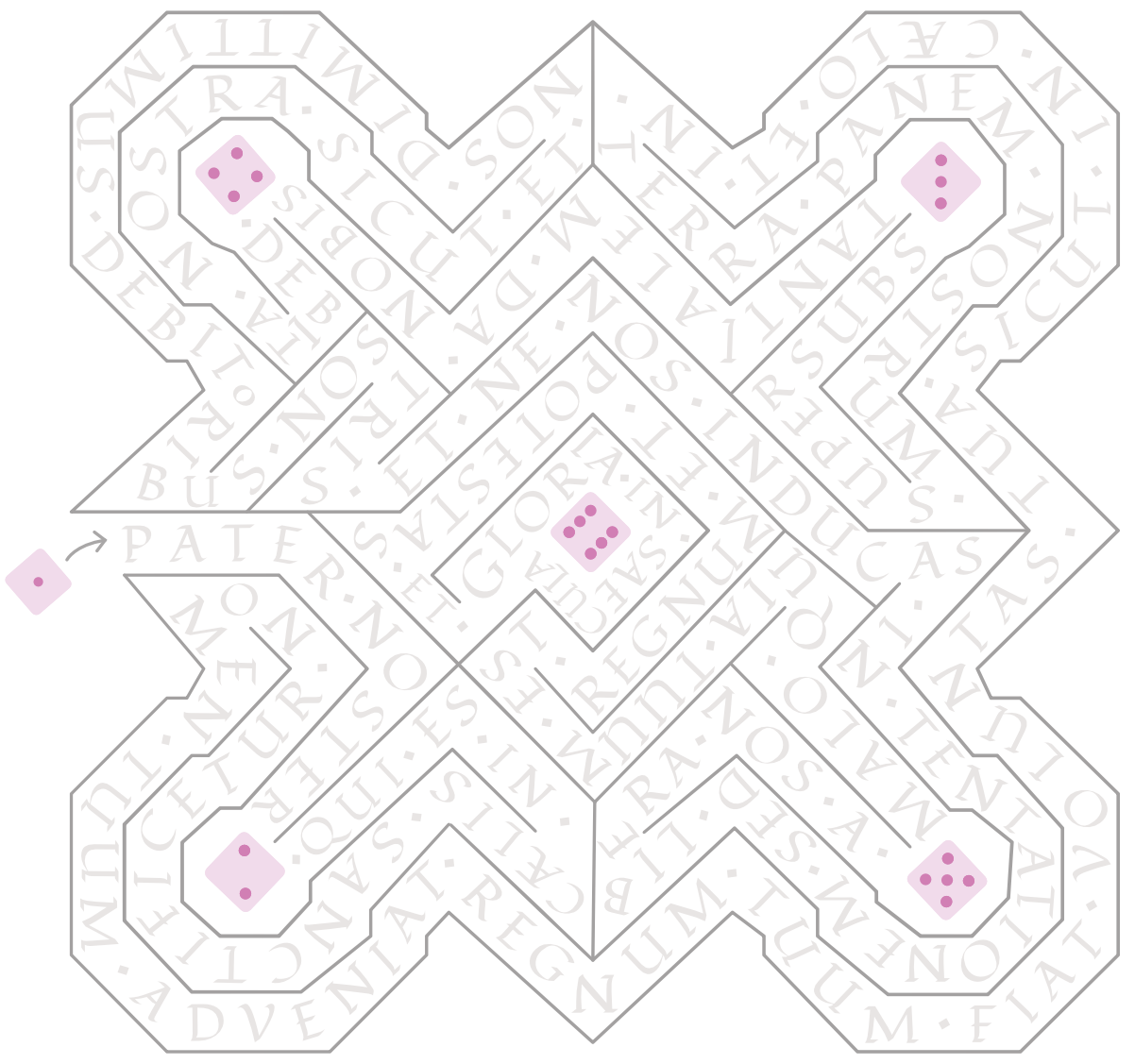
To follow this, a clerk will advance a die up through six stations of the labyrinth3 at… some trigger.
I'm not sure exactly what
Potentially this is a place to bring back Twists.
Each step along the way, the die’s face can be moved to match the die at that station, so it grows step by step.
The Labyrinth die can then be substituted in4 a roll, but without rolling it; the value of the die is whatever step it was at5. This makes the Clergy good at slowly building to some transcendent observation that puts everything together (perhaps the Columbo/Poirot style reveal, or something more mysterious).
The text of the Labyrinth is the Pater Noster67, winding its way through the twists and turns8.
Footnotes
-
Specifically modeled off of the Reims Cathedral. ↩
-
And for the fullest experience, I would recommend actually tracing through the labyrinth by sliding the die through. ↩
-
Or added to, even? ↩
-
It probably then rolls back down at least one step. ↩
-
And commonly added doxology after it, because that’s what fit in the track. ↩
-
An older variant was less detailed, with just a few incipits of popular Motifs referencing religious concepts. Both have a similar thematic tie for the clerk, creating a loose narrative (that you don’t have to try to mirror perfectly) of the ups and downs and spiritual seeking involved in getting to that 6 on the die. Also, figure it gives the clerk a little bit of a common Latin prayer as a reference point. ↩
-
In a deliberately somewhat uneven form. With parchment expensive and illustration time consuming, I love how some medieval diagrams have a “measure once, cut once” appearance to them (even though there is a whole lot of very carefully plotted out work too - I don’t want to just dismiss all work as looking like that), and wanted to capture that aesthetic. ↩