And he that told the tale in older times
Says that Sir Gareth wedded Lyonors,
But he, that told it later, says Lynette.Alfred, Lord Tennyson, Gareth and Lynette
I don’t quite follow The Great Pendragon Campaign’s timeline 1-1. First, I had the foolish1 idea to extend the timeline further2. I also rearrange some storylines to specifically cater to my tastes and I shuffle around the dates - especially to line up how I want with other events in the world3.
This also extends to the pre-campaign histories as given in the core books and/or Book of Sires. I also started here, but deviate (even more in this case4).
So if you do know the GPC and my references sometimes seem to not line up, that’s why. The bulk of the way things are pieced together is similar - it’s completely derivative of the previous work and not made up whole-cloth by me - but the exact dates slid this way and that a bit, sometimes even to the degree of scrambling the order of things slightly.
As a short reference, I made my own division of the campaign5 and pre-campaign6 - and can summarize the broad divisions here:
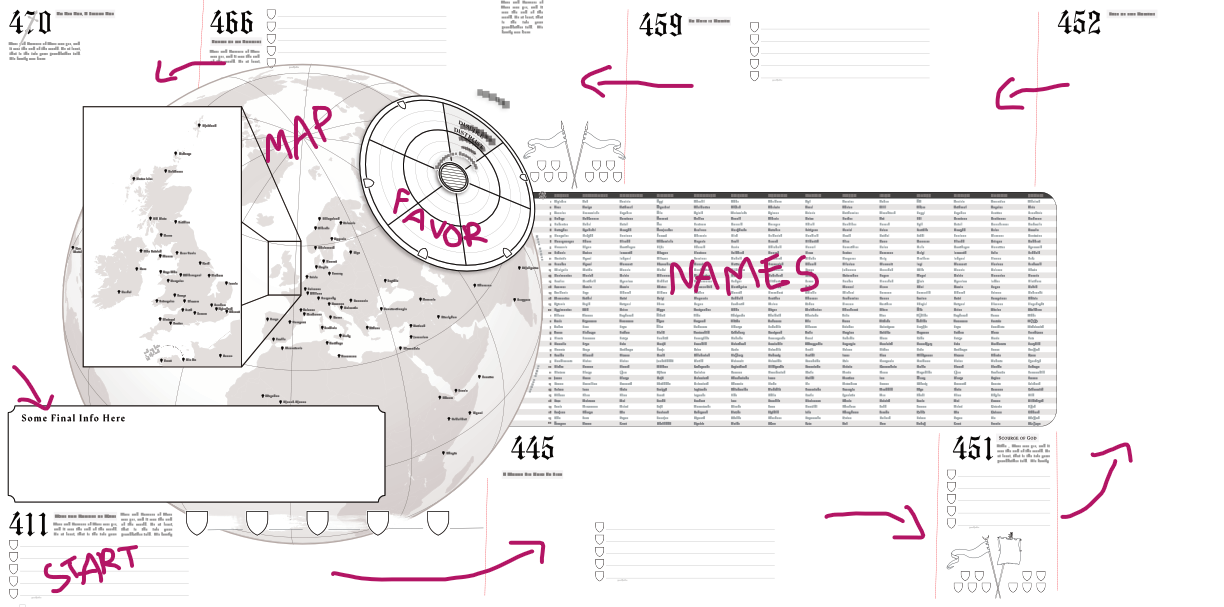
Wars and Rumors of Wars (411-444)
Honorius, having sent letters to the cities of Britain, counselling them to be watchful of their own security…
Zosimus, New History
This is the start of the pre-campaign history - which flies by7. The Roman legions leave Britain and the first of what will become knights are made as the Romano-Brythonic leadership struggles to look to their own defenses.
The only point of light is the rule of the High King Custennin - but he is slain, as is his eldest son, the short reigning King Constans. The island of Britain plunges into a doubtful future.
A World Lit Only By Fire (445-450)
Then clattered the king, battle-young:
“This is no easterly dawning, no dragon flies out there,
nor here upon this hall will these horns ever burn,
yet they shall be borne aloft, while birds bicker,
grey-hamed guldering, the woods of war warbling,
the shield shall meet its shaft. Now shines the moon
a wanderer under the welkin. Now wax the deeds of woefare,
that mean to wreak this malice against our people.
The Finnsburh Fragment
The wicked8 Vortigern becomes the High King as raids from all sides batter the island. To try to defend the lands, Vortigern invites the Saxons to settle as mercenary foederati - hoping to invite one set of wolves to scare off the others.
It maybe won’t end as well as he thinks.
Scourge of God (451)
On the Catalaunian Plains, not far from the city of Metz, which they had taken, the Huns were cut down in battle with the aid of God and defeated by general Aetius and King Theoderic, who had made a peace treaty with each other. The darkness of night interrupted the fighting. King Theoderic was laid low there and died. Almost 300,000 men are said to have fallen in that battle.
Hydatius, Chronicon
The Battle of the Catalaunian Plains. Not so much a distinct era in itself, but it’s a major battle of its era9 and thus one I want to give time for players to weave into.
Last of the Romans (452-458)
Then all the councillors, together with that proud tyrant Gurthrigern10, the British king, were so blinded, that, as a protection to their country, they sealed its doom by inviting in among them like wolves into the sheep-fold, the fierce and impious Saxons, a race hateful both to God and men, to repel the invasions of the northern nations. Nothing was ever so pernicious to our country, nothing was ever so unlucky. What palpable darkness must have enveloped their minds-darkness desperate and cruel!
Gildas, De Excidio et Conquestu Britanniae
Vortigern is playing a shell game of tribes and influence11, trying to stop the bleeding of raiding on all sides of the island while he gets more and more dependent on his Saxon “allies”. Back on the Continent, the victorious General Aetius is murdered by the paranoid Emperor Valentinian III… who is quickly murdered himself. As the western empire falls into more chaos, there’s a brief respite with the vigorous Emperor Majorian.
To Heir is Human12 (459-465)
But Vortigern did eschew giving heed unto their counsel, for he loved the Saxons above all other nations on account of his wife. Which when the Britons understood, they forthwith forsook Vortigern and with one accord raised up Vortimer his son to be their King, who accepting their counsel, at once began to drive out the barbarians everywhere, fighting against them and continually harassing them with fresh incursions and slaughter.
Geoffrey of Monmouth, Historia Regum Britanniae
The player characters are born and Vortigern’s son Vortimer launches his first rebellion against his father.
Enemy of My Enemies (466-469)
he would have governed the kingdom in a noble manner, had God permitted
William of Malmesbury, Chronicle of the Kings of England
Vortimer’s second rebellion leads to a brief respite from the Saxons, even though he’s unable to reconcile with Ambrosius and Uther, the sons of the old High King who also have supporters wanting to overthrow Vortigern.
An Axe Age, A Sword Age (470-475)
The sea drives us to the barbarians and the barbarians drive us back to the sea; thus are we tossed to and fro between two kinds of death, being either drowned or put to the sword.
Gildas, De Excidio et Conquestu Britanniae
Vortimer’s rebellion is finally crushed brutally in the Treachery of the Long Knives. Vortigern is made even more a puppet to the victorious Saxons and holes up in the Cambrian mountains as Ambrosius and Uther plan to invade.
Pendragons (476 - 494)
Fly the fire of the sons of Constantine, if you are able to do it: already they are fitting out their ships; already are they leaving the Armorican shore; already are they spreading out their sails to the wind… To your ruin did you prove a traitor to their father, and invite the Saxons into the island.
Geoffrey of Monmouth, Historia Regum Britanniae
The start of the actual campaign.
Ambrosius Aurelianus is crowned King of the Britons as his invasion kills Vortigern, Hengist and Horsa and throws the Saxons back to coastal enclaves (not fully gone, but much reduced in strength and for now willing to sue to peace).
A key conceit of my plans is to start the player characters being left behind by their parents13 to be fostered in safety back on the Continent in Armorica14. This would be a kind of “training wheels” to learn the games’ systems and concepts in a smaller scale.
Unfortunately for the Britons, despite the high hopes of Ambrosius’ rule, trouble still finds them and Ambrosius himself is slain. That’s probably about the time any of the remaining parents etc. would die off, and the player characters would be adults and arrive in Britain. Not only is the new king Uther less impressive and hoped for than his brother was, but the players are seeing it in reality vs. hearing about the exploits from afar. As the realm and king slowly fall apart, it should be easy to start introducing questions about what you do when the king isn’t all that.
The Anarchy (495-507)
HOMŌ · HOMINĪ · LUPUS · EST
man is a wolf to manLatin proverb
If failed kings were bad, the anarchy is worse - Uther’s death leads to an extended period where there’s no strong leadership and the Saxons once again are ascendent on the island.
The anarchy is a time for opportunity and uncertainty15. While it’s generally a dark time which whittles down what players got to build up before it, it also gives them more room to maneuver on what matters to them and what will be their legacy in the future periods.
The Boy King (508-516)
Blow trumpet, for the world is white with May;
Blow trumpet, the long night hath rolled away!
Blow through the living world “Let the King reign.”Alfred, Lord Tennyson, The Coming of Arthur
Arthur draws the sword from the stone and begins to usher in a new kind of kingdom. This is the first big inflection point of genre. It’s still seeped in the grimmer struggles of the last two periods - the “Dark Ages” proper - but is starting to transform into the more romantic and idealistic stories of Arthur. Chivalry maybe isn’t a fool’s game now.
Arthur crushes the opposing petty kings of the island, Briton and Saxon alike, culminating at Badon Hill. He gets married, establishes the Round Table, etc.
That Hideous Strength (517-524)
MĪLLE · VIAE · DŪCUNT · HOMINĒS · PER · SAECULA · RŌMAM
a thousand roads lead men forever to RomeAlan de Lille, Liber Parabolarum
With his local opposition out of the way, we divert to the Roman War16. Characters may follow Arthur on a long adventure against Theodoric the Great on the Continent, while at home we start to plant seeds for later stories, like that new knight Lancelot.
Pax Arthuriana (525-535)
And the blackbird calls clearest
Of sweet birds that sing,
And the dear becomes dearest
Because it is SpringJohn Masefield, The Birth of Arthur
The Peace of Arthur proper - the major wars are over, high adventure has more to do with damsels in distress, romantic adventures, the incursion of wondrous and mysterious creatures and quests, etc.
There is a hint of something souring beneath the surface - the sowing of the last few periods starting to reap - as we get into the second major genre shift: from high romance to what I call “Arthurian Gothic”, initiated in…
The Wastelands (536-553)
And this figure he added eek therto,
That if gold ruste, what shal iren do?Geoffrey Chaucer, General Prologue to the Canterbury Tales
The Late Antique Little Ice Age begins as the failings of Camelot start to crash into life in dramatic and physical ways - though also just as meaningfully in what the GPC so poetically calls:
…the invisible Wasteland, the one that inhabits men’s souls…
This is the era of the Grail Quest and also starts a major side-diversion into Scandinavia (to tie in Beowulf and Hamlet in these generally grim periods).
Candles in the Wind (554-560)
Man that is born of a woman hath but a short time to live, and is full of misery.
He cometh up, and is cut down, like a flower; he fleeth as it were a shadow…
Earth to earth. Ashes to ashes. Dust to dust.The Anglican Book of Common Prayer: The Order for the Burial of the Dead
The final period - freed from the worst of the wastelands but still deep in “Arthurian Gothic”. This is a world of distrust and treachery, where the shining armor of knights is a cynical illusion, a bad joke. Where innovation seems to have loosed terrible things that cannot be put back17 and where Arthur dies at the end.
Footnotes
-
This is something I probably would change if I had started this campaign today. I’m really intrigued by the storyline going through the rule of Ambrosius and Uther, Arthur’s predecessors, to get the full scope… but I understand the troubles people have had running these kinds of early-start campaigns, which don’t even get to Arthur until 1/3 of the way through. I think it is better to start closer, though there is some awkwardness! I don’t think you should drop the Anarchy, for instance, but narratively and gameplaywise it’s a confusing period to start in - and some of the elements that can make it very cool are cooler for having built up to it and seen the difference. ↩
-
Though, in the end, I only extend it about 5 years, because I compress some of the timelines too. ↩
-
Perhaps most egregiously, Hailey’s comet arrives at the historical date, and not several years off. I believe I understand why it gets repositioned to a more dramatic date (that’s also historically bound), but I shuffle in an alternative there. ↩
-
Just to start I have to deviate because I shift the starting year of the campaign back, and thus I shift everything else I’m following similarly. But even after that, I make bigger changes in this section, though it’s less relevant to the main campaign. ↩
-
Which has its similarities to the major “Periods” dividing up the GPC - you can probably see how each one aligns - though I shift a few sub-periods from one to the other and the starts and ends are different. This set of distinctions used to be useful for some things; in the current design, I’m not sure if it’s actually going to be used. ↩
-
Which I don’t think has such divisions in the Book of Sires. But I need it to be able to run through the backstory by period rather than year-by-year. ↩
-
The whole pre-campaign background is used for creating characters and meant to be run through in a single session. So the long years, especially on this section, are not to be so concerning.
(also, unlike in the formula for Pendragon’s character creation, it doesn’t necessarily run through year by year with rolls - so this also doesn’t dominate the precampaign the way its long set of years might suggest. In fact, each section here is split up to mark that it gets a similar chunk of focus in this session) ↩
-
Or, at least, troubled and ill-ended. You might think of it more as a tragic story ↩
-
Including for families that might come from further afield than Britain at this point in their history. There’s a lot of interesting chances to be on either side, and there’s major characters to meet and tie your story to. ↩
-
aka Vortigern ↩
-
Including a warm welcome to the south for best boy Cunedda ↩
-
A pun I have shamelessly stolen from King’s Quest III ↩
-
Or other relatives. Whoever survived the pre-campaign history. ↩
-
As there’s a large Brythonic population there that sheltered Ambrosius and Uther while Vortigern ruled in Britain, and so it’s where the invasion was launched from. ↩
-
This is why it (awkwardly) fits so well after some time for players to get their bearings and sink their teeth into the setting. It’s a disruption to the status quo. ↩
-
Per Malory’s use of it as the early centerpoint for the story that maybe starts the fall but represents a zenith of power, rather than as the final climax before a hubristic fall and death. ↩
-
There are cannons in Morte D’Arthur and, by God, there will be cannons in the game. But while this late medieval gunpowder era is already a new kind of warfare, I’m almost aiming thematically for something stronger - for a WWI vibe. This is not just the death of the Middle Ages from Malory’s view, but the modern writer’s elegy for the death of chivalry. ↩