When my lady married first, not quite seven years ago, she did it on your advice. Now her husband is dead, and she is grieved. Six feet of earth is all he has, who formerly owned all this land, and who was indeed its ornament. It is a pity he lived so short a while. A woman cannot bear a shield, nor does she know how to fight with lance. It would exalt and dignify her again if she should marry some worthy lord.
Chrétien of Troyes, Yvain1
Marriage2. This probably requires less explanation to the modern reader than Fealty or Chivalry; it’s pretty clear what it is and why it’s a big life decision and commitment for the character.
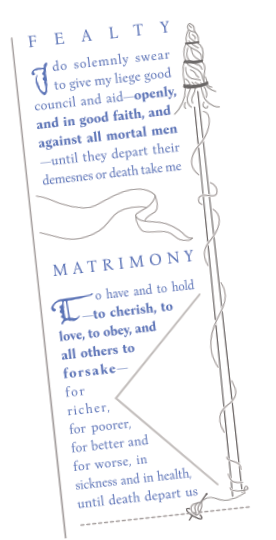
But why only Ladies?
Both Knights and Ladies get married3. But it is only automatically45 on the sheet for one side.
The reason is sexism. While a knight may be single or married, when they are away society will not badger them over this; out of sight and out of mind, if they so wish6. For a lady, it is a constant reminder, either of how the coat of arms7 is empty or filled8.
Footnotes
-
In this particular story, this speech by Lady Laudine’s seneschal is a ploy she’s set up to make sure her nobles support her marriage (and feel like they’re the ones encouraging her to take it), but it highlights the cold calculus that can be involved. ↩
-
And marriage-like relationships (what we might call common-law marriage), which also may or may not count for this, depending on cultural and family nuances. ↩
-
Many of the clergy are barred from marriage, though how strictly this is interpreted and enforced varies over the period and branches. All three social classes get involved in other relationships as well, openly or secretly, but the ones that society and their families care about is marriage for the purposes of creating kids to inherit their property. ↩
-
A knight may still fill one of their free Obligations with their marital vows or their love for their spouse - there’s nothing against this. Furthermore, a character’s spouse may be relevant to a host of other Obligations (like Fealty if there’s a relationship there), their Passions and purely tactical calculations. ↩
-
Also, any marriage should probably go in a character’s Record of Major Life Events, so it’s at least written down on the back of the sheet. But there’s a big difference between the back and front of the sheet! ↩
-
Again, this is society as a whole. Plenty of individuals may care. There will be parents who want grandkids, friends who care about the marriage or their companion’s morals, etc. ↩
-
This is specifically the marital impalement; the half that would be split to show the husband’s coat of arms (rather than covering it up in the main coat of arms). It can be filled in when a lady marries. Between this and Fealty, a lady can be decked out in a whole lot of other people’s colors; but that can be a strength as well as a weakness. ↩
-
Individuals may have other opinions, and the character may even reject the social pressure - but it’s always there regardless. Even the rebel is shaped by what she is rebelling against. ↩