You all think you know exactly how the story goes, but by God you don’t! It must be told with the utmost care and in the proper order, and you won’t hear me tell it otherwise than in the right order, each part at the proper time, as presented in my true source.
First Continuation of Perceval
It’s easy and hard to start telling a story in the middle. It’s hard because by this point it’s easy to forget what is only obvious because I’ve been sitting on that context of what came before1. Even the archaeology for this post has brought up things I barely remembered.
But it’s easy because if I wasn’t writing it now, I’d have to have written it earlier.
I’ve tinkered with this game since at least 2018. I didn’t write a lot down early on, or I’d write it down in ephemeral places and overwrite my old notes all the time. I never wrote down my thoughts for other people like this.
The history isn’t all necessary to understand the current design, but it’s interesting and it might help fill in the gaps where I haven’t written the replacement for an old assumption yet.
2018 - Forged When the World Was Young
In Camelot, King Mordred warms himself every day in front of a roaring fire stoked by the shattered pieces of the Round Table.
The Great Pendragon Campaign (5.2)
Reading that line was the moment that Pendragon captured my interest. I hadn’t actually bought the Great Pendragon Campaign to play Pendragon. I had bought it to provide inspiration for running The Darkening of Mirkwood for The One Ring2.
At this point I had been playing tabletop roleplaying games for several years, including one long and especially involved campaign of the Pathfinder (first edition) adventure path Kingmaker, and I often tinkered with rules, made new settings, and pulled pieces from one game to another.
So it may have been shocking to my rpg friend group when I described the book to them and said:
Guys, I want to play this campaign straight. I want to use the system, I want to use the setting and the adventures just as laid out in the book.
Now, I didn’t technically stick to that for very long. As I read more, read up on discussions online, etc. - I found small things to tweak.
How do you make APP matter? Is such-and-such a kinda mediocre adventure, or off the tone of the years around it? How do you integrate in this cool splatbook from the older edition? Which economy system are you using - Book of the Manor?, Book of the Estate?
But these are all tweaks. They’re homerules, which are commonplace in all games. I don’t think Pendragon as a system or the campaign is in particular need of these, as games go - but it’s not immune and there’s a lot of good advice online you might want to try if you play it3.
But eventually, as the group I was playing with dispersed and I had a lot of time to tinker rather than play, just patching a system started to not make sense. You can patch and patch, and then try to tweak the systems to rebalance them to counter the issues your patches introduced, forever - but some deep changes are easier to handle with a new system4.
And I had just the right system to use as a base - to build my new Pendragon on top of …
2020 - In Space, No One Can Hear You… Joust?
We commit these bodies to the void with a glad heart. For within each seed, there is the promise of a flower. And within each death, no matter how small, there’s always a new life.
Alien 3 (1992)
Okay, hear me out.
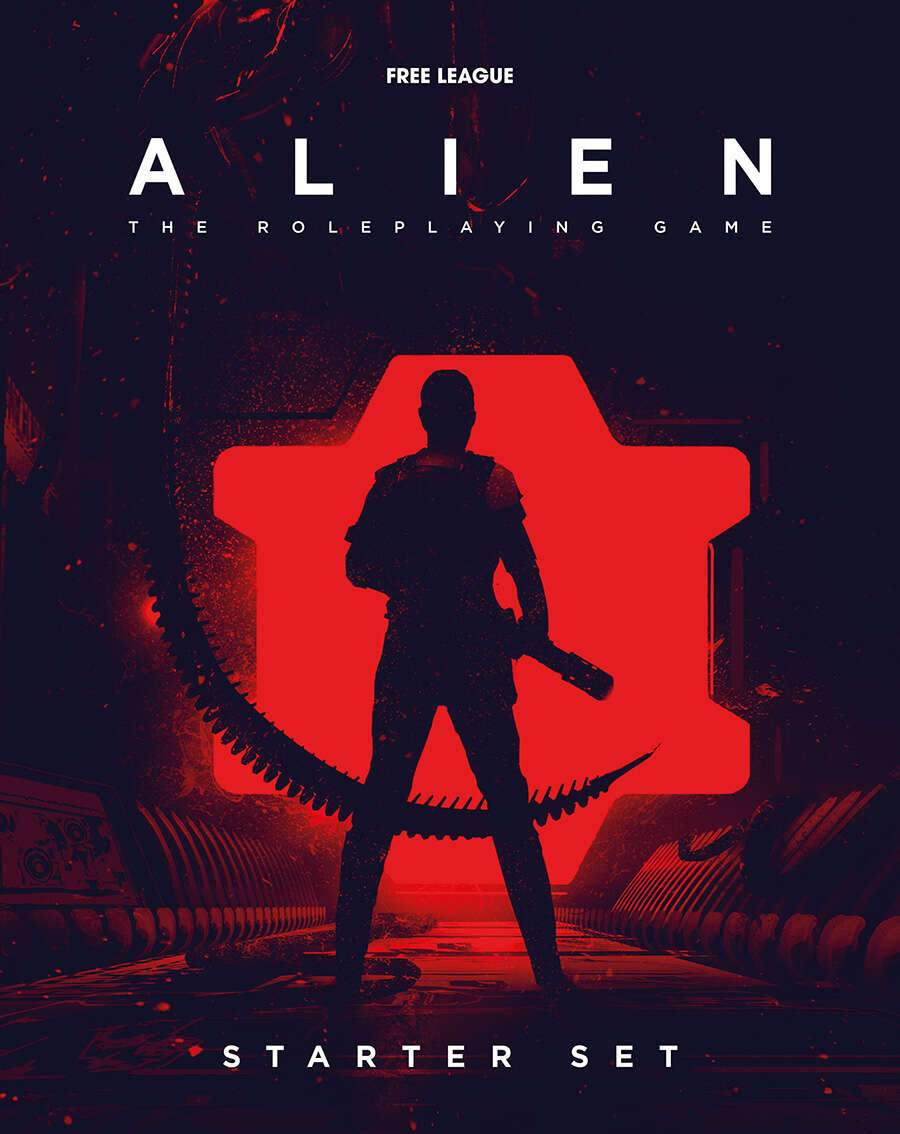
Alien: The Roleplaying Game, published by Free League Publishing in 20195, follows an implementation of the Year Zero Engine , a game system originally made for Mutant: Year Zero but tweaked for a variety of different settings.
It’s a fairly straightforward, malleable system6 - with a shared generic rule set that each game tweaks a little bit to bend it to their genre.
Alien’s killer gimmick is Stress.
The core game mechanic uses a pool of d6 dice where you get more dice for more skills or tools or so on, and you want to roll a 6 or multiple 6’s - fairly typical to the Year Zero Engine. If you fail, you can reroll to “push your luck” - which is again typical in this family of games but also usually the place each puts their twist on the rules.
In Alien, when you push the roll you add a special Stress die to your pool and to all other pools you’ll make later on (aka your pool starts out mostly about the skills and stuff, but as you gain stress that pile starts to become a bigger and bigger part of what you’re rolling). This means as you get more stressed, you get more and more dice to roll - you’re on edge, ready for action. But each roll of a Stress die can fail terribly if you roll a 1 - so the longer you have that stress and the more you’re piling on - the greater your risk7.
It’s a slick system, very atmospheric for the growing horror and the competent and explosive but dangerous action that the Alien series has.
But it could also represent passion - the heart of the knight driving them on despite the failings of the body, the growing tension of the quest tearing down the person over time.
I started to deconstruct Pendragon and its splatbooks for the pieces I wanted to set up first, and started sticking them on pages8 and trying to get the probabilities to line up.
I still wanted something very Pendragon-esque in process (there’s still even some d20 based rules, floating right next to the d6 dice pool parts) - and Stress couldn’t be king; there was actually being hurt, old age, experience… a lot of different factors I wanted to interplay and have their own thing to say9.
So I had a Stress system from Alien in one corner, a couple d20 systems from Pendragon (or at least very similar to its use - streamlined or tweaked for style, but effectively using the same mechanics) stapled onto another corner, and a big empty hole in the middle I vaguely figured I’d be able to fill in to tie it all together.
As I’m easily distracted, so the more I saw this big hole the more I just ignored it and tacked on more subsystems and minigames to put on top of… whatever filled that hole.
I also picked up Affinity Publisher - which made iterating on character sheet designs a lot easier, though also gave me yet another distraction to perfect instead of working on core systems - but this meant my former sheets mostly fell to the wayside10.
2021 - Dorsolateral Prefrontal Cortex
I live by my reputation and the honor that burdens my existence. Stand fast, foe! We shall let fate and our martial skills determine your destiny!
Cortex Prime (fantasy milestone example)
I think I had seen the Kickstarter for Cortex Prime back in 2017, but had paid it little heed11. I don’t actually remember what thread or hook I stumbled across four years later, with the system in uncertain times - but this time it piqued my interest.
I think part of this was that I was realizing that the core of my Alien based hack was refusing to fit together. The dice system was more and more complex while still not feeling like a satisfying answer to the tests - like the Naked Lancelot Test - I threw its way.
The subsystems and side-rules, meanwhile, were growing like weeds with no direction. It was clear they weren’t going to fit together even if the core worked out - they had no cohesive vision.
I needed a complete refresh, and Cortex offered an option to build from. I had looked into some other generic rpgs or “toolkit” rpgs before. I’d never seen the appeal in GURPS. I had liked Fate in many of its concepts, but the core dice system didn’t really delight me and I couldn’t match the levels of granularity in subsystems that I had been looking for12. Genesys seemed complex and I just never got the book.
Cortex, though, clicked. Step dice was just about the right degree of granularity for each component I cared about13 and worked well on the character sheet, the various dice tricks gave me a lot of things to tool around and promised a way for players to get really unique feeling characters.
And so we get to the first sheet I still have a copy of - May 2021:
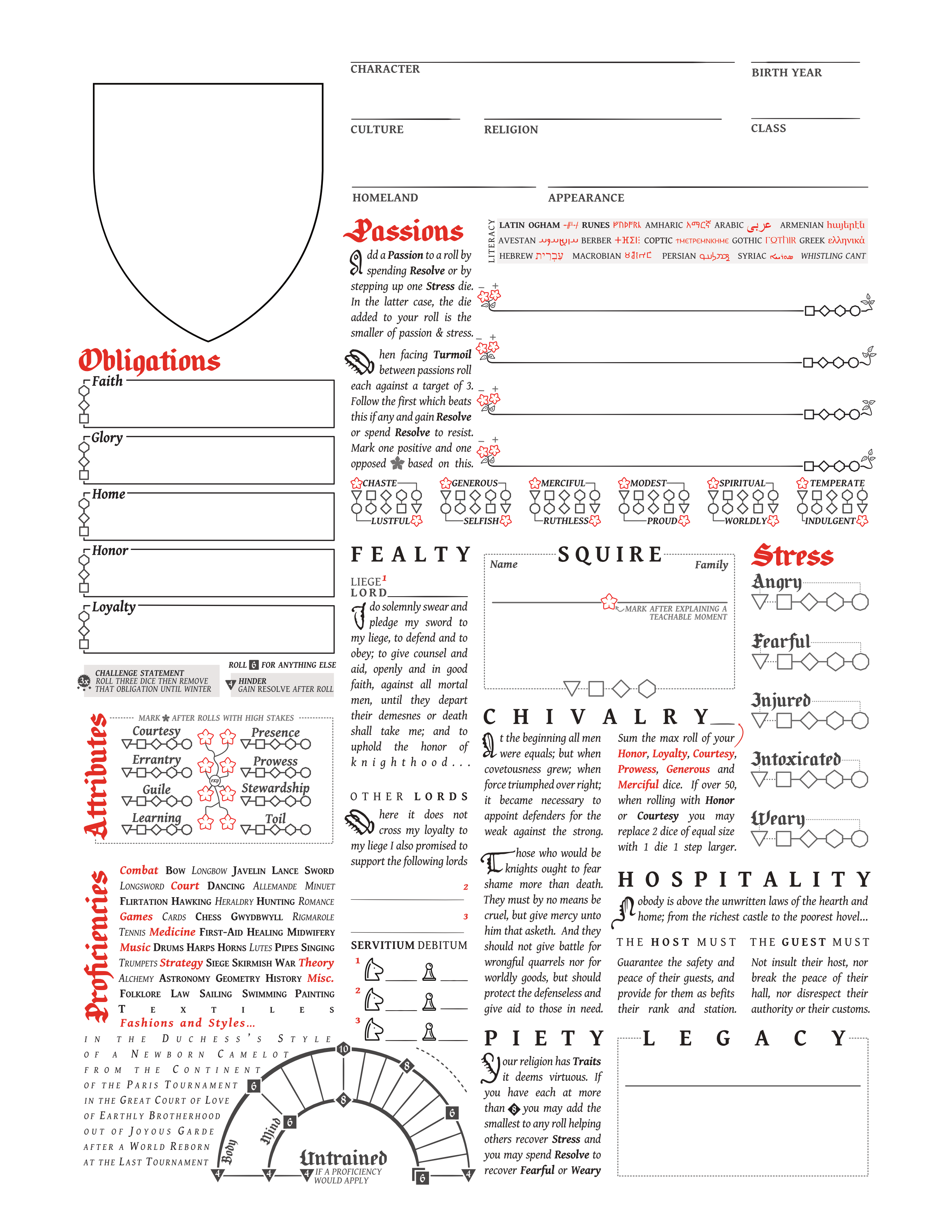
Several of these components had already been designed for the Alien implementation and were just ported over to the new system. There were several new concepts - separate types of Stress, a freeform Legacy field, Obligations - and an implementation of Passions that mostly used the same dice as the rest of the rules.
The changes also had really reshuffled the sheet round - giving me a lot of room for the large blocks of text.
I should start with those as they’re a rather atypical part of a character sheet. I wanted to ground the players in the main assumptions taught to them from childhood. You shouldn’t forget your liege - the idealized goal of your class in society - your faith - the rules of hospitality - your family legacy14.
As standard Cortex, there’s three main trait sets - Obligations, Attributes (which maintains a lean towards the Pendragon style of leveling up skills) and Proficiencies (which have a shape that persisted in the character sheet for a long time - a little hidden Rota Fortunae motif).
Finally, there was Stress and Passions - which, still remembering some of the interesting ties between Stress and Passions in the previous designs, I tied to how high your Stress levels were.
I had also landed on a 3-way sheet split. I don’t remember how much of that came in during the Alien designs and how much was new to this one, but while you had a character sheet you’d also have one for your House:
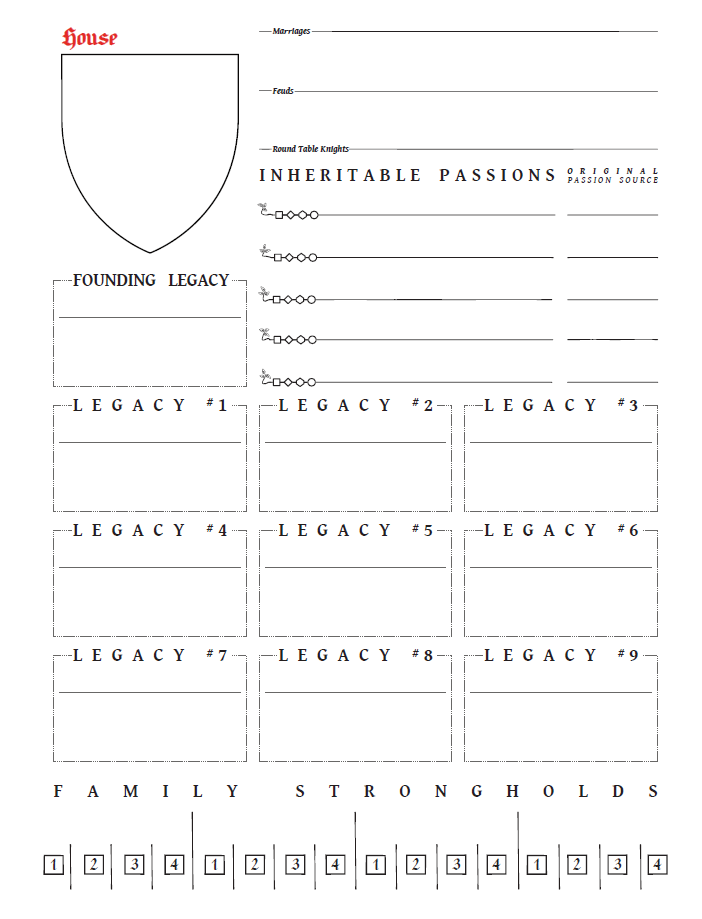
and one for your estate or other goods (which also usually passed between characters) - (front):
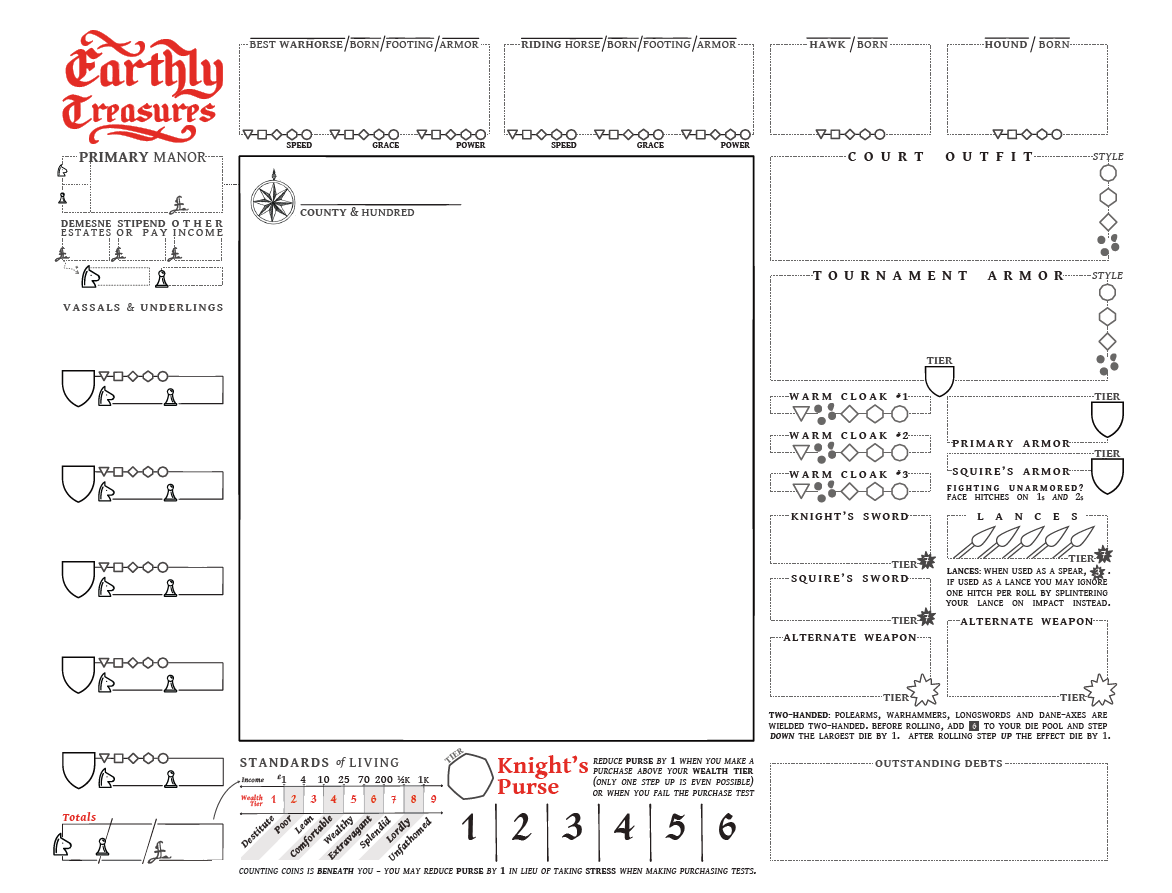 (back):15
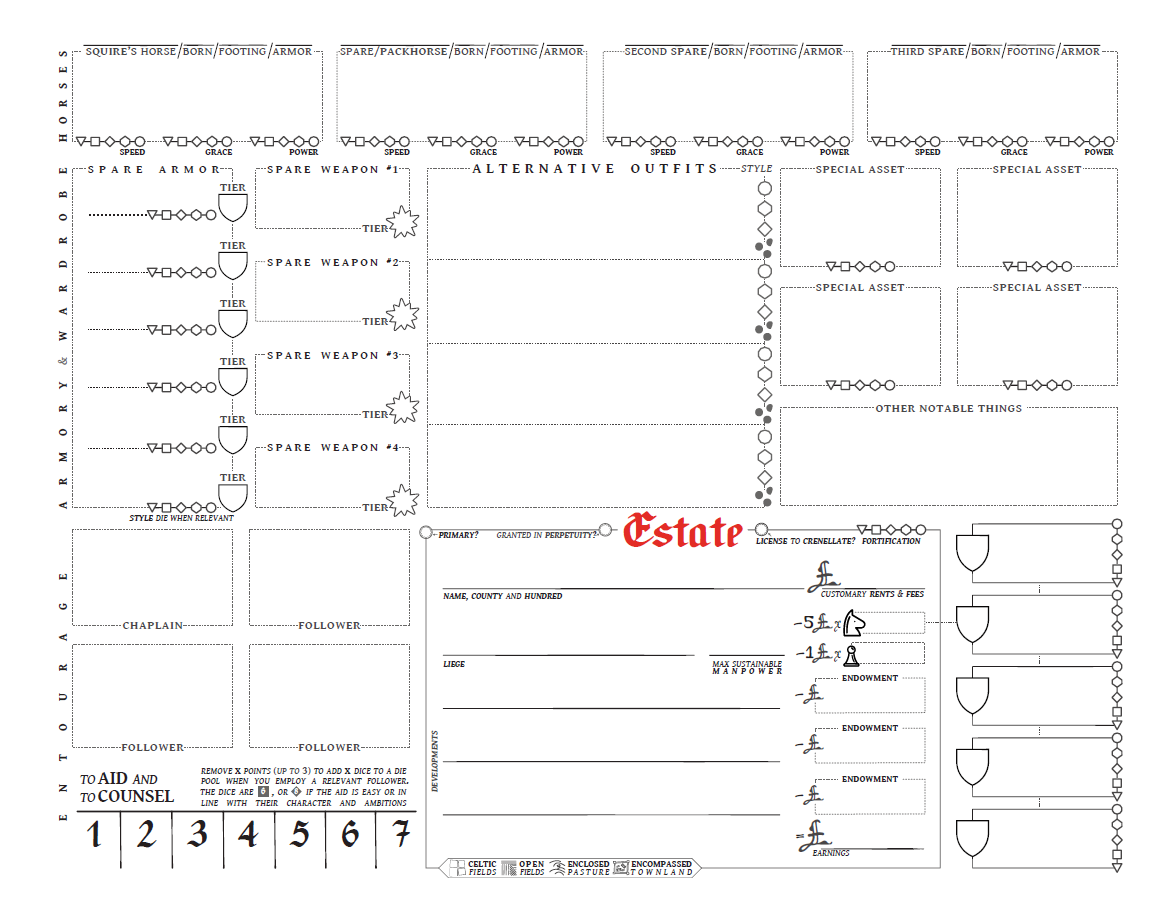
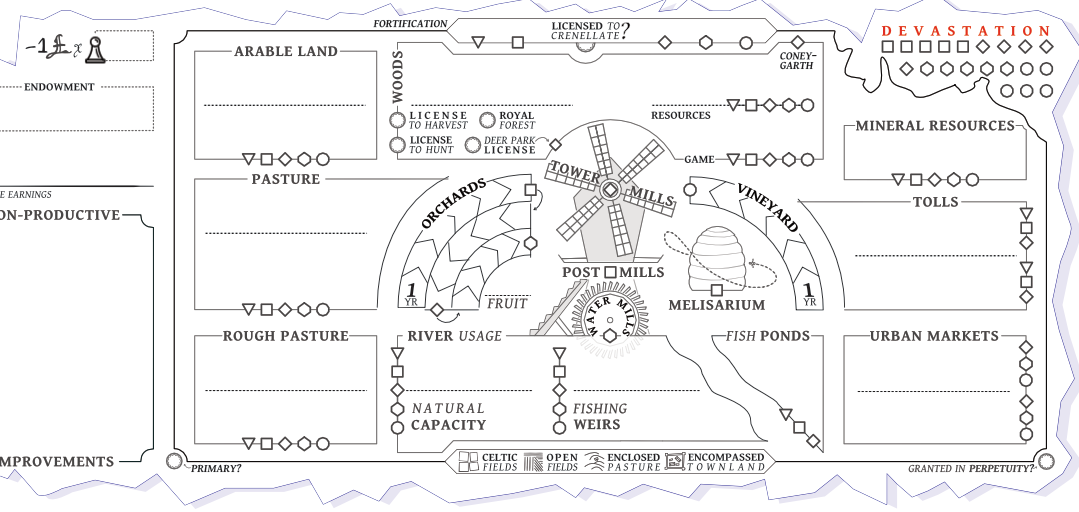
I also have this undated fragment of a page - it may have been from before the above (as a just-after-switching-from-Alien-design), or more likely a middle evolution afterwards. It’s certainly a lot more skeuomorphic16:
Adrift
From time to time, she would wonder whether the shadows were fleeting because they were only shadows of reality, or if the world of reality itself were composed of nothing but shadows. If that world is never viewed directly, it is impossible to decide between shadows and reality.
Natsume Sōseki,Kairo-kō
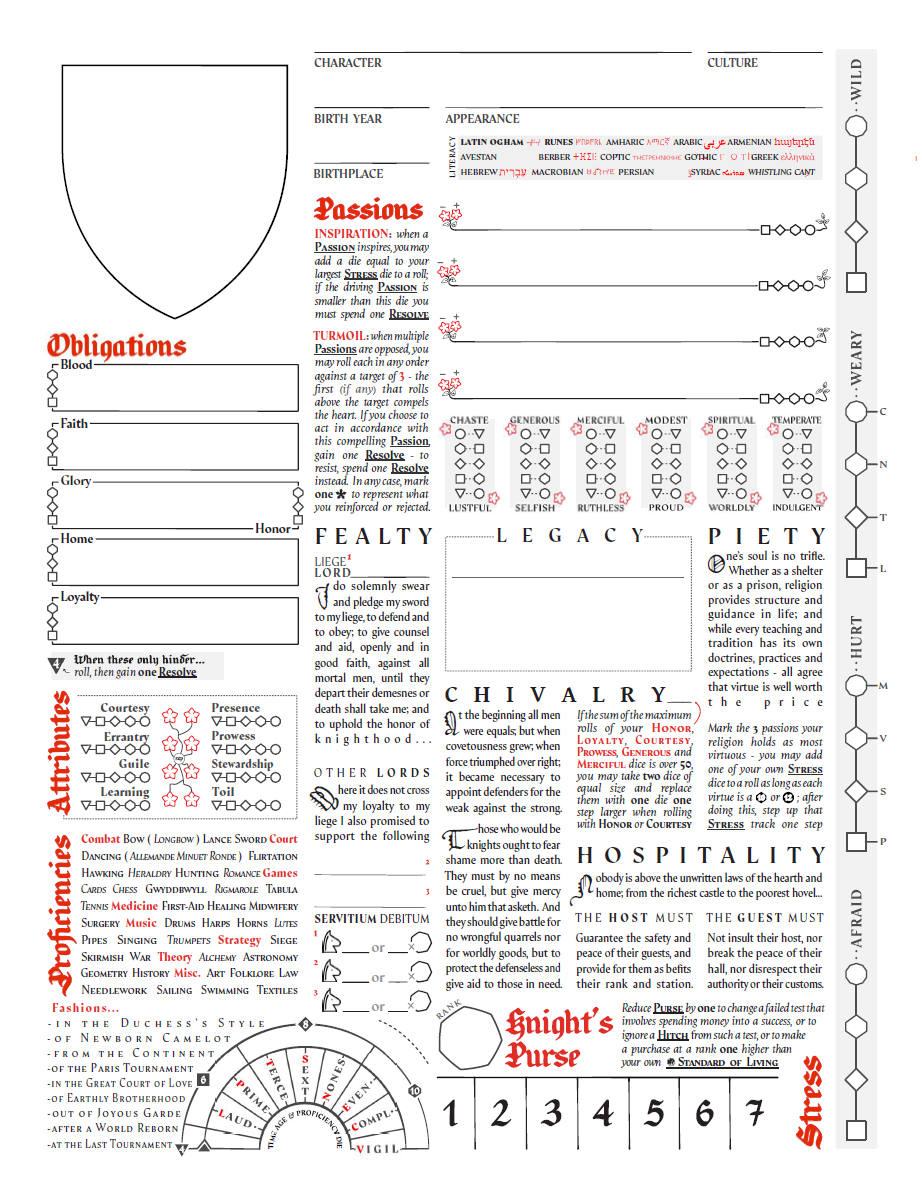
The next few years didn’t see as major of renovations. In 2022, the sheets are fairly recognizable from before - with minor adjustments to layout and improvements in my art skills. The biggest difference being that Purse has moved to an individual sheet level as the Squire moves into a separate card.
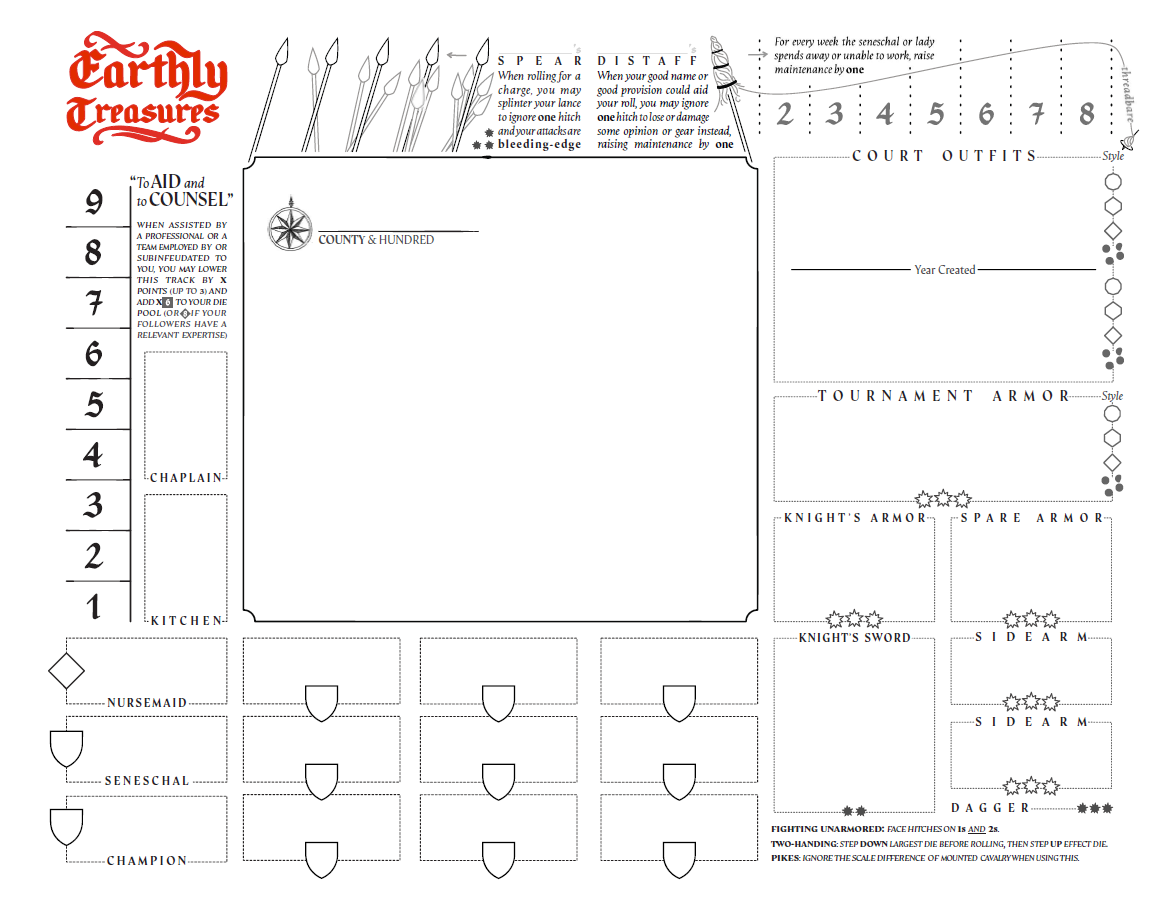
 Treasures has also changed17, but again mostly in style rather than substance - and in a few new rules and details I had made without any real plans of how they’d actually fit in.
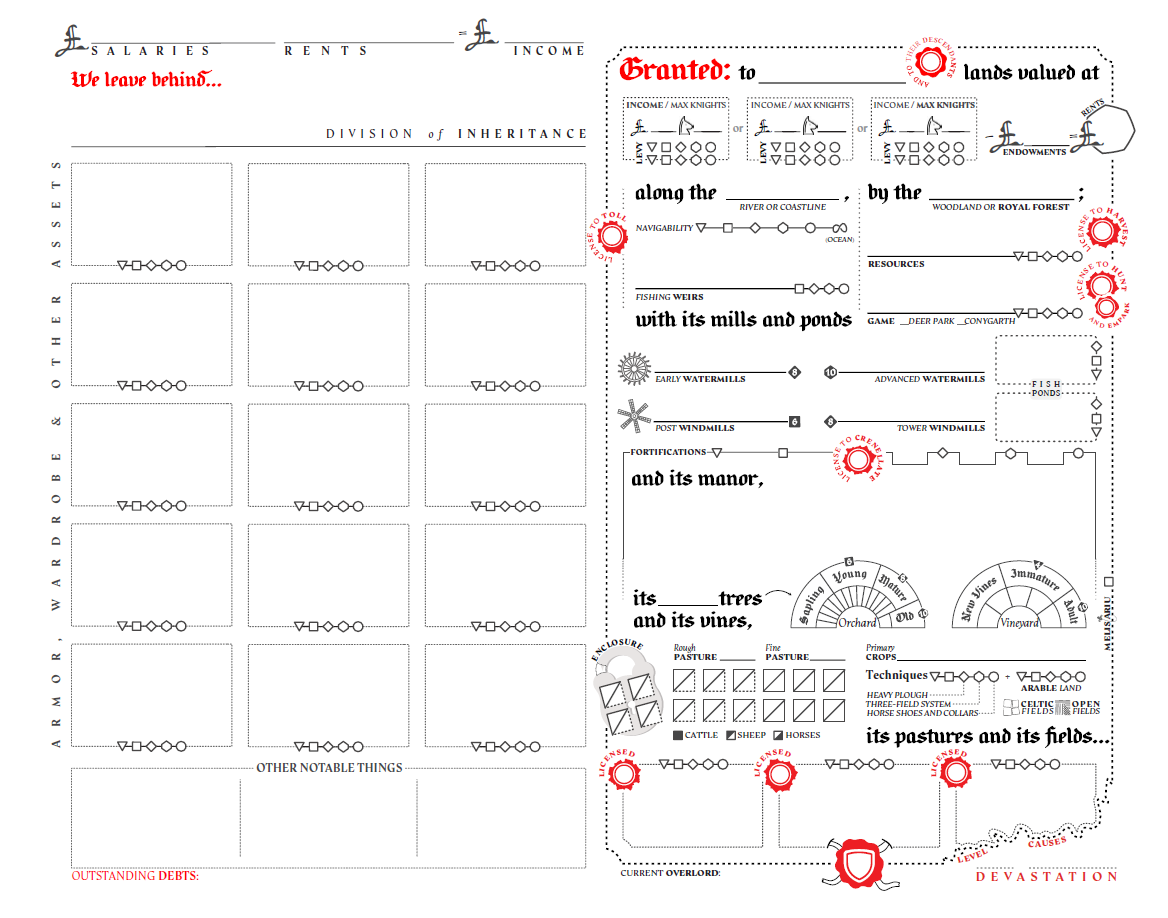 A few miscellaneous points:
- The core question of an estate’s management, to me, has been guns or butter - how much are you balancing different expenses? This design gets pretty blunt about that - instead of having exact accounting of what you spend and cut, you’d get three options for your estate: “balanced”, “poorer but military focused”, or “growth heavy but a soft target”
- Technological progress and societal change was another key to the estate.
- Meanwhile, having an estate itself is visible on both sides of the sheet - including a big open place (a place to draw a map) on the front. Not all knights would have one, and I wanted it to feel “like a big hole in the heart that only land can satisfy” if that was empty.
- I really was interested in characters breaking their spears and potentially running out - because I was listening to Morte D’Arthur and damn, those knights be splintering spears all the time.18
- A lot of decisions were made based on where empty space was. For example, there’s an empty block after I describe the rules for Aid & Council… so you get some room to describe a few specific parts19.
2024’s sees similarly little change - though I had built out variants for different eras of knights as sensibilities changed, such as this one for knights getting really obsessed in the Grail era:
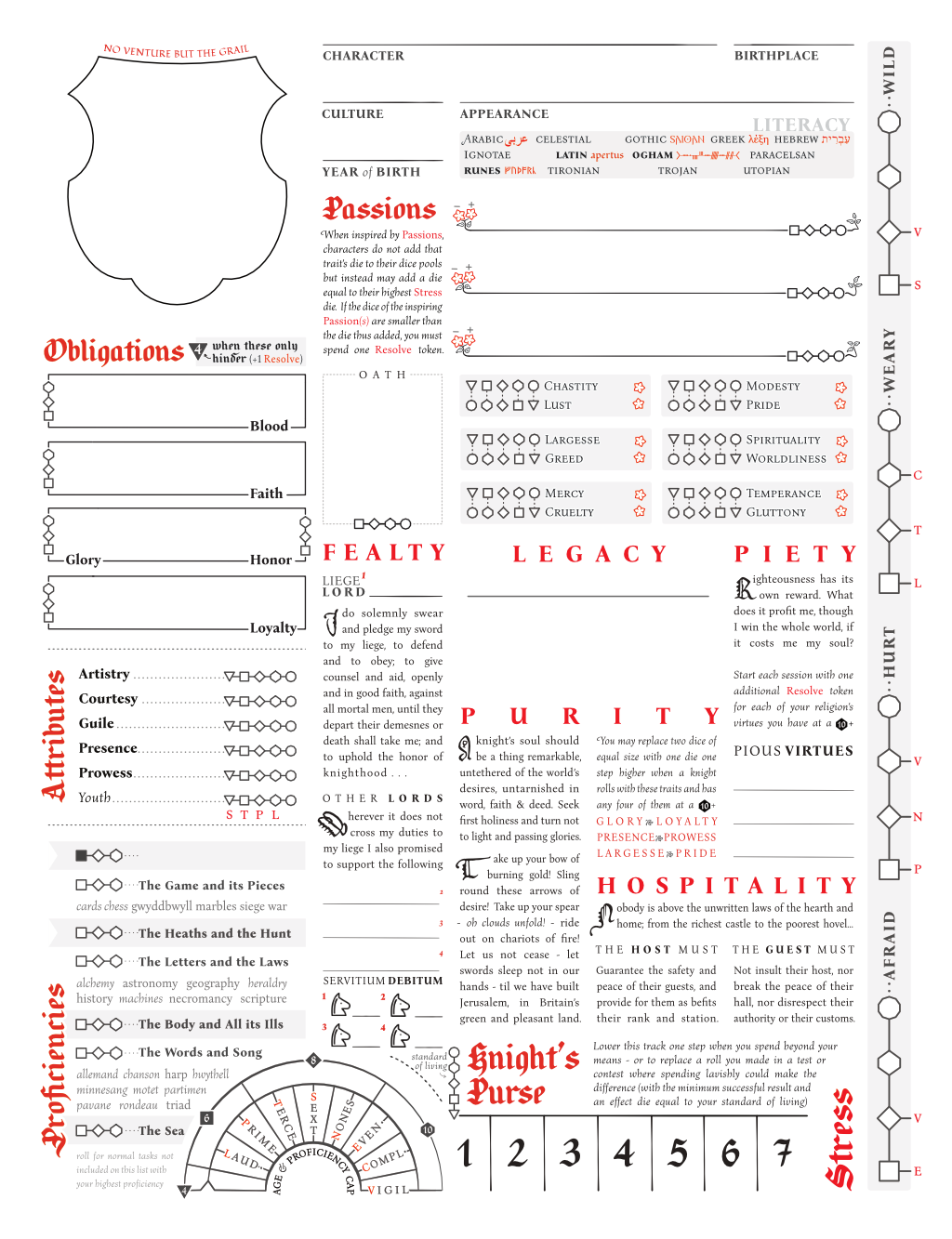 Like with the previous era, the retooling and theory-crafted subsystems were devouring the design.
2024 - Shields will be Shattered
During such times people become soft and pious. They forget what is here on earth, and instead they seek something beyond this life and beyond death. I cannot do that … I love the life here on this earth with its fierce hatreds and enduring love, with its violent anger and silent pride.
Felix Dahn, Ein Kampf um Rom
You should playtest your games. Ideally way before they look like all the above designs, but late’s better than never.
In 2024 I had a new group form, and I pitched them several games, including trying out a simplified version of my tinkered with system - which is what they picked. Not in the whole Great Pendragon Campaign - but a separate setting: Heroic Age Scandinavia20.
That immediately gave me a new puzzle: how do I make this into a simplified version? Each player needs 3 separate sheets, minus all the squires, horses, etc. - and each page is covered with text and rules I haven’t fully finished! How do I make that one sheet that we can actually use?
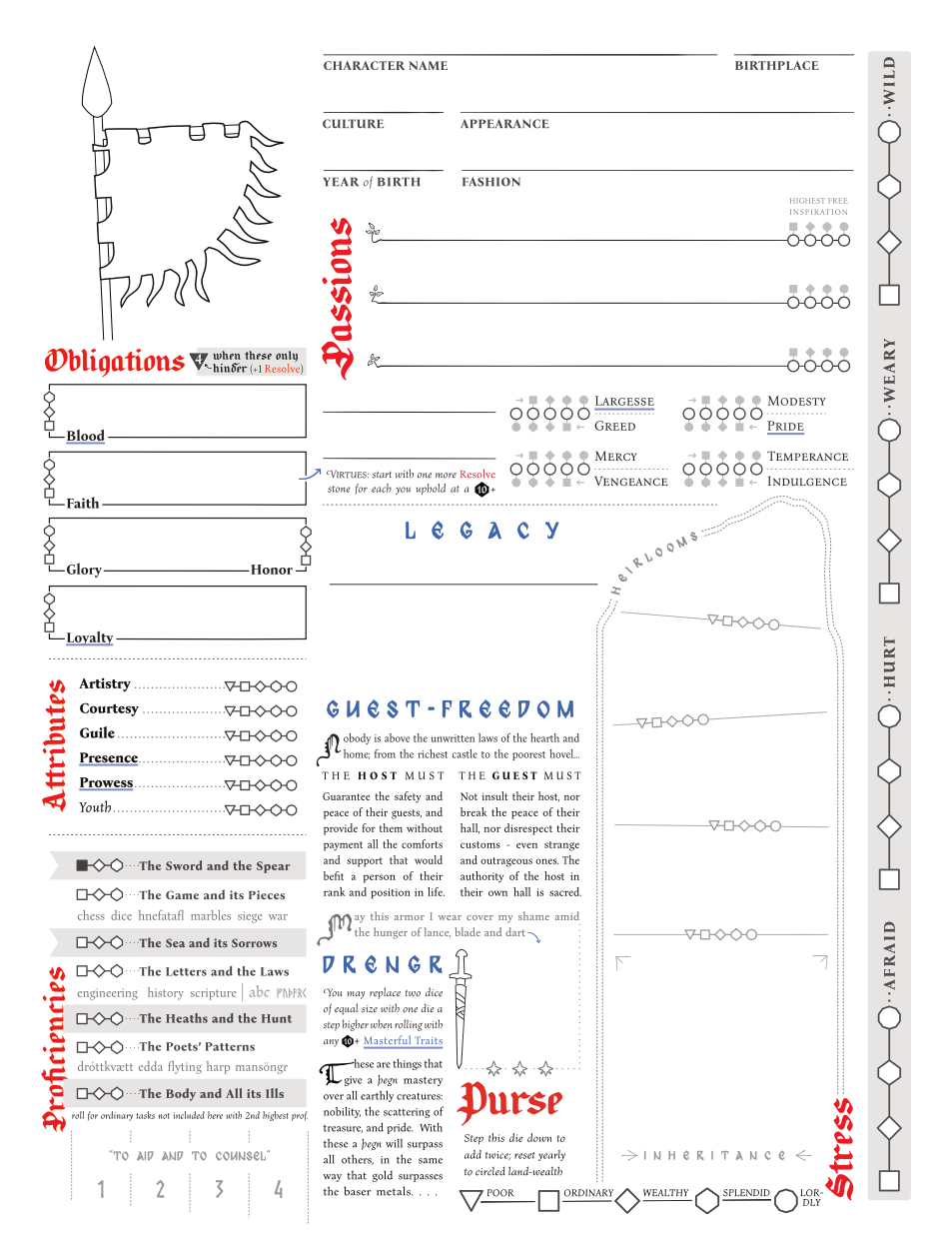 Several of the more complicated systems like Purse are simplified or replaced by basic implementations - better to test the core mechanics first. The central text gets slimmed down, and only a few parts of the treasure sheet etc. fall back into one sheet, while some extra space from rules move into side sheets.
I also moved some of the logic into the map - which since I knew the exact group and even the exact characters, I could focus on supporting just that size of party:21
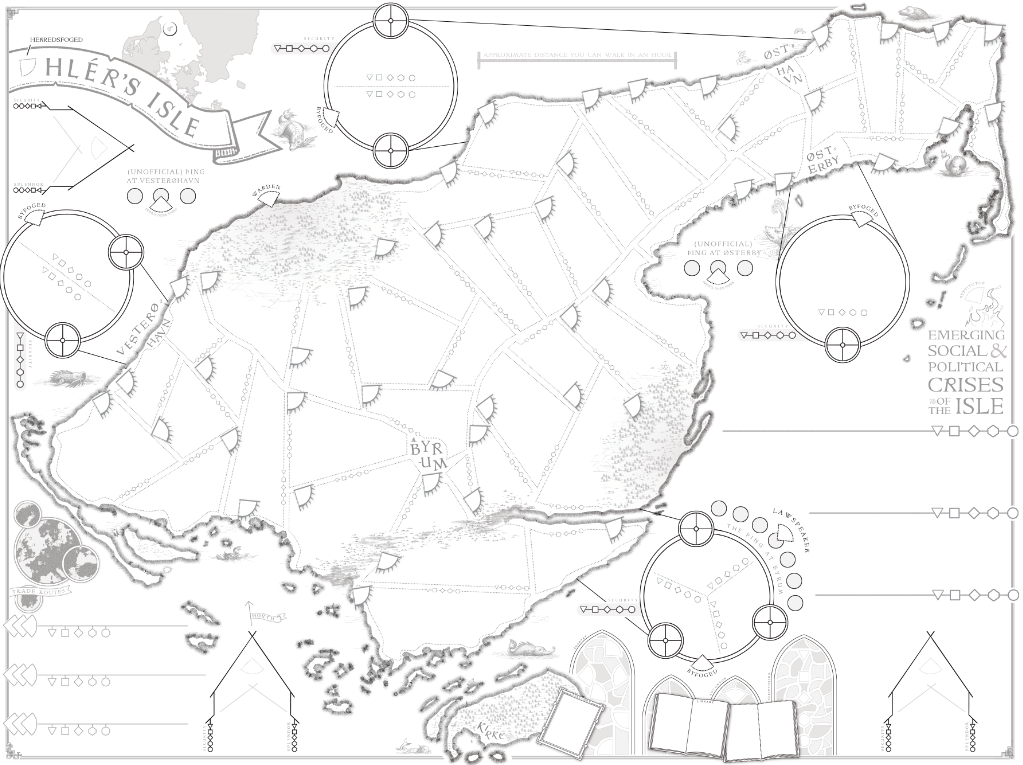
Since the estate system of the main game was both complex and full of gaps I hadn’t filled yet, I knew that side of things would be entirely different and quickly came up with an extension of the main Cortex dice system: get a pool of dice from your resources, roll against some challenge, keep painting more portions of the map your color, or stop opponents, etc.
There’s probably a lot to say about what I learned from using the system in actual play, but the biggest takeaway was simple:
I don’t think Cortex is the right system for this game22. And the simplified version I had made was too complex.
Oof. Back to the drawing board.
2025 - The Wildest of Words
If the bugs are daunted by the thought of fighting a Dragon, remind them that most obstacles in PICO don’t require a physical solution. The crushrooms will point that some things require brains, not brawn.
Rob Leigh, The Soggy Dragon
Fortunately, I found another system that on its head is a terrible fit for the genre: The Wildsea
The game mechanics descend from Blades in the Dark - which I had previously dismissed as a base for the game. In this formulation, though, we’re balanced around a larger set of dice we can composite from several sources - an aspect I had liked from the Cortex version, and there were a few other bits that clicked.
For instance, in The Wildsea there’s a major focus around a collection of resources that you pick up and spend - which is not very knightly at all. Knights don’t go around collecting bits and bobs most of the time.
…but picking up and spending Fame is a versatile way of unifying all the different things that do follow knights around. Sometimes it is a bit or bob - those magic shields that only show up for one chapter of the story, for example - but sometimes it’s a person, a steed, the stories or rumors or reputations that emerge and recede in the poems, and so on.
The use of these is powered by the knight’s fame in ways that make a lot of sense to the Medieval mind - the reputation of the item and its power being linked.
So this seemed adaptable in ways Blades hadn’t, and I started tinkering with it.23
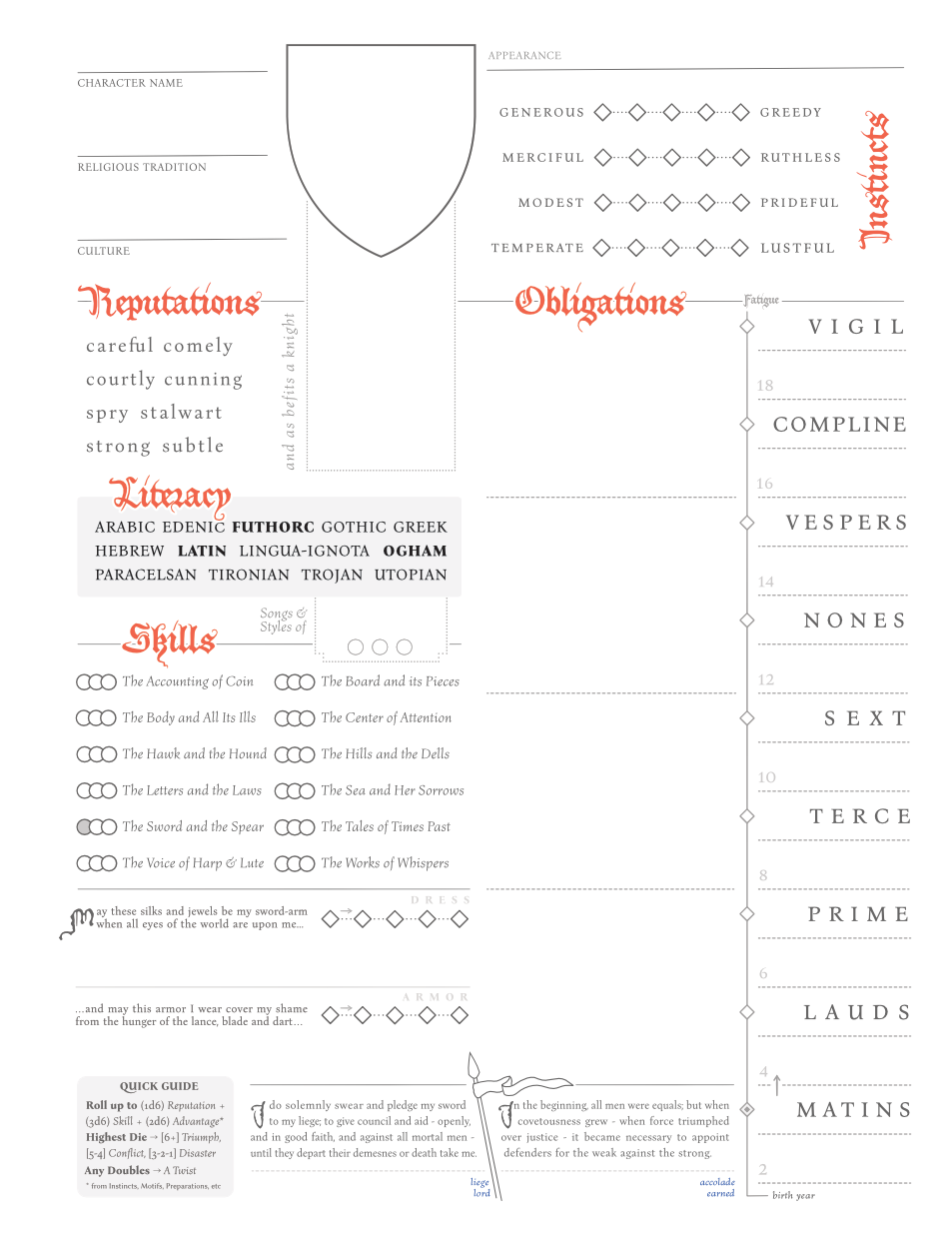
As I got deeper into this, though, it suggested a further look back at Blades in the Dark and its family tree. Now that we’re back in a d6 pool system, there’s a lot of mechanics waiting around there, including…
2026 - The Roots of the Earth
After every request, Keii offered scornful comments that I need not repeat, and shall not do so, since I am hurrying to the end of this adventure.
Diu Krone
Trophy Dark is a 2022 rpg based on the earlier Cthulhu Dark focused on doomed adventurers in horror settings, which has a variety of interesting dice mechanics - but one in particular that we’re interested in here: Ruin
Much like Alien’s Stress, we’re back to a second type of d6 die that’s rolled in the dice pool and which can cause negative results. Based on how bad things are your dice pool may have more or less of these dice, and if they are the highest24 rolled you advance a sort of clock.
This gives a different way to handle damage and opposition than comes with The Wildsea and its progeny - a separate lever we can control on each roll. I’m calling this Peril - how dangerous is the action you’re taking - separate from how challenging it is.
This is back to adding complications to the base system - but fewer than other possible strategies I considered. And so we’re at the current design:
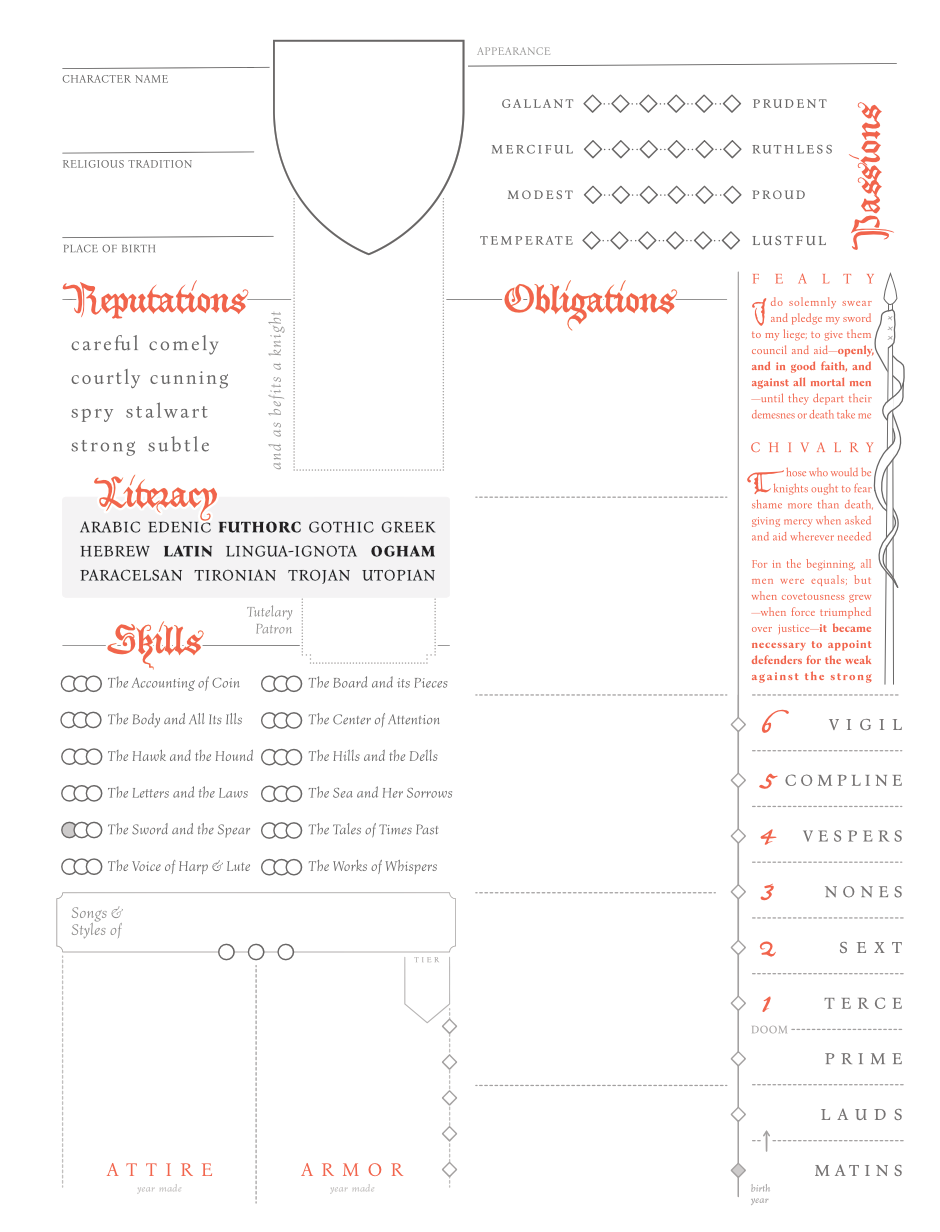
But this post has gone on long enough - in the next, we’ll get more into how the system works25, especially for those without the base experience of The Wildsea or Blades in the Dark to guess at some of the pieces.
Footnotes
-
And even the people I’ve spoken to about it have learned about it iteratively and have more context than you may. ↩
-
And not even in its original setting. But that’s a story for another time. ↩
-
Obsessively picking and rearranging them as I did maybe isn’t always advised. If you have a group to run with it, just run and find out what you need. I didn’t. ↩
-
In particular, I had just played Disco Elysium and came away from it with the fundamental lesson that I wanted a system built around having a unified resolution system. ↩
-
There also has been a second edition at this point that I’ve heard is much better organized. That wasn’t out at the time - all my knowledge is from the first edition. ↩
-
So the “balance” of things has been mostly worked out, isn’t sensitive to really complicated interactions, and it’s meant to take a little tweaking here and there. ↩
-
Doubly so since the higher your stress is when that fail comes, the harder the consequences can be. ↩
-
Unfortunately, I think I overwrote or deleted most of these. Later on I got more careful about keeping a history of old designs (though I’m still hardly professional about this), but I was very cavalier at this point. I still have some loose notes on percentages and partial rules, but no character sheets or other things to show you. ↩
-
Some for reasonable reasons, some less so. I don’t think a Stress-centric game could fit my current goals for The Death of Arthur (which is open to less linear paths for tension to grow because it operates on a longer timescale - some quests still might fit that growing dread over a season, but others less so) - but I think it could be a good Arthurian game. ↩
-
Sadly, because I’d like to have shown an example of how much better they got over time. ↩
-
I’ve not been a huge Kickstarter funder, so this isn’t surprising. ↩
-
I might be closer to that now . ↩
-
And, from Fate I had already considered and enjoyed the idea of multi-column dice pools: i.e. a roll being Skill + Approach + Distinction. ↩
-
Squire looks like it fits into this section as well, but that’s just coincidence. ↩
-
Ignore the odd three-grey-dots bit in some of the dice - that’s a pdf export issue I had with the brushes. They’re just supposed to be dice shapes like all the others. ↩
-
For some reason, the Estate section has always bent a lot more skeuomorphic in my designs. Skeumorphism is hard - I’m not a great artist - but in careful use it can help give players texture that helps immerse them. I’m for it in general, but it’s not easy for a lot of elements. There just aren’t parallels that work, in many cases, and it’s easy to end up mixing metaphors in ways that are just baffling and overly confusing for the player. ↩
-
As did Family. It’s not particularly interesting, though. ↩
-
Also they break their necks a lot. That’s irrelevant to this sheet or anything else here, but if you know please tell me what Malory is talking about when he says they break their necks - because they do it all the time and it might be statistically the least dangerous injury described given how quickly they always bounce back up from it compared to when any other kind of damage happens. ↩
-
Though I picked kitchen staff specifically, because I had learned from previous campaigns that that was always the first thing about their houses that players would fixate on. RPG players love detailed food. ↩
-
i.e. proto-Vikings - the era of the sagas they wrote down, Beowulf, etc. - the northern heroic age gave me a way to test the vibes of the first third of the campaign, and way to use a lot of the research I had built up on the setting for that time period, while being close enough to what people are looking for when they think Scandinavian early medieval adventures. ↩
-
This is technically a later version of the map once I realized I needed more detail in the actual minigame here. I don’t have the original still sitting around, unfortunately. ↩
-
Not that it’s a bad system or one I don’t want to play. Not even that I didn’t want some of its DNA in the game. But I found we were playing against the system more than with it. ↩
-
Unrelated, but you might also notice in the character sheets that this was where I went from full bright red to more of a burnt-ochre for rubrication. ↩
-
So - subtly different from Stress, there’s an interplay between how strong your current roll is with other dice and how likely trouble is to happen - and between how good your overall result. ↩
-
I intended to fit a bit more of that into this post, originally, but it’s gone overlong. ↩