The pen is the tongue of the soul; as are the thoughts engendered there, so will be the things written.
Miguel de Cervantes, Don Quixote
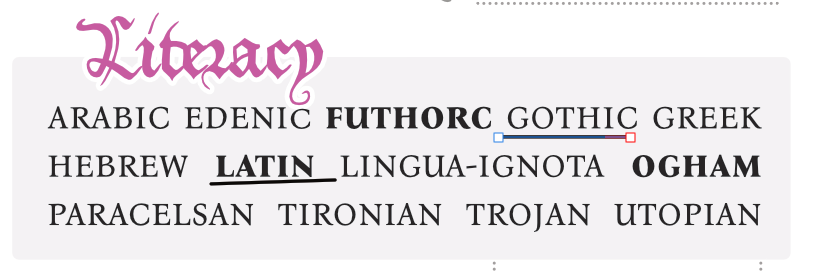
What languages can the character read?1 Reading may open up a lot of opportunities for clues and information from people who are not physically there, and illiteracy may make it harder to communicate with others - though it’s not a huge stumbling block.
Literacies are a piece of narrative information - they don’t have a direct mechanical advantage2, but they gate what a character can or can’t try to do3.
How does one gain a literacy?
I’m not sure. I don’t think it’s worth as much as a skill (or at least, a second literacy is worth less - the first may be worth that much, but there’s a lot of diminishing returns, especially after Latin), and it’s not something most characters would try to fill out just for completionism’s sake.
How Illiterate are the Middle Ages?
Probably not as much as you’d assume. Literacy was definitely lower, though more so among the poor4 than your characters, but gentry do often try to learn and teach, including for women as well as men.
Reading, not Speaking
We’re not tracking what languages a character can speak. It’s assumed there’s enough of a lingua franca5 that most characters can understand enough to get by6 in most situations.
Some rpgs do interesting stuff with spoken languages - including The Wildsea - but in this campaign most situations don’t really rely on that kind of plot point, or rely entirely on it7.
We’re also not tracking writing so much as reading8
What scripts?
There’s 3 bold options - because there’s three scripts you are much more likely to learn than any of the others9. Of the rare scripts, there’s also a few which are not always available… because they haven’t been invented at the start of the campaign10.
| Common | Rarer | Constructed |
|---|---|---|
| Latin | Arabic | Edenic |
| Ogham | Gothic | Lingua-Ignota |
| Futhorc | Greek | Paracelsan |
| Hebrew | Utopian | |
| Tironian | ||
| Trojan |
Footnotes
-
To some degree of proficiency. They may still struggle some, but also characters without this may still be able to know a few letters or even a couple words. ↩
-
Even though this game does take other inspiration from The Wildsea, and their literacy system is very interesting - it’s not the kind of setting we’re in. ↩
-
You cannot just roll the information out of a book you can’t read (though you can try other things, like finding someone who can read and using all your other tools on them) ↩
-
But literate peasants are not that shocking a sight, and the rich and powerful are not all literate. ↩
-
Primarily vulgar Latin across the Roman world, some close enough Brythonic language across the Isles, and proto-English/Frisian across the North Sea. ↩
-
Augmented perhaps by explanations, translators, gestures and pictures, etc. ↩
-
i.e. if you’re in a situation where you are really fish out of water, it’s deliberately a place where you wouldn’t be expected to know the local languages, so a hypothetical language mechanic would always be either trivially useful or trivially useless ↩
-
There is a difference at this time! Writing skills are ↩
-
In fact, it may be more common to know just Latin (by far the most common of the common scripts in this area) than all the rare scripts combined. Think of the rare scripts as an odd special quirk, not necessarily something that will get exercised often. ↩
-
For obvious reasons, these tend to be especially rare. ↩