Why frown upon a friend? Few live that have too many,
Edwin Arlington Robinson, Lancelot
The Pathfinder 1st edition core rulebook defines Leadership as:
Prerequisites: Character level 7th
Benefit: This feat enables you to attract a loyal cohort and a number of devoted subordinates who assist you. A cohort is generally an NPC with class levels, while followers are typically lower level NPCs. See Table: Leadership for what level of cohort and how many followers you can recruit.
…and then four charts and several paragraphs of modifiers for your Leadership Score and other aspects of those charts1 and stipulations2 on how the followers3 and cohorts can work. It’s an intensely baroque system, inherited over several D&D editions worth of caveats and patches, which to be candid, was broken4.
Thus it was in my first campaign I was in when I took this feat for my character5 and afterward when all players took it. After all, it was a campaign about leadership, so this was what the system had “about” that concept.
What it boiled down to, in a mix of vibes and houserules, was an additional character each player built and tracked, which… didn’t do much. It was a compelling player fantasy, at least for many of the characters6, but one that the game was frustratingly not built around.
Being the Boss
Unlike Pathfinder, which only occasionally sets up this player fantasy, a game where everyone’s a knight (or similar) cannot avoid it. The knight’s squire is perhaps the archetype of the superhero sidekick, not to mention the constellation of other lackeys a respectable member of the gentry can summon to their support. As Greg Stafford’s Book of the Entourage explains it:
As the holder of a manor, each vassal knight in King Arthur Pendragon heads a small feudal society that revolves entirely around him. This is the knight’s household. He doesn’t have equal time to do everything or see everyone, and so his household does many tasks for him. His personal social sphere forms layers around him.
In Pendragon, these supporting characters can be built as complete characters, like the “cohorts” in Pathfinder, when that seems important, but usually they’re made a lot simpler. Generally, this follows one of three patterns.
The more detailed supporting cast, like squires, act as skill replacements. That is, they are one or more skills with scores based on their own experience that may be rolled in lieu of the main character’s skill when relevant.
For example, squires7 have the “Squire Roll” based off of a single modifier8 that’s rolled for most things a knight would need the squire to do, either because the knight can’t be there or needs their specific support. Some of their renditions over the different editions and expansions include other skills, and this expands in the other types of supporting characters, but still nothing that goes beyond a small corner of a character sheet.
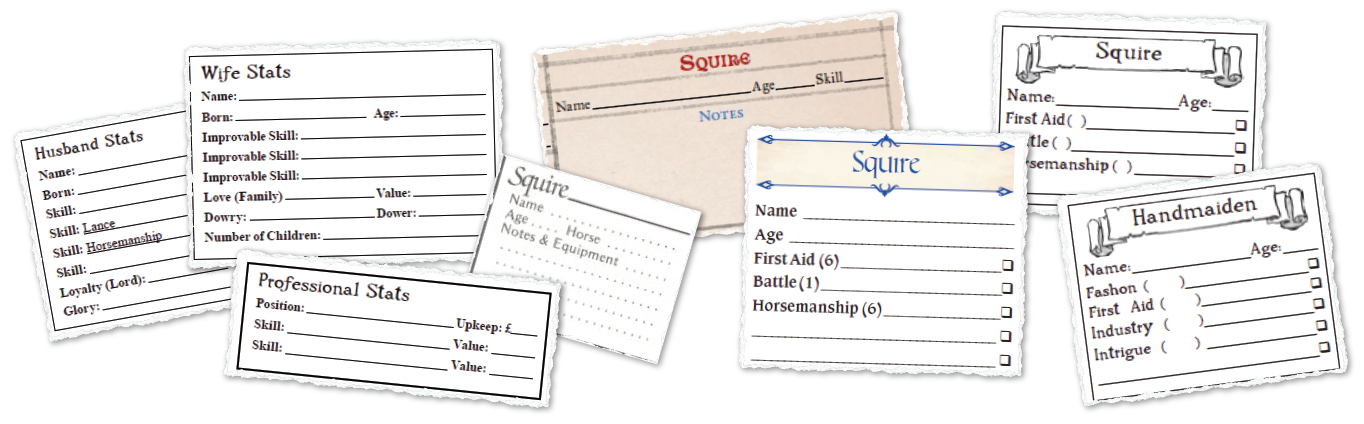
A second way to represent these supporting characters is by a modifier to the character’s rolls, or special options in yearly upkeep steps. For instance patronage of a Writer from Book of the Estate gives:9
2 Glory per year, a roll for the Patron on Read (Latin)10, and the chance for a new book.
The third way… we’ll come back to later.
So What About in This Game?
For Companions11, I want a separate sheet—because I want to emphasize change and allow characters to shuffle between players without erasing and rewriting, and just because I think it’s neat—but a simple one.
I want it to allow for12 tracking the character’s:
- Name13, role, and basic biographical details14.
- Age15
- General Personality
- Relationship to you
- Relationship to other people (especially, other important people)
- Independence16
- Death
I settled on a fairly open half-page sheet:
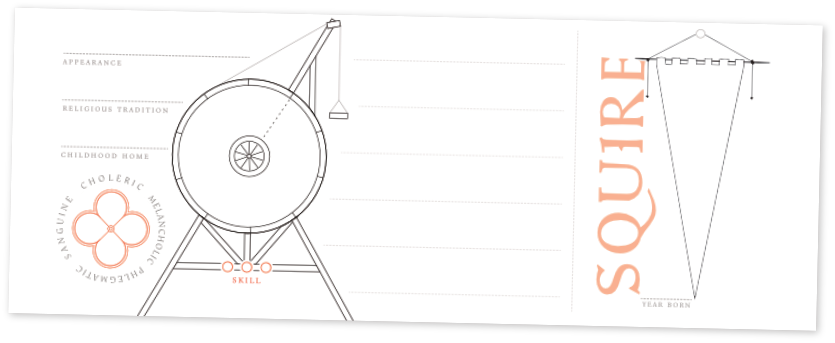
Each type of companion I decided to allow has roughly the same design. On the right we have their Coat of Arms as a fast way to identify their family ties17, plus the space for their name18, their role (color-coded), and year born.
On the left edge we have the biographical details and a single-axis personality question, based on the four humors19. These are supporting characters with a very simple inner world to generate or keep track of.
The center is meant to track their relationship and story with the player characters. The open lines let you track particular events or notes, and the treadwheel crane is a wheel representing some meaningful relationship arc.20
I imagine this as something that feels like the famous “Loyalty Missions” of the Mass Effect video game series. Every companion is generated with something that matters to them21 with a varying number of spokes on the crane wheel. Advance all of them and you’ve built an important bond.
That leads to the companion’s skill, or general level of competence22. Like Pendragon’s Squire Skill, this is meant to be a single description of how much you can trust them doing things in their normal remit independent of you.
This acts as a Skill (unlike main characters, companions don’t have Reputations to add a fourth die). Each starts with 0-2 points to this, and completing the relationship arc adds one23. Further progress is up to the GM and may likely require additional quests.
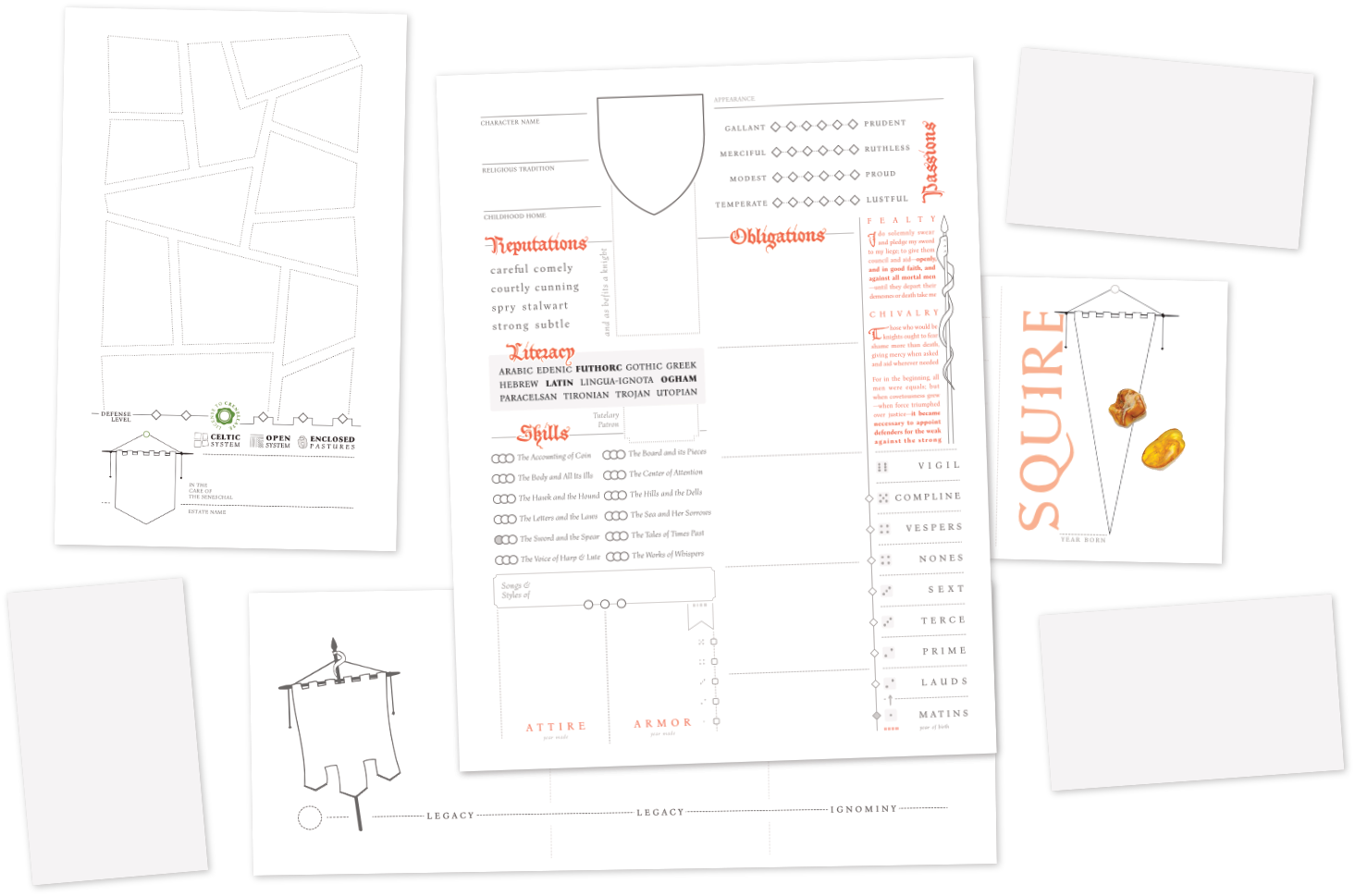
The companion may also act as a Motif, allowing an even simpler form of support using Fame or Riches to provide Advantage where relevant. When the details and independent action of the character is less important, the page is meant to tuck away conveniently behind the main character sheet.
The Million Masks of God
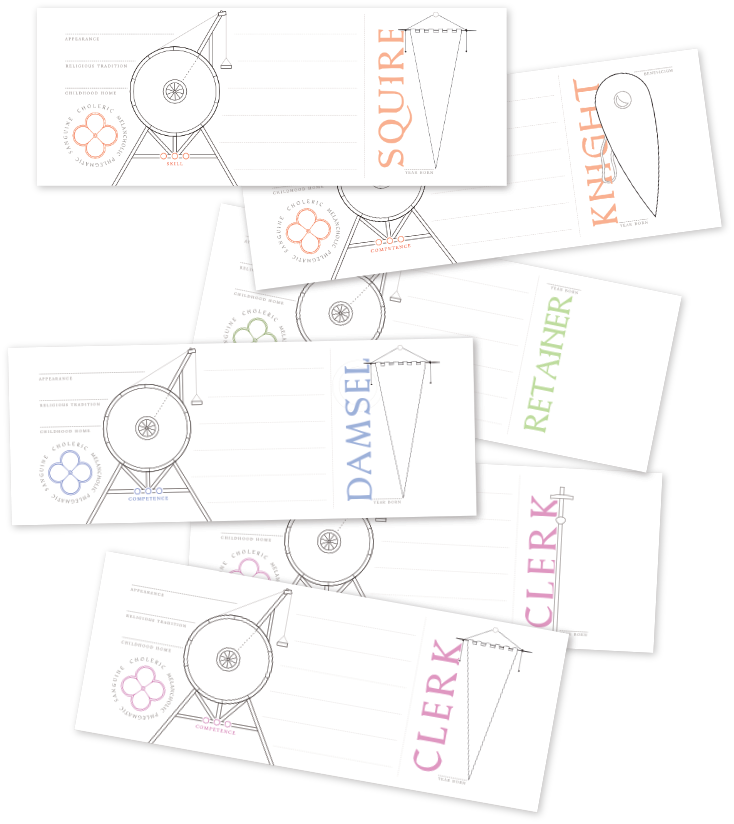
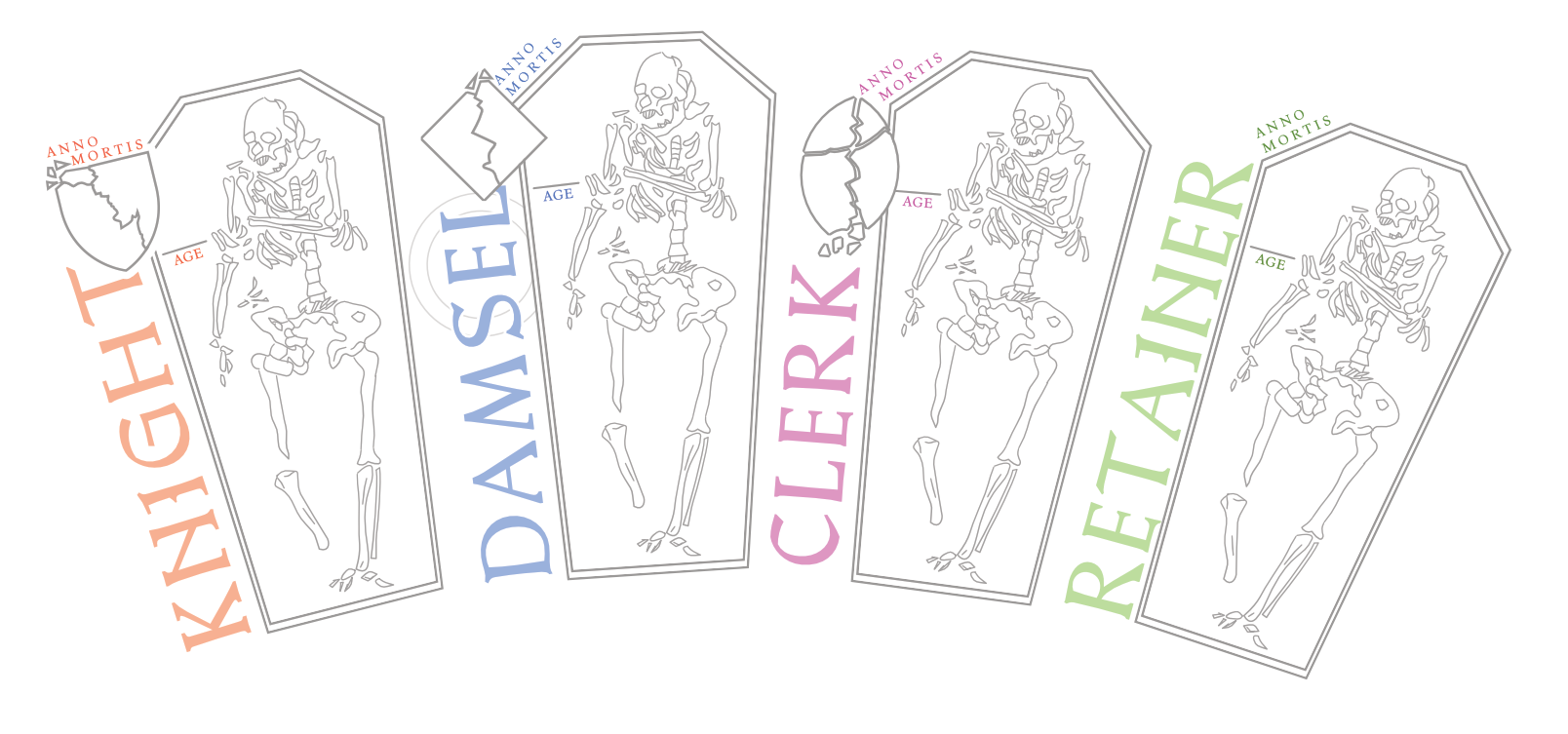
Of course, squires are not the only companions you may have. I have five others24. Knights, who also include their Beneficium2526, and Damsels, who double as Dames if you cross out the s and l to save needing two different versions and switches when they marry27…

… as well as Clerks as a lump combination of any kind of priest, monk, nun or other acolyte or (broadly, Christian) clergy, and a general Retainer class to lump in everyone else, especially the common folk28.
Retainers and non-noble Clerks don’t have a coat of arms. I actually waffled on whether I wanted to include them, or to represent the class divide by having them act as ordinary Motifs written on plain cards.
Some short term characters (a mob you’ve incited to help you, for instance) still could be plain motifs, but I think there’s enough details it’s better to give a real sheet than have the players keep track of the relationship arc, competence, etc. And even more importantly, I don’t want the way they’re tracked to be different in death. While class distinctions are a real influence to encourage the players to subliminally feel, it’s harder to tell that lie in the face of death, the great leveler.
Man’s Best Friend (and Greatest Servant)
But humans aren’t the only type of companion you can have. In fact, there is a third type of companion in Pendragon that I skipped earlier to avoid spoiling this point.
The most important supporting character in Pendragon, in terms of the mechanics they’re represented… is your horse.
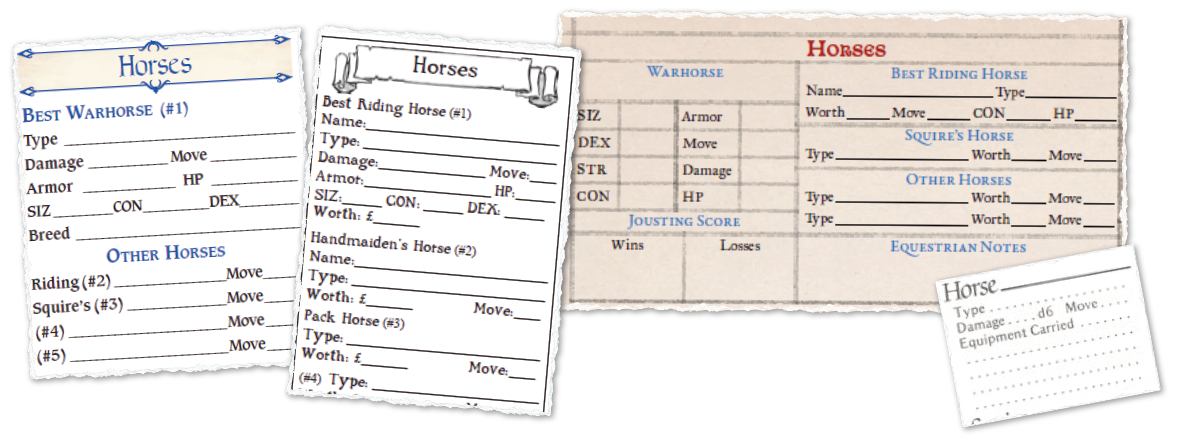
Sure, it’s still a lot simpler than a full character sheet, but it’s a separate fully built character. Their stats act fully independently, with their own hit points, separate attacks, etc. The section for all supporting characters in total has 2 pages of explanation in the 6th edition Core Rulebook. Horses have their own 9 page chapter.
A few other animals also get recognition, mostly following the 2nd style of supporting characters mentioned in the earlier section. For example, the Keen Lead Dog you can get in family history29 from Book of Knights and Ladies gives:
+3 to Hunting; always finds its way home whether alone or with his master. Roll d20 each Winter; on 01-03, dog dies; on 04-06 it had a pup like itself.
A simple bonus plus a little event. There’s horses, hawks, cats, even a goose30.
I think of these there are two particularly interesting ones to elevate beyond mere motifs, the Horse and the Hound.
Both of these are relevant to most characters, and very important. They’re bred and selected for their pedigrees31, meaning there’s a game within a game for animal breeding. And they’re bred towards specializations32.
My designs for these animal companions are even more work-in-progress than the human counterparts, but look roughly like this.
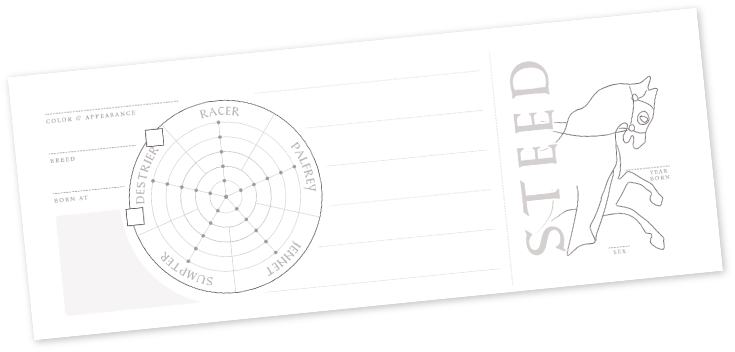
Again, the rightmost section that peeks out from under the main sheet is your coat of arms represented over the caparison33 of the horse I’ve crudely traced from manuscript sources, though you can also get a bit of an idea of the horse’s color or appearance. Its role, Steed34, and Year Born are also here, as well as Sex, because that’s important for breeding.
On the left, the basic details this time are Color35 and Appearance, Breed36 and… Born At37.
The center still has the same open area to wax poetic about your shared adventures, but the big wheel this time38 is a radar chart to mark the relative ability of your companion across different proficiencies.
- Racer, or its ability to run fast and outpace other steeds.
- Palfrey for its elegance and comfort.
- Jennet39 for its deftness of foot and ability to handle rougher terrains.
- Sumpter for its strength at bearing loads and other hard labors40.
- Destrier for its power as a warhorse.
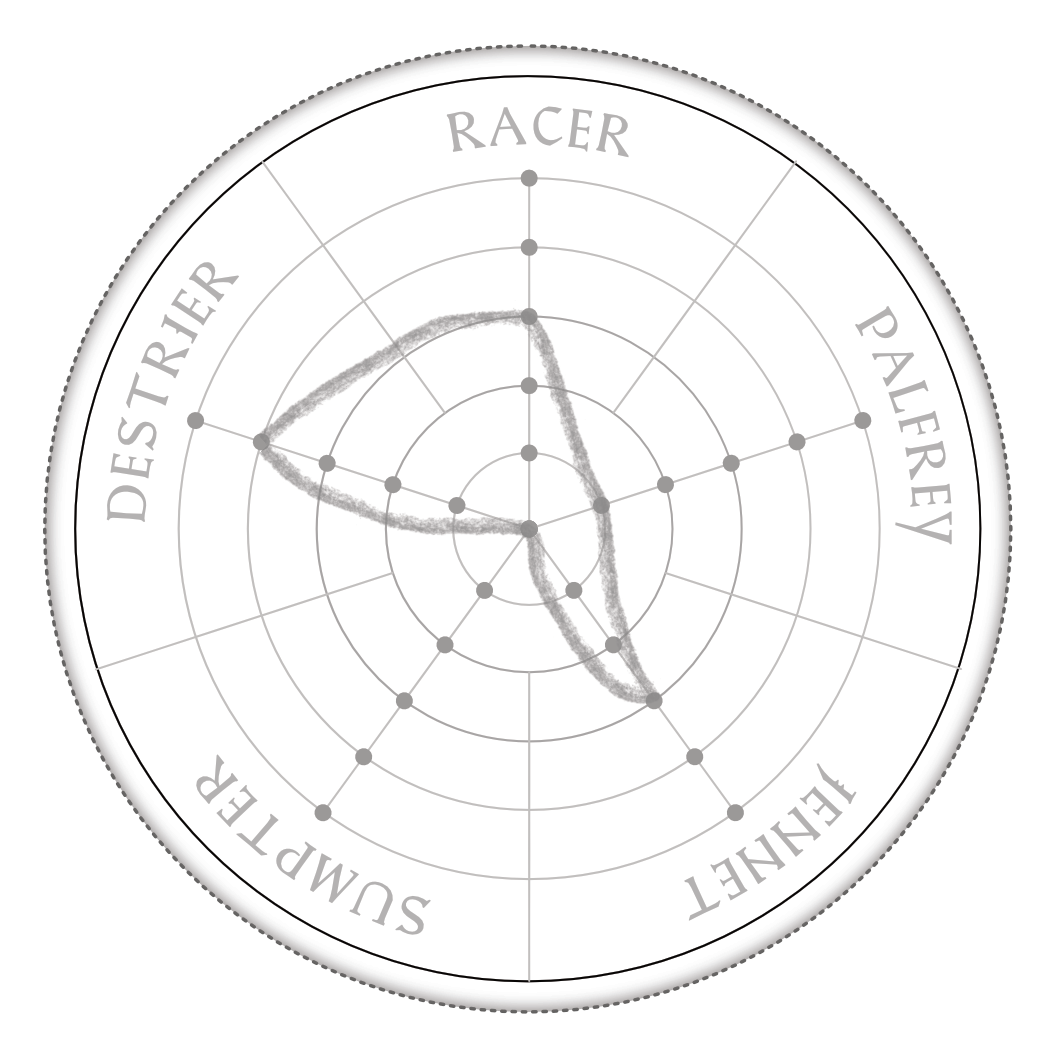
My initial thoughts for this are that they can be used as a dice pool when it acts independently and is acting towards one of these archetypical roles, but would more normally be used as a comparison against an opponent’s steed or some fixed requirement41.
Still absent from this is some way to mark if it’s armored or not, and to mark some special traits that can be trained or bred, including some way to mark potential42. Then there’d be rolls for the year based on the horses you had or traded stud rights around for, and some abstractions for the rest of your stables’ qualities and neighbors, for the potential new horses born. By crossbreeding and selective picking, players who were into that could push for higher quality horses and new breeds43.
The Hound sheet don’t have a drawing yet, but I’m picturing a similar medieval manuscript tracing44 and a wheel split with the smaller set of Tracker45, Trickster46, Courser47 and Biter48.
If Not Friend, Then Why Friend Shaped?
Those are all the companion types I have planned for now. There were several that I tried that didn’t make the cut.
Cat and Hawk as mentioned above, of course, but also had several iterations of a "Warband" "Company" or "Army" sheet49.
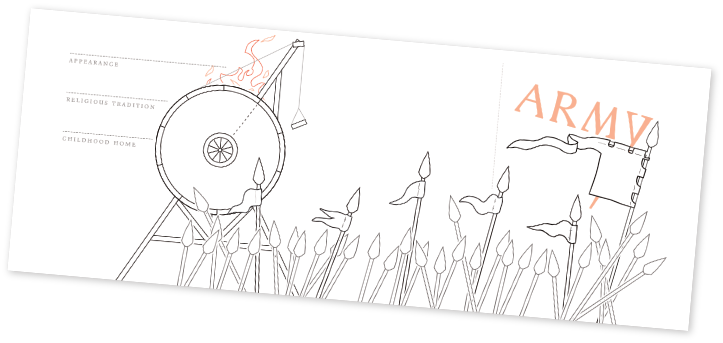
This had the special gimmick of opening up to reveal a place to record everyone who died under your leadership, represented with shields falling into what was sketched out to be a Hellmouth.
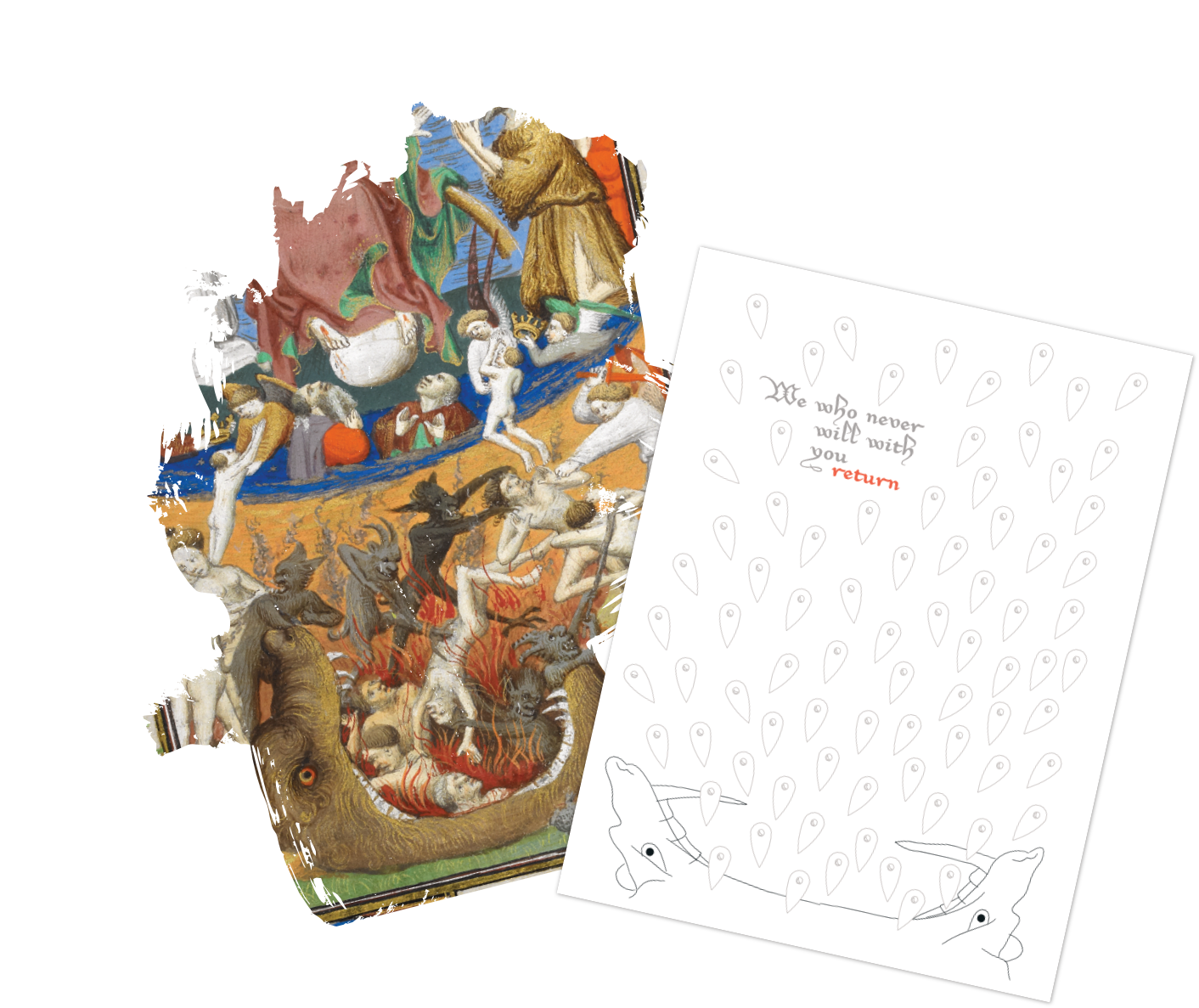
That part remains really compelling to me, but I felt it didn’t fit as a Companion. While there is certainly bonding and development that goes into being in a warband, I didn’t want it to feel like characters were growing and especially owning their armies. I worry this would make it too much a game of generals, rather than knights, and act funny when players were in the same armies.
I had also considered Books and Saints. I liked the idea of companions that were only alive in a poetic sense of the word. A saint’s connection might be tied to your family line, but also maybe would be strengthened if you had gone on a pilgrimage or were carrying a relic (I even have a reliquary icon.

In the end, I didn’t find mechanics I felt were compelling and worth the complication compared to letting them be more freeform motifs.
But now that we’ve covered all the things that were or weren’t Companions, there may be one question haunting you. Why have I only shown you one side of the sheet?
Effigy and Cadaver
Cadaver monuments were a popular decoration for the tombs of the gentry in the Late Middle Ages. Instead of just depicting the deceased in peaceful glory—the gisant or effigy—these statues went out of their way to depict the decayed and rotten body left behind—a transi.
While the gisant showcased the achievements and position of the dead, the transi was meant to remind the viewer of its transience. To say:
Sum quod eris, et eram quod sis50
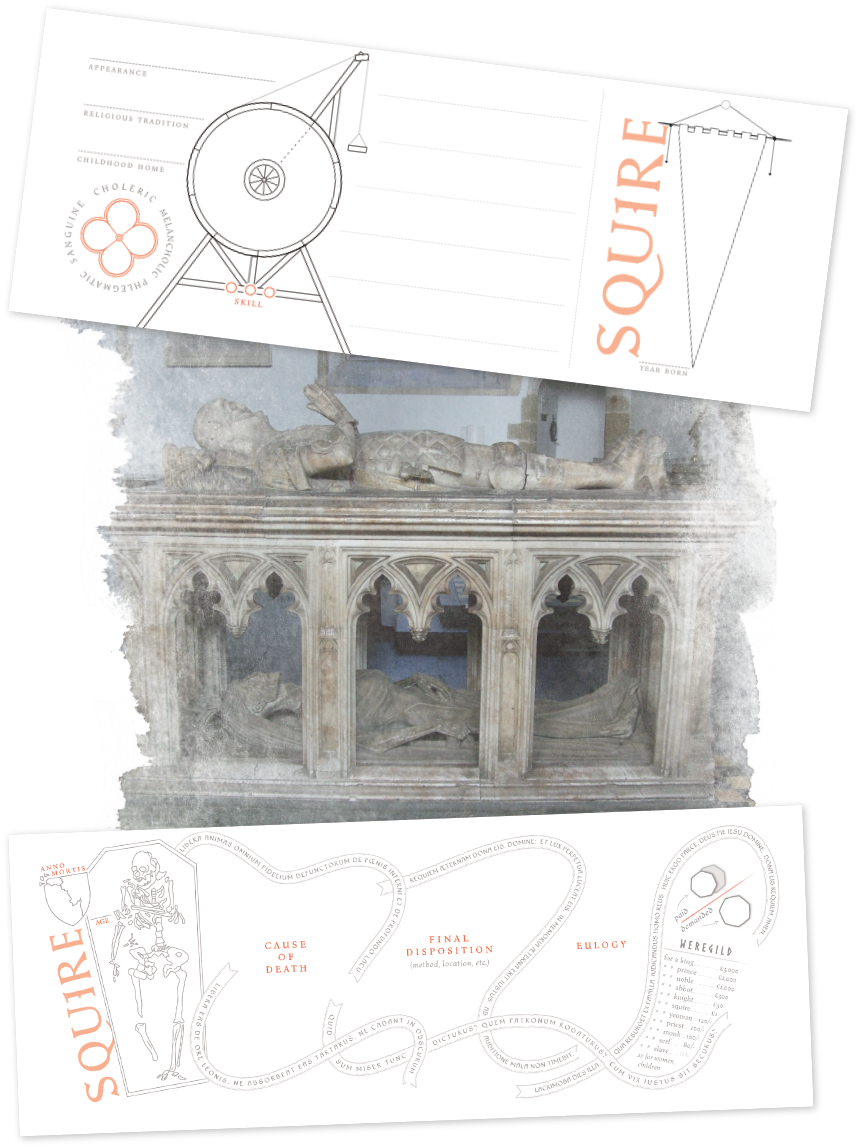
That’s my intent with the back side of the companion sheets upon the death of the characters, to be the transi to the gisant of the main side. In fact, at one point I was trying to push this so hard I had a gimmicky fading of part of the word “Squire” to represent the decay into “Soil”.

That didn’t survive having other character types, as apart from a real stretch in Damsel → Dust, there was no obvious route for the other names.
For the actual sheet, we get the character’s role51 again, and a place for a coat of arms52. For biographical details, the Anno Mortis or year of death, and their age upon dying53, next to a tracing of a skeleton from an archaeological dig site.
Of the four remaining compartments, the fourth is the most straightforward. Weregild is a practice among those English invaders, where a monetary compensation can be set for the dead, to settle the blood feud. A table54 of common prices is given.
Next from the right is a Eulogy. Whatever you want to say about them.
Then their Final Disposition is primarily there for “where were they buried?” in case you want or need to visit, or in case it’s unsatisfying. I hedged the wording because of the possibility of cremation or other practices, or just the chance that you’ve failed to recover the body55.
And finally, Cause of Death may be the most cutting. How did they die? Where? And Why? Maybe it will remind you of a vendetta you will continue to harbor for the rest of your life, or maybe of a guilt. Maybe both.
To make a less rigid border between these sections, I tried to wrap them in something like a speech scroll with generally thematic but arbitrary parts of the Requiem Mass:
- libera animas omnium fidelium defunctorum de pœnis inferni et de profundo lacu56
- libera eas de ore leonis, ne absorbeat eas tartarus, ne cadant in obscurum57
- Requiem æternam dona eis, Domine: et lux perpetua luceat eis. In memoria æterna erit iustus: ab auditione mala non timebit.58
- Quid sum miser tunc dicturus? Quem Patronum Rogaturus? Cum vix iustus sit securus?59
- Lacrimosa dies illa, Qua resurget ex favílla Iudicandus homo reus: Huic ergo parce, Deus: Pie Iesu Domine, Dona eis requiem. Amen.60
Aside from the palette swap and some minor adjustments, the other human sheet backs are the same.
But that leaves the dead animals61. Rarely given the same pomp and circumstance, even when buried at all, nor any kind of weregild, these get a simpler design62 leaving blank space if a particular edge case comes around.
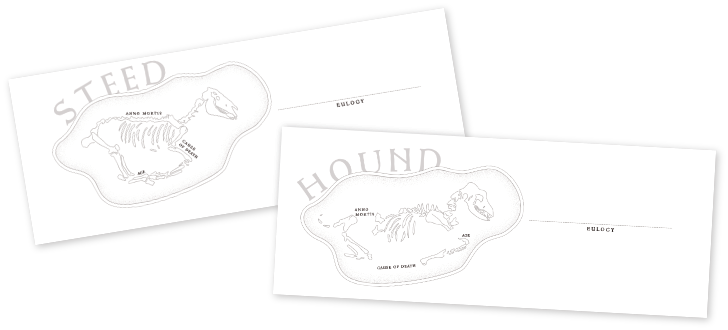
This does awkwardly mean that, despite the skeleton taking up more space on the half-page, there is more room to eulogize a dead animal than your human friends. I don’t mean anything by that; there just isn’t anything else I’ve thought of to put there.
Footnotes
-
It’s good to be famous, generous, or have a “special power”. It’s bad to be a failure, to be cruel, to have caused the death of previous followers (this penalty is about half as strong as having a horse that your companion’s going to get jealous of, or half as strong a bad thing as being not-homeless is a good thing). ↩
-
Not counting additional rules across the other systems. ↩
-
Which are the more meaningless part of the feat in general, as the system as a whole drifted from the early philosophy of D&D (for as much as that actually held) where “typically lower level NPCs” could be relevant. There’s a ton of calculations for exactly how many followers you have and what their levels are, which is rarely what matters. It’s not a coincidence that so many later Leadership style feats (1, 2, 3, 4, 5), especially ones I saw get discussion, focused on just the cohort. Similarly, the closest system, as far as I’m aware, in the 2nd edition is purely cohort focused (though, confusing to anyone familiar with the older, it calls these “followers”). ↩
-
Both so worthless that it does nothing, and so game-breakingly powerful that the GM has to step in to stop you and make it worthless. ↩
-
Which is why I’m using it as the introductory example in its parent D&D 3.5’s version of the feat, or earlier. ↩
-
Arguably the other characters were more appropriately made for the system, if not the campaign. ↩
-
Who among all your little henchmen, are by far the least tacked on. ↩
-
Based off their age in 5th edition, or their standing in 6th edition. ↩
-
On top of being able to act as a skill replacement for Read Latin and Write Latin skills. ↩
-
i.e. a possible leveling up of that skill. ↩
-
My current name for the system—though I am warming to Pendragon’s use of “Supporters” and have considered “Followers” or “Retainers”; I’m not definitive on what I want this to be called yet. ↩
-
But not necessarily require all elements—or not require them right away, at least. Many of my early designs, though, were very cramped trying to give only enough space for what was necessary all the time. It’s better to leave a bit more open, I think. ↩
-
Perhaps simple and obvious, but an important part of having stakes. I like Pendragon 6e’s imperative on this: “They deserve names. Give them one.” ↩
-
I picked specifically Appearance, Religious Tradition and Childhood Home (similar to player characters, this is a proxy for culture and relationships). ↩
-
via Year Born so it doesn’t need constant updating, same as with the player characters ↩
-
This is, I think, the important aspect of how the more important secondary characters in Pendragon aren’t just a modifier to your stats but feel like they are rolling for their own actions sometimes. ↩
-
The primary way I see this is “who is going to be really upset if they don’t come back?” ↩
-
Unmarked, but intended to fit it to the right of that. ↩
-
And housed in a quatrefoil design just because it looks cool. ↩
-
Because it’s “character building”. Also I had made the treadwheel crane for something else earlier that got scrapped, but I like the metaphor/pun. ↩
-
Probably not always as focused as the Mass Effect example; often more vague, like “show me I’m wanted” or “help me overcome my fears”, so you can work in how it might get slowly resolved through the events of other adventures. ↩
-
In fact, after I exported the images for this post… I renamed it to Competence. I feel that’s less likely to get confused. ↩
-
And lets you shift their personality if you want to. There’s no penalty or benefit to these, necessarily, but you may like it or feel it’s relevant to what they went through. ↩
-
Or four, if you don’t double count noble and non-noble clerks. ↩
-
i.e. the reverse of the Servitium Debitum; for what benefit are they serving you as a knight? Husband? Vassal (of what fief)? Household knight? Just on this mission for you? ↩
-
Also knights are the only one with a special coat of arms (mostly because they likely take a more militant role). I might also give them an armor indication somewhere, but I don’t know if they’ll need to be in that kind of focus. ↩
-
If you follow the guideline and cross them out in the same stroke, it’s even in the shape of a ring, which is exactly the kind of visual gimmick I like. ↩
-
They have the same green tone as the Estate sheet, if you were curious. The rest match the character sheets they are closest related to. ↩
-
If Aquitanian. Several of the other cultures also have an animal that might reproduce but also could grow old, too, and I find all of them delightful. ↩
-
Albeit one that lays golden eggs. ↩
-
Unlike Hawks, which I originally expected to keep in this same category, who don’t seem to be often bred in captivity for medieval hawking. Apparently they just kept capturing and training the birds from the wild? ↩
-
This is what largely drops cats out of the running. There’s a lot less specialized breeds for cats at the time. You can have a good mouser as a motif for instance but you don’t need to track what type of good it is. ↩
-
A bit anachronistic for some eras, and not relevant for all horses, but this keeps the color coding to family Coats of Arms consistent across characters, even horses. ↩
-
Not “Horse” because it lets you collapse a few edge cases. I don’t want a separate one just for a good mule, or obscure things like giant cats. ↩
-
Color specifically matters for its value. Regardless of the nuance of how you draw it, it gets a specific classification. ↩
-
To help distinguish what kind of traits it’s expected to have, from its pedigree. ↩
-
…vaguely to determine where you “got it from” or if it was part of your own stables. Maybe a complete parentage would be more relevant and fit closer to the pedigree angle. ↩
-
Styled after nine-men’s morris boards, though it also makes me think of Myst III: Exile’s J’nanin tower puzzle, for anyone who recognizes that reference. ↩
-
I’m not super fond of this name. ↩
-
As gentry you’re rarely caring about horses for their ability to pull plows, etc. but that would roll into this. ↩
-
e.g. “That’s a heavy load and will slow down or stall any horse that’s not at least a 3 in Sumpter” ↩
-
i.e. even if this horse is a dud, it’s got good genes. ↩
-
And this would be augmented as the wider world opened up and traded in, with new stock that might have higher stats and potentials, for a kind of arms race. ↩
-
With maybe a dog color for colors. ↩
-
For good hounds, able to smell and follow prey. ↩
-
For dogs that are just plain clever. ↩
-
For what will become greyhounds, etc. This is the other “style” of a good hunting dog, one that’s able to keep up with its prey and run them down. ↩
-
For its ability to fight, both for guarding and for hunting prey that might be more dangerous. ↩
-
Ignore that this one says things like “Childhood Home” which are just not replaced from the normal companion sheet - armies would have different traits tracked. ↩
-
I am what you will be, and I was what you are. (inscribed on the monument of William Sylke, precentor of Exeter Cathedral, died 1485) ↩
-
And the name can fit around there too. ↩
-
Again, perhaps more pertinent this time, who is going to be upset that they didn’t come back? ↩
-
Now it will never grow older. ↩
-
Very tentatively valued between the historical Norðleoda laga and other explanations I’ve read, the various Pendragon editions, and other rpgs that institute this. Because of the different ways each interprets and freezes the concept of prices across the broad spectrum of the Middle Ages (or their specific but still general timeframes), and different gameability aspects built in, each comes to different conclusions. I probably also will, but once I’ve figured out more economic elements. ↩
-
Or in perhaps the most interesting thing to fill in, intentionally left them to rot. You monster. ↩
-
“deliver the souls of all the faithful departed / from the pains of hell and from the bottomless pit” (Offertory) ↩
-
“deliver them from the lion’s mouth, / that Tartarus swallow them not up, / that they fall not into darkness,” (Offertory) ↩
-
“Eternal rest give unto them, O Lord; / and let perpetual light shine upon them. / The just shall be in everlasting remembrance; / he shall not fear the evil hearing.” (Gradual) ↩
-
“What shall I, poor wretch, say? / What patron shall I entreat? / when the just may hardly be sure?” (Dies Irae) ↩
-
“Tearful will be that day / on which from the glowing embers will arise / the guilty man who is to be judged: / Then, spare him, O God.” (Dies Irae) ↩
-
A very normal thing to write in a post. ↩
-
Again traced off of pictures of archaeological digs, and meant to imply a dug pit. ↩